







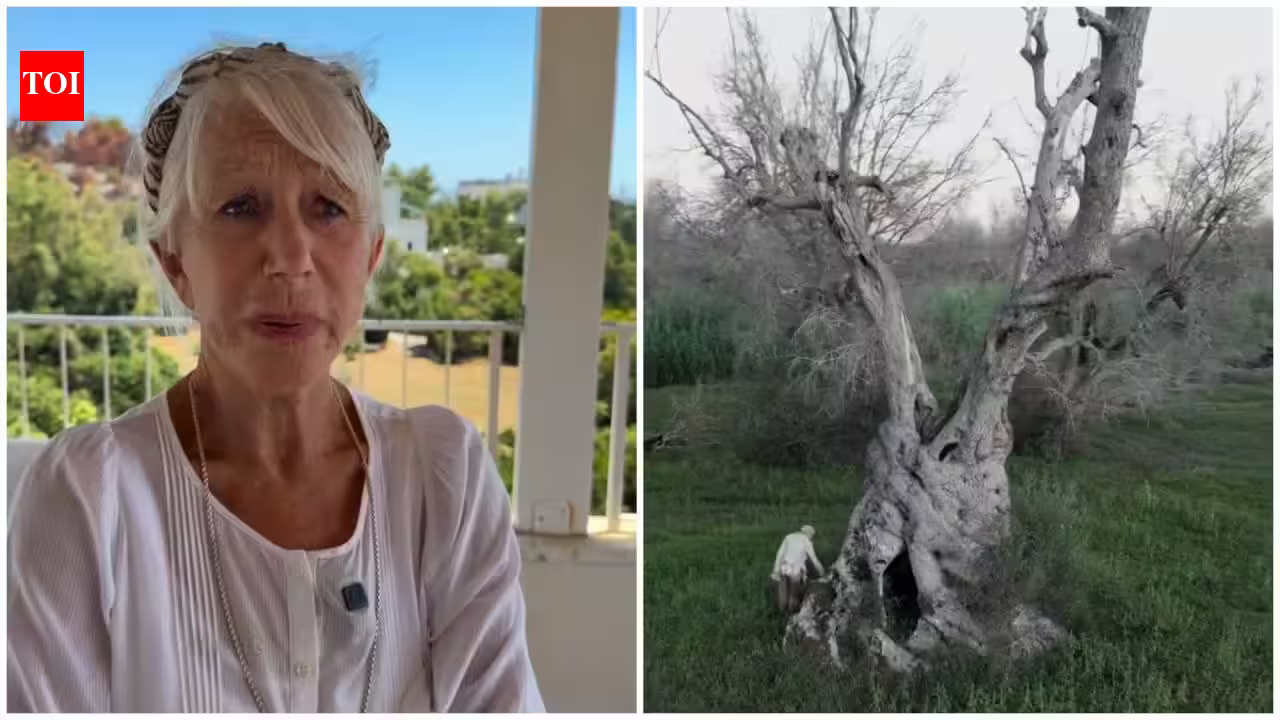
Oscar-winning actress Dame Helen Mirren has built a career defined by her commanding presence, whether portraying monarchs on the silver screen or embodying the grit of a seasoned performer. Yet, at 81, her most significant performance isn’t found in a script or a film set. Instead, it is being played out in the sun-drenched, rugged landscape of Puglia, Italy, where she is engaged in a desperate, high-stakes battle to preserve a piece of history that is literally dying at her doorstep.
The crisis involves Xylella fastidiosa, a lethal bacterial pathogen that has been ravaging Italy’s olive groves since its arrival in 2013. The numbers are staggering: an estimated 22 million trees have been lost to the infection, which is spread by spittlebugs and causes the foliage to wither and the tree to slowly succumb to dehydration. For Mirren, this isn’t just an agricultural disaster—it’s a slow-motion cultural erasure of trees that have stood since the days of the Roman Empire.
A Personal Stake in Puglia’s Landscape
Mirren’s connection to this mission is rooted in the soil of her own backyard. In 2007, she and her husband, director Taylor Hackford, acquired a 16th-century farmhouse in the southeastern region of Puglia. To them, the land was more than an investment; it was a sanctuary surrounded by ancient, gnarled olive trees that had bore fruit for centuries.
Like many residents, Mirren initially viewed the reports of the bacteria with a sense of distant detachment. “We—just like everybody else—thought, ‘Oh, it won’t come to us,'” she admitted in a recent interview. But the pathogen proved relentless, eventually encroaching upon their own property. Witnessing the systematic death of these living monuments was a turning point for the actress. When the trees surrounding her home began to brown and perish, the theoretical crisis became a visceral, personal tragedy, compelling her to transition from a concerned neighbor to a public advocate.
Why Helen Mirren Co-Founded Save the Olives
The devastation caused by Xylella brought with it a secondary infection: the spread of misinformation. Conspiracy theories and conflicting scientific reports created a fog of confusion, hindering effective response efforts. Recognizing that public indifference and bad information were as dangerous as the bacterium itself, Mirren helped launch the initiative “Save the Olives.”
The organization’s primary objective has been to act as a beacon of clarity, providing the public with fact-based information while lobbying for serious intervention. “It’s amazing how people want to put on blinkers and pretend it’s not happening,” Mirren remarked. For her, the tragedy is compounded by the sheer age of the victims. “When you think that this living thing has been in the earth, living, surviving since the Romans—come on! We have to save these trees.”
Her work with the foundation is an attempt to force the world to look, to acknowledge the loss of a biological heritage that belongs to humanity, not just to the farmers of Puglia.
The Practical Fight: Grafting and Innovation
Mirren’s approach to conservation is pragmatic rather than merely sentimental. Save the Olives is heavily invested in the scientific side of the fight, specifically through a grafting program designed to save endangered trees. The process involves grafting varieties of olive trees that have shown natural resistance to Xylella onto the trunks of infected or susceptible older trees.
It is an expensive and labor-intensive endeavor, which is why the organization has introduced an adoption program. Supporters can contribute to the survival of these trees, with a donation of roughly €500 ($560) funding the grafting process for a specific tree. In return, adopters receive the GPS coordinates and photos of their adopted tree, effectively creating a global network of guardians for Italy’s green heritage.
Beyond preservation, the organization is working in tandem with agricultural researchers to develop new, resistant species that can maintain the region’s high-quality oil production. This is crucial because, as Mirren notes, olive oil isn’t just a culinary staple; it is the lifeblood of the Italian economy. The loss of these groves has crippled local livelihoods and caused damage that reaches into the billions of euros.
A Legacy Beyond the Screen
There is a poetic resonance in seeing an icon like Helen Mirren, who has spent her life being celebrated for her own longevity and relevance in a fickle industry, fighting to protect the longevity of something that has outlived countless civilizations.
Her advocacy serves as a reminder that fame, when applied to a cause, can cut through the noise of modern life. She doesn’t approach this as a celebrity looking for a photo opportunity; she speaks with the passion of a landowner who sees these trees as “miraculous things.”
While the scale of the damage is undeniably grim, Mirren’s outlook remains firmly rooted in hope. She believes that through science, investment, and a collective refusal to look away, the remaining ancient groves can be rescued. As she continues to bridge the gap between Hollywood prestige and the struggle for ecological survival, Mirren is proving that while you can’t save everything, you can certainly fight for what matters most. For her, the olive trees are worth the fight—not just for the oil they produce, but for the history they hold and the future they represent.
Disclaimer: This content is auto-generated for informational purposes only.
Source: Read Original News