







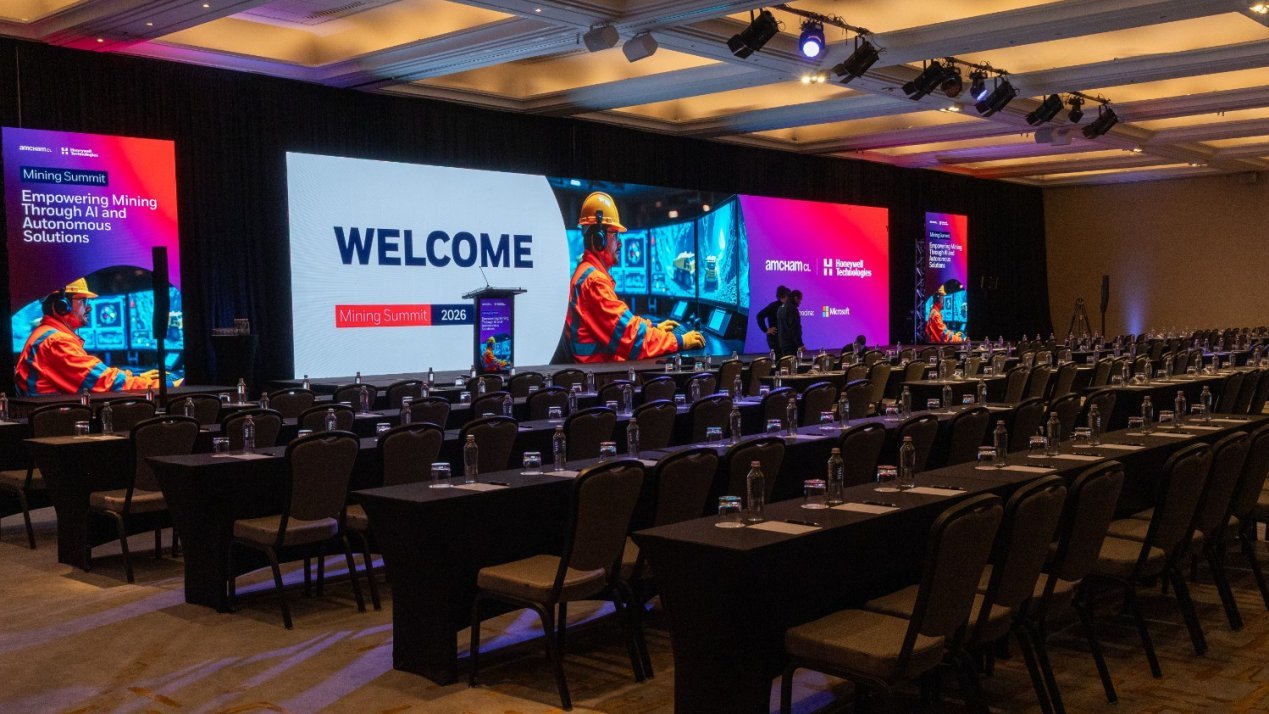
Industry leaders, technology experts, and policy representatives gathered in Santiago, Chile, on September 24 for the “Mining Summit: Empowering Mining Through AI and Autonomous Solutions.” Organized by AmCham Chile and Honeywell with sponsorship from Microsoft, the event served as a critical platform to explore how the mining sector can bridge the widening gap between the surging global demand for minerals and the logistical complexities of modern extraction.
## Bridging the Productivity Gap with Digital Transformation
As data centers and green energy initiatives drive a massive uptick in the need for copper, mining companies are facing a paradoxical challenge: the concentration of minerals in existing deposits is declining. This geological reality requires miners to process significantly more material to yield the same volume of product. During the summit, José Simón, Vice President and General Manager for Latin America of Process Automation at Honeywell, highlighted that this hurdle is further complicated by rising costs associated with unscheduled downtime and a dwindling pool of specialized talent.
Simón argued that before mining companies can fully realize the potential of autonomous operations, they must first optimize their fundamental digital infrastructure. “Once implemented, technologies such as advanced process control, training simulators, and remote operation centers become the necessary foundation for deploying AI,” he noted. By maximizing the utility of existing plant assets, companies can create a scalable framework for more advanced technological integration.
## The Human Factor in Technological Adoption
While the hardware and software for automation are increasingly available, industry leaders warned that technological investment alone is insufficient. Joaquín Villarino, Executive President of the Mining Council, offered a sobering assessment: mining firms are currently acquiring technology at a rate that far outpaces their internal capability to effectively utilize it.
Villarino emphasized that the path toward an autonomous future requires a cultural shift within the boardroom. Management must prioritize continuous training and break down the internal bureaucratic barriers that often stifle the integration of new tools in active, continuous operations. Furthermore, with a significant portion of the workforce nearing retirement, there is an urgent need to capture and institutionalize the “tribal knowledge” held by experienced personnel. This transfer of expertise is essential to ensuring that the next generation of miners, supported by AI systems, can operate with the same level of intuition and safety as their predecessors.
## Digital Cognition: Complementing Human Expertise
To address the daily operational challenges of alarm management and maintenance, Jason Urso, Technology Director of Process Automation at Honeywell, proposed the concept of “digital cognition.” This framework combines traditional sensors and process models with AI to provide actionable intelligence to operators. Unlike pure automation, which executes predefined rules, digital cognition acts as a support system, offering recommendations for complex tasks like emergency responses or repair scheduling.
Urso urged companies to adopt a focused, modular approach to implementation. Rather than viewing AI as a universal panacea, he recommended starting with specific, high-friction operational problems—such as process variability or recurring downtime—and stress-testing AI solutions on a single unit before attempting enterprise-wide deployment.
The summit concluded with a clear consensus: the future of mining is inextricably linked to technological maturation. By combining robust sensing, proactive safety monitoring, and a strategy that empowers rather than replaces the human operator, the mining industry aims to secure the raw materials necessary to power the global digital and electrical infrastructure. As José Magalhães Fernandes, President for Latin America at Honeywell, noted, it is through these precise technological integrations that the industry will successfully narrow the widening chasm between production capacity and global demand.
Disclaimer: This content is auto-generated for informational purposes only.
Source: Read Original News