







South African households are facing a deepening cost-of-living crisis, with families increasingly forced to choose between keeping the lights on, commuting to work, and putting food on the table. New data reveals that the battle for survival has pushed the average household to a breaking point, where even basic nutrition has become a luxury.
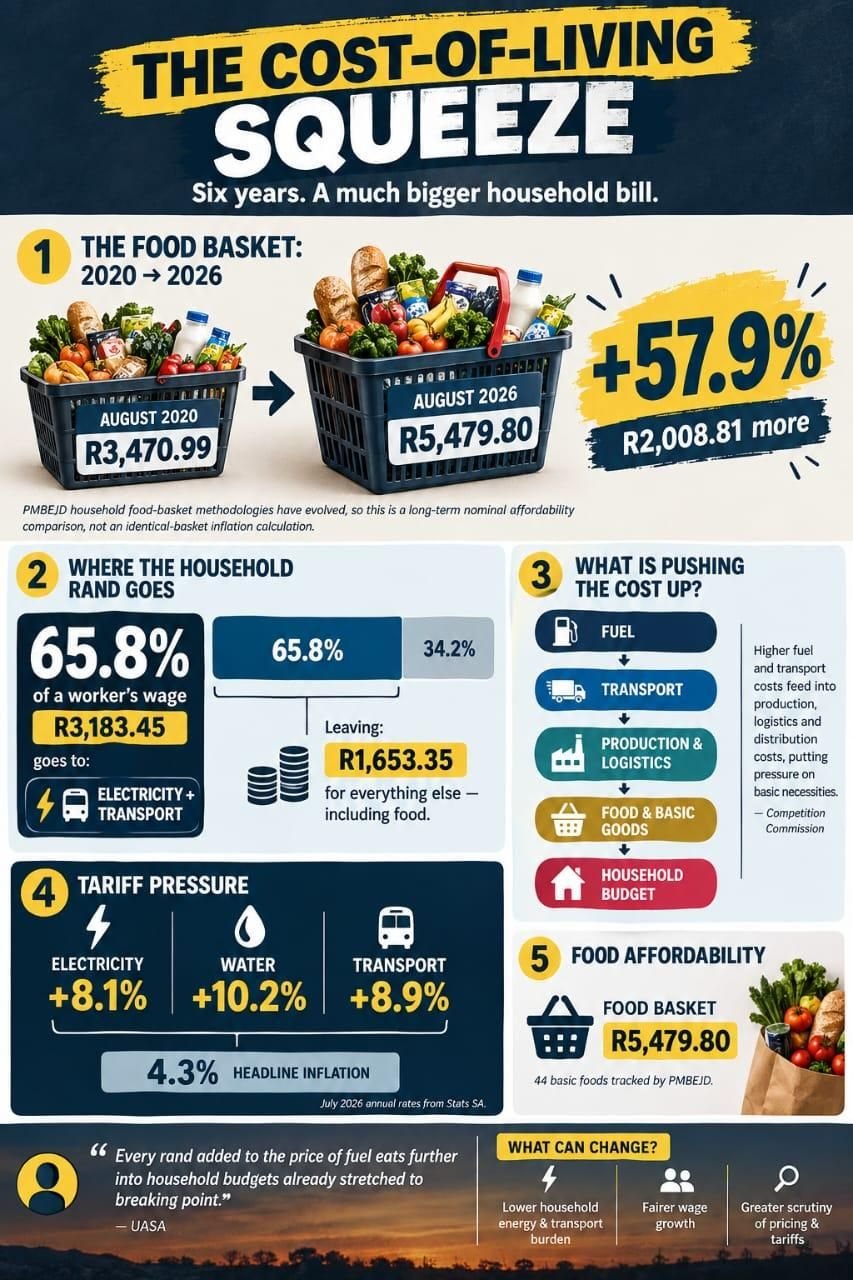
According to the latest figures from the Pietermaritzburg Economic Justice and Dignity Group (PMBEJD), the cost of an average household food basket reached R5 479.80 in August. While this reflects a marginal dip of 0.9% compared to July, it remains 1.8% higher than a year ago. However, experts warn that focusing solely on grocery bills ignores the systemic “competition for money” that governs low-income households.
“Households don’t receive income and earmark fixed pots for food,” said Mervyn Abrahams, director of the PMBEJD. “They first pay absolute essentials: rent or bond, electricity, and transport. Food is normally bought with whatever money is left over. More often than not, it means less food and less nutritious food.”
The scale of this squeeze is stark. In August, electricity and transport costs consumed R3 183.45—nearly 66% of a typical worker’s wage—leaving only R1 653.35 for food, clothing, and other necessities. This crisis is being further exacerbated by rising fuel costs, which the Competition Commission warned in its August 2026 report are driving up production and logistics costs throughout the economy.
Trade unions are now sounding the alarm, arguing that workers can no longer absorb these shocks. Abigail Moyo of the United Association of South Africa (UASA) stated that the current economic strain is why labor groups are pushing for inflation-linked wage increases. “Every rand added to the price of fuel eats further into household budgets already stretched to breaking point,” she said.
The pressure is most visible among the elderly. At SASSA offices in Durban, pensioners have been vocal in their demands for the Older Persons Grant—currently capped at R2 420—to be increased to R5 000. For many, the current stipend is insufficient to cover utilities, let alone basic nutrition. “We barely make it,” said pensioner Quinton Eri. “The food that we buy is not enough money for it. We’ve got to worry about where your next meal is coming from.”
This decline in nutrition carries long-term consequences, particularly for children. The PMBEJD noted that the cost of feeding one child a basic nutritious diet is R961.96, while the government’s Child Support Grant remains at just R580.
Abrahams warned that these trade-offs are creating an “intergenerational poverty trap” that begins on the plates of children under five. As households are forced to prioritize fixed utilities over nutrition, the path to a sustainable future grows increasingly narrow for millions of South Africans.
Disclaimer: This content is auto-generated for informational purposes only.
Source: Read Original News