


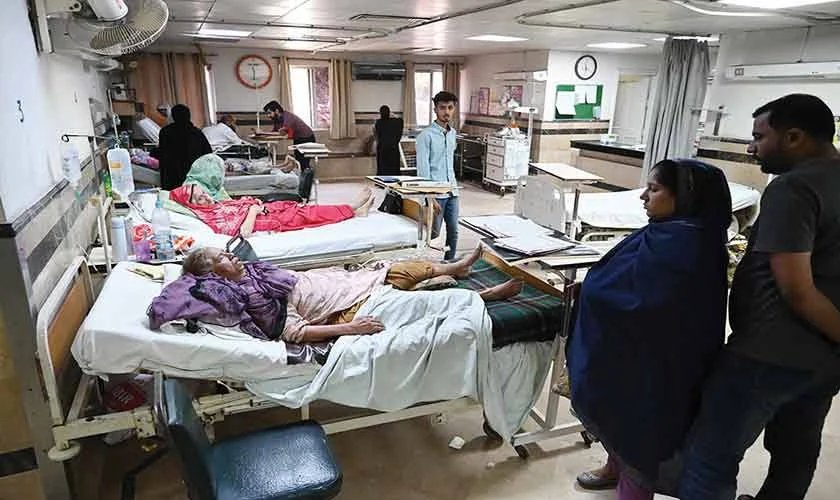
Lahore is once again suffocating under a toxic blanket of smog, with air quality readings confirming its status as the world’s most polluted city. As the city’s Air Quality Index (AQI) regularly shatters international safety limits, public hospitals are struggling to manage a silent, unchecked surge in respiratory illnesses.
Recent data reveals the severity of the crisis: Lahore’s average AQI has been recorded at a hazardous 410—a staggering 51.8 times higher than the World Health Organization’s (WHO) recommended guidelines. In specific neighborhoods, the situation is even more dire. Areas such as Shahdara have registered an alarming AQI of 808, while Allama Iqbal Town (627), Defence Phase 6 (620), and Model Town (587) are effectively operating as high-risk zones.
Despite the obvious public health emergency, the Punjab government has yet to produce official data regarding the scale of the crisis. Medical professionals estimate that the number of residents suffering from smog-related ailments could reach into the millions, yet this burden remains largely invisible in official statistics.
“Although the software is in place in hospitals, it lacks the provision to separately record or manage smog-related illnesses,” explains Dr. Salman Kazmi. “There is no precise way to establish the actual number of people affected.”
While indoor hospital admissions provide a snapshot of the crisis, they fail to account for the massive influx of patients at outpatient departments (OPD) and private clinics. Doctors report that nearly every patient they see is presenting with flu, cough, sinusitis, or pneumonia-like symptoms. Spokespersons for the provincial health departments have confirmed that no centralized registry for smog-related illnesses is currently being maintained, and no specific emergency funds or dedicated smog-care units have been allocated.
Experts, however, warn that the current “business-as-usual” approach is failing. Dr. Irfan Malik, a professor of pulmonology at the University of Lahore, notes a 30 to 40 percent surge in severe respiratory cases, including asthma and Chronic Obstructive Pulmonary Disease (COPD). He characterizes the pollution as an “invisible killer,” pointing out that fine particulate matter (PM 2.5) does far more than irritate lungs—it triggers systemic inflammation and increases the risk of cardiovascular events, such as heart attacks.
The health implications extend across all demographics. Pediatricians warn that the microscopic toxins can impair lung development in children, while researchers note that these particles can cross the blood-brain barrier, increasing the risk of long-term cognitive decline and dementia in the elderly. For pregnant women, the toxic air carries heightened risks of premature delivery and neonatal complications.
Dr. Nasrullah, a pulmonologist at Mayo Hospital, draws a stark comparison to the impact of active smoking, noting that the city’s atmosphere essentially subjects its residents to constant, involuntary passive smoke. This environmental hazard is compounded by systemic failures, including the daily entry of 50,000 heavy vehicles into the city, unmonitored industrial emissions, and the ongoing practice of crop-residue burning.
While Minister for Specialised Healthcare and Medical Education Khawaja Salman Rafique maintains that hospitals are prepared to handle the patient influx, medical professionals argue that reactive, routine care is insufficient for a structural disaster of this magnitude.
Health experts are calling for immediate administrative action. Their recommendations include the mandatory integration of a smog registry within hospital digital systems to track epidemiology, the enforcement of stricter industrial emission standards, and the implementation of green infrastructure, such as carbon-absorbing tree belts. They further suggest that during extreme pollution spikes, the government must adopt more aggressive measures, including smart lockdowns, the staggering of market hours, and the temporary transition of schools and offices to online modes to minimize public exposure.
As the smog season reaches its peak, the disconnect between the worsening environmental reality and the lack of a coordinated, data-driven health response remains a critical failure that threatens the well-being of millions of Lahore’s residents.
Disclaimer: This content is auto-generated for informational purposes only.
Source: Read Original News