








The number of ‘green jobs’ in the EU economy continues to expand, rising by 6%, on average, every year since 2014, new data from Eurostat has revealed.
According to the data, employment in the EU’s green economy accounted for 5.8 million full-time jobs in 2023, with demand for activities linked to environmental protection and resource management rising across the region.
Green jobs
The construction sector saw the biggest increase in green jobs between 2014 and 2023, rising from 700,000 full-time roles in 2014 to 1.6 million in 2023, representing average annual growth of 11%.
This included jobs in the construction of energy-efficient buildings, renewable energy installations and refurbishment projects designed to improve energy performance, Eurostat noted.
The agriculture, forestry and fishing sector reported a 5% increase in green jobs over the same period, accounting for 700,000 jobs in 2023. Elsewhere, manufacturing saw its environmental workforce grow from 700,000 to 1 million full-time equivalent jobs between 2014 and 2023.

Employment growth
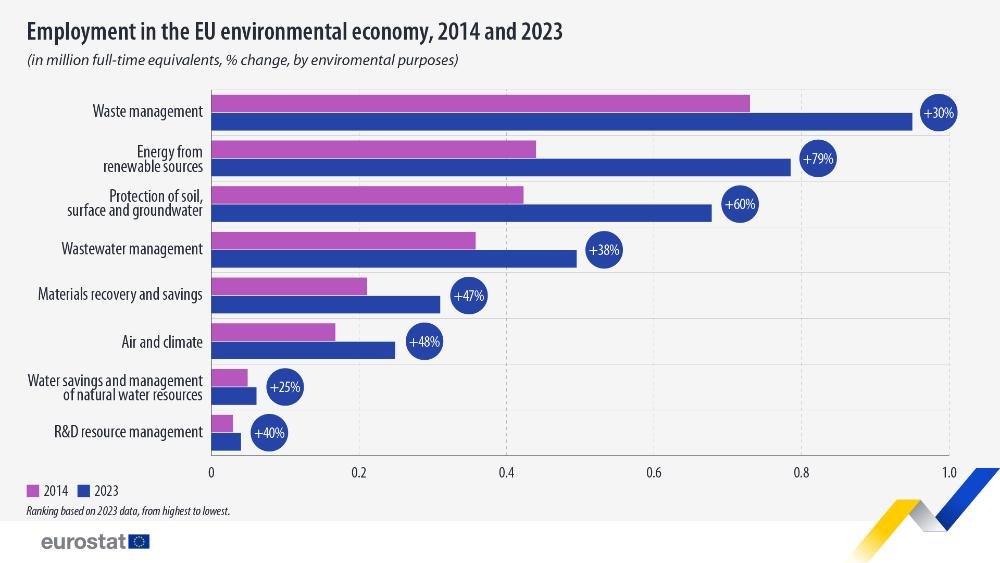
In terms of the environmental activities that generated the strongest employment growth, jobs linked to renewable energy reported the largest increase, rising by 79% between 2014 and 2023, Eurostat noted. Employment in this sector rose from around 400,000 to 800,000 full-time roles over the period.
Employment connected to the protection of soil, surface water and groundwater increased from 400,000 full-time jobs to around 700,000, an increase of 60% over the same period.
Elsewhere, air and climate-related activities saw growth of 48%, while jobs linked to materials recovery and resource savings rose by 47%, and employment in wastewater management increased by 38%, reaching 500,000 full-time jobs as of 2023.
Waste management was the top sector for green jobs, accounting for 900,000 full-time roles as of 2023, representing 16% of total environmental employment across the European Union, Eurostat noted. Read more here.