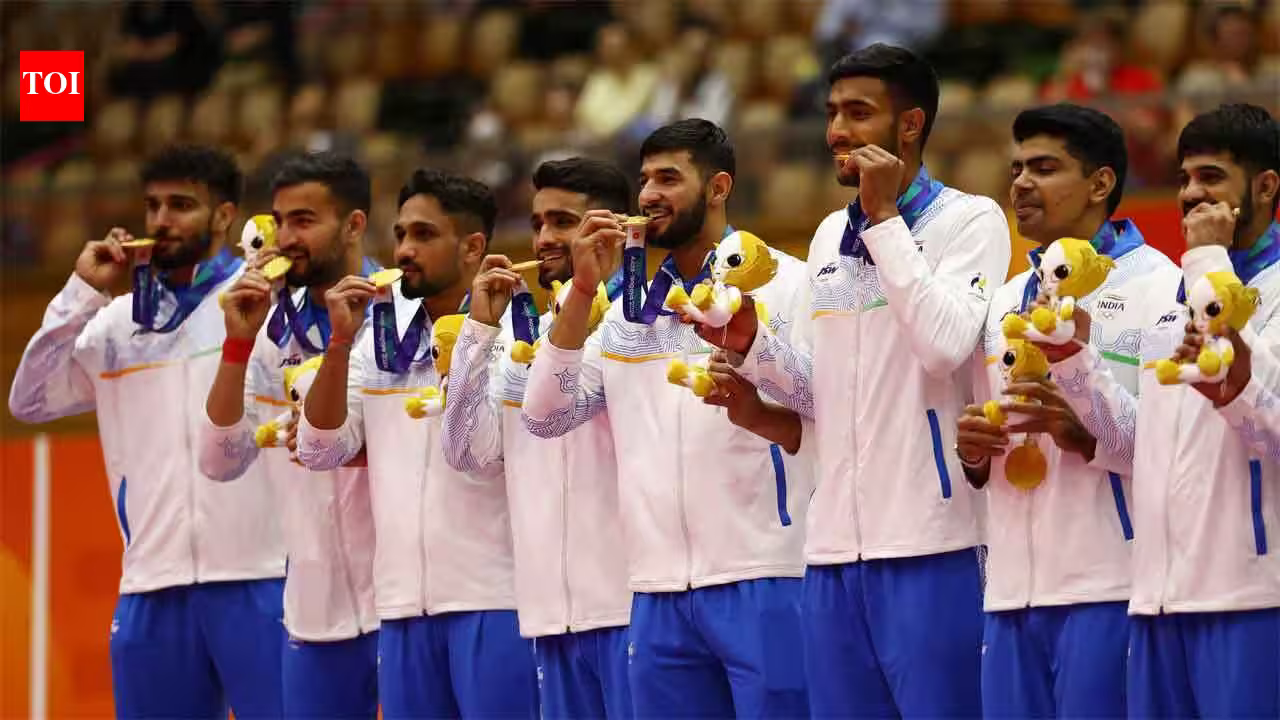







Hunger, in its most literal and metaphorical sense, defined India’s golden campaign at the Asian Games. While the world watched the men’s kabaddi final against Iran, the Indian squad was fueled by something far more potent than nutrition: an unyielding obsession with reclaiming their throne. In a staggering revelation following their 40-34 victory, captain Pawan Sehrawat disclosed that the team had essentially abstained from eating properly leading up to the title clash.
“Khali pet gold jita hai,” Sehrawat remarked, a phrase that translates to “We won gold on an empty stomach.” It was a bold statement, underscoring the level of anxiety and focus that permeated the camp before they walked onto the mat to secure India’s ninth Asian Games gold medal in the sport.
‘Those 40 minutes were important’
The path to the podium was fraught with tension. Despite rigorous preparations and a solid track record, the weight of expectation loomed large over the players. For Sehrawat, the hours leading up to the final were an exercise in mental endurance.
“I was very excited about the match, but until the result comes, it stays in the mind,” Sehrawat told reporters. “Those 40 minutes were important.”
The importance of those minutes was underscored by the match’s volatile narrative. India struggled to find their rhythm early on, heading into the half-time break trailing 17-18. It was a precarious position for a team that had navigated the tournament undefeated. However, the second half saw a tactical transformation. Raiders Arjun Deshwal and Devank Dalal shifted gears, applying relentless pressure on the Iranian defense, while the defensive backbone of Sumit and Jaideep fortified the Indian lines.
India turns the final around
The momentum began to decisively shift with 10 minutes remaining on the clock. In a pivotal sequence, Arjun Deshwal outmaneuvered Iran captain Fazel Atrachali, clearing the path for India to inflict an “All-Out.” This maneuver put India ahead by five points, a buffer they would not relinquish.
The defensive clinic continued as Sumit executed a perfectly timed tackle on Amirmohammad Zafar Danesh, effectively stifling Iran’s counter-attack. Late-match contributions from Rahul Sethpal served as the final nail in the coffin, cementing a victory that showcased not just individual brilliance, but tactical maturity. For the players, the realization that they had secured gold brought an emotional release that had been bottled up since the morning of the match.
“Everyone is emotional,” Sehrawat said. “And it was that once the 40 minutes are over, we will eat and drink well. Not just one, but after that gold has come.”
Keeping an eye on the bigger picture
Beyond the individual match, the team was hyper-aware of their contribution to the national narrative. As they navigated the closing days of the Games, the players kept a close watch on India’s position in the overall medal tally.
“We were seeing on the way that if our two golds were added, then where would we go?” Sehrawat explained. The focus on national prestige remained a constant companion to their training. After the intense final, the team largely disconnected, choosing to remain in their “gold medal bubble” rather than obsessing over the final standings, letting the gravity of their own achievement take precedence.
A legacy and a dedication
Victory is rarely a solo act, and for Pawan Sehrawat, this medal is inextricably linked to the guidance of his mentor, coach Randhir Sehrawat. In the wake of the triumph, the captain took the opportunity to advocate for his coach’s legacy, calling on the Indian government to recognize Randhir with the Dronacharya Award.
“I would like to dedicate it to my coach, Randhir Sehrawat,” the captain stated emphatically. “It is because of him that this medal has come to me.” He pointed to the string of Arjuna Award winners who have emerged from Randhir’s tutelage as clear evidence of his impact on Indian sports, suggesting that official recognition is long overdue.
‘Japan has created history for me’
For the skipper, the tournament was memorable beyond the final scoreline. Serving as a flag-bearer at the opening ceremony alongside shooting sensation Manu Bhaker, Sehrawat felt the weight and honor of representing his country on the continental stage.
Reflecting on his time in Japan, he spoke with genuine reverence for the experience. “Japan is very beautiful. For me, Japan has created history. I was a flag-bearer. I was with such a good athlete, Manu Bhaker. For me, it is a miracle.”
As the Indian contingent returns home, they carry with them more than just gold around their necks. They carry a testament to the sacrifice, the nervous energy, and the singular, hungry drive that allowed them to withstand the pressure of a nation and come out on top. They didn’t just play a game of kabaddi; they played a game of endurance—one that proved that for these athletes, the hunger for gold is, indeed, the most powerful motivator of all.
Disclaimer: This content is auto-generated for informational purposes only.
Source: Read Original News