







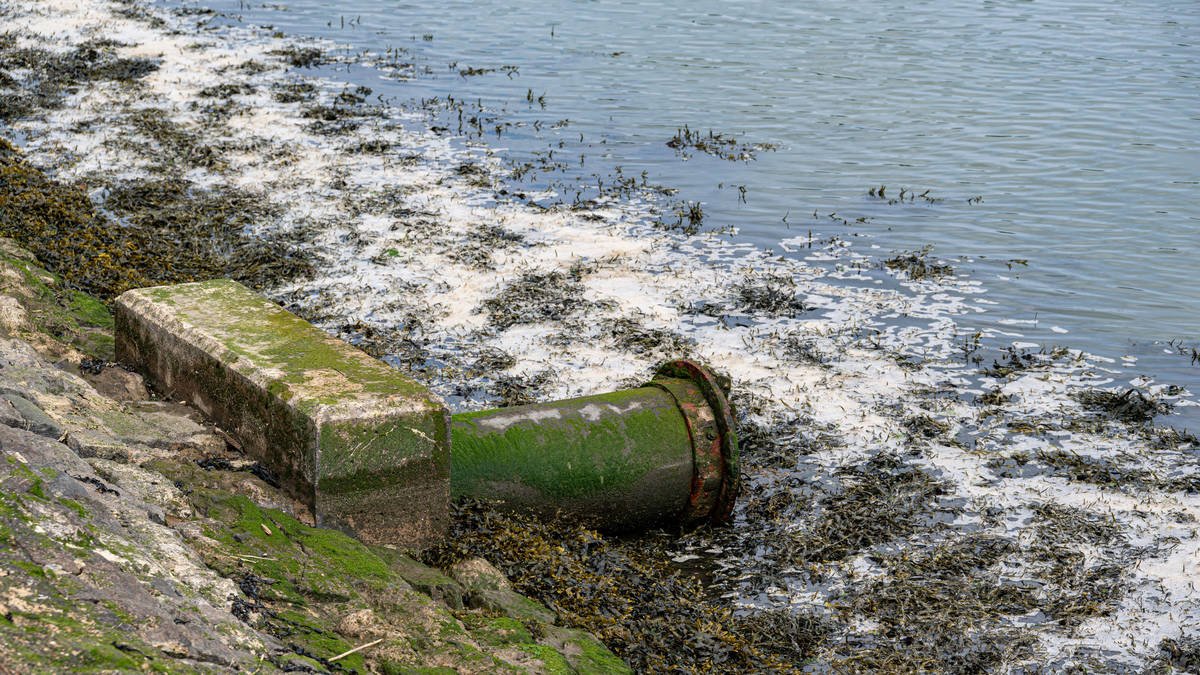
The figures, obtained by Robert Forrester, the former EA employee whose story inspired the docudrama Dirty Business, examine the reporting of Category 1 and 2 sewage spills across England.
Of the 2,002 incidents reported as potentially having either a “major” or “significant” impact on people’s health and the environment, only 78 were eventually classified as serious incidents.
In 1,449 (72%) of these cases, spills were downgraded without officials from the EA visiting the site in person to assess the damage.
In 2016, by contrast, when cuts to the EA’s sewage monitoring budget were announced, only 12 spills were downgraded without being inspected; 2025’s figures therefore represent a 120-fold increase in such incidents.
The Environment Agency argues that it takes “evidence-based decisions” about incident attendance and categorisation, and that it tends to overestimate the seriousness of a pollution event in its initial assessment.
Campaigners argue that delays in reporting make it harder for the EA to identify spills that are potentially harmful to human health.
Forrester, who spent over two decades working for the regulator, argues that the low attendance rate is, in part, explained by delays in the reporting of serious incidents by water companies.
“Their attitude is very poor at best,” Forrester says of the water companies’ commitment to transparency and to reporting data as quickly as possible.
“These aren’t just all incidents, including minor incidents: these are the serious ones, the worst ones, the highest level of potential criminality from the water companies.”
Delays in the reporting of spills allow time for pollutants, such as sewage, to flow further downstream, along with other evidence, such as fish that have died due to exposure to effluent and chemicals.
“It will be a resource-based decision saying it’s not worth attending, because so much time has passed – hours, days, weeks – meaning the evidence has gone.
“For the ones we do attend, as well, someone within the agency has to assess that report as a major incident – a category one… the fact it is downgraded after attendance will tell you how long the delay was in water companies reporting it, to make sure all the evidence is effectively washed away, any dead fish are cleaned up, and there’s nothing to see when agency officers get there.”
Last year, water companies released raw sewage into England’s rivers and seas for 48% fewer hours than in 2024, though this was partly explained by reduced rainfall across the year.
Despite there being fewer incidents, however, significant delays remained in water companies reporting incidents to the EA.
Analysis by Surfers Against Sewage, a campaign group pushing for improved water quality in the UK, found that it took, on average, around 25 hours for water companies to report incidents to the Environment Agency.
South East Water, whose chief executive, David Hinton, was forced to resign in May following repeated failures to supply drinking water to the company’s customers, had the longest average delay, taking over 75 hours to report its incidents to the EA. The company says it conducts a “root cause analysis” when things go wrong.
Of the water companies that are also responsible for sewage management, South West Water had the worst record for such delays, averaging 56 hours between an incident starting and it being reported to the EA.
The company was recently fined a record £1.8m for an outbreak in 2024 of Cryptosporidium, a parasite that can cause diarrhoea, stomach cramps and dehydration. The company apologised for the outbreak.
Water UK, which represents water companies, says the self-reporting of pollution incidents is at its highest level ever, and pointed to the £104 billion worth of investment committed by its members “to secure our water supplies, end sewage entering our rivers and seas and support economic growth.”
Giles Bristow, the chief executive of Surfers Against Sewage, said delays in reporting are contributing to a “public health crisis”.
“We get notified of about 2,000 cases a year of people getting sick from being in and around our wild waters.
“That’s just the tip of the iceberg,” he says.
Though the majority of cases reported to Surfers Against Sewage are bouts of gastroenteritis, diarrhoea and vomiting, others have experienced more serious illnesses.
In a particularly alarming case from last year, Bristow says they spoke to a woman who developed heart disease after contracting a virus while swimming with her friends in the sea during a hen do. She required a triple bypass.
Bristow is unconvinced that the measures announced by the government so far, including an additional 10,000 inspections of waterways last year, meet the scale of the challenge: “There’s nothing that inspires that confidence. It’s great that the government has put the industry under some sort of spotlight, but this doesn’t go far enough.”
Forrester goes further, however.
“Things are no different now,” he concludes. “The only remedy for me is the public ownership model – nationalisation.”
In response to the criticism about the proportion of incidents being downgraded, a spokesperson for the EA said: “Our process is robust and evidence-led. We take a precautionary approach, initially categorising incidents as higher risk, and then our expert officers make evidence-based decisions about incident attendance and categorisation as more information becomes available. We attend the majority of confirmed serious and significant incidents.
“We hold water companies to account – carrying out over 10,000 inspections last year and securing more than £153 million in fines since 2015 – and we won’t hesitate to take action where standards aren’t met.”
DEFRA, meanwhile, said it had started “swift action to hold water companies to account”, including establishing a new regulator, ending water company self-monitoring and introducing ‘no notice’ inspections of rivers, lakes and seas across the country.