








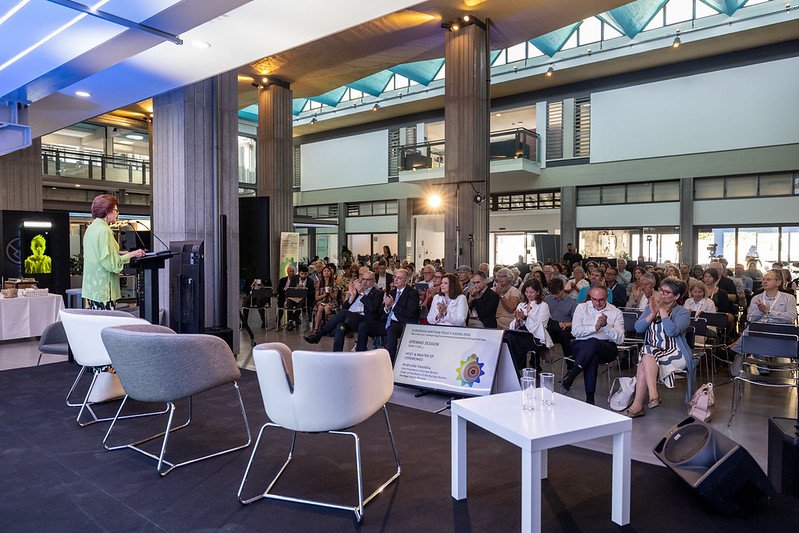
Heritage leaders, policymakers, environmental experts and representatives of civil society gathered in the morning of 29 May in Nicosia for the European Heritage Policy Agora 2026, held within the framework of the European Cultural Heritage Summit 2026. Under the theme “Mare Nostrum: Championing Environmental Sustainability through Heritage”, the Agora explored how cultural heritage can contribute to climate action and connect nature and culture across the Mediterranean, encompassing Europe, West Asia and North Africa.

Opening the Agora, Androulla Vassiliou, Vice-President of Europa Nostra and Chair of the Board of the Europa Nostra Heritage Hub in Nicosia, welcomed participants and underscored the significance of holding the Summit in Cyprus. Situated at the crossroads of Europe, West Asia and North Africa, the island offers a unique perspective on the shared histories, cultural exchanges and contemporary challenges that shape the Mediterranean region.
Hosted at CYENS – Centre of Excellence in the heart of Nicosia, the event highlighted the growing recognition of heritage as a policy resource capable of supporting sustainable development in a region facing increasing environmental, social and geopolitical pressures.
Stronger role for culture within European sustainability, climate and external relations policies
The keynote address was delivered by European Commissioner for Fisheries and Oceans, Costas Kadis, who emphasised the close links between maritime policy and cultural heritage. He highlighted the impact of climate change on coastal sites and communities, including sea-level rise, erosion and flooding, and stressed the importance of integrating natural and cultural heritage within broader environmental strategies.
Commissioner Kadis also pointed to traditional maritime knowledge as a valuable source of expertise for adaptation efforts and called for stronger cooperation across the Mediterranean basin.

The Deputy Minister of Culture of Cyprus, Vasiliki Kassianidou, presented the cultural priorities of the Cyprus Presidency of the Council of the European Union, describing the Mediterranean as a shared space of exchange rather than a line of division. She advocated for a stronger role for culture within European sustainability, climate and external relations policies, highlighting its contribution to dialogue and mutual understanding.

In her address, H.R.H. Princess Dana Firas of Jordan, President of the Petra National Trust, Chair of the International National Trusts Organisation (INTO) and UNESCO Goodwill Ambassador, emphasised the importance of local stewardship in safeguarding heritage. She highlighted the role of civil society organisations and community engagement in addressing the combined pressures of war, climate change and rapid urban transformation, while calling for greater international collaboration.

Luca Jahier, ESG & Euromed Vice-President and EESC President 2018-2020, emphasised the role of cultural heritage as a source of sustainable resilience and a stabilising force in economic and social development. He also highlighted its potential to serve as a geopolitical bridge, fostering dialogue, cooperation and mutual understanding across the Mediterranean.
Advocacy Action ahead of COP31 in Antalya, Türkiye
The first panel discussion focused on advocacy ahead of the 2026 United Nations Climate Change Conference – COP31, which will take place from 9 to 20 November in Antalya, Türkiye. Moderated by Andrew Potts, Heritage and Climate Action Advisor at Europa Nostra, the session examined the relationship between fossil fuel dependency, geopolitical instability and climate impacts across the Mediterranean. Speakers discussed how cultural heritage can inform climate policy, contribute to a just transition and support communities facing disproportionate environmental challenges.

Contributions from Cristina Garzillo-Leemhuis of ICLEI Europe, Jorge Chaminé of the European Music Centre, Dr Ege Yildirim of Europa Nostra Türkiye and Professor Nikolas Bakirtzis of The Cyprus Institute explored the role of both tangible and intangible heritage in shaping public understanding of environmental change, supporting economic diversification and fostering cooperation across borders.
Best Practices in support of Advocacy Action
The second panel discussion showcased practical examples from the Withstanding Change project and other initiatives across the region. Chaired by Catherine Leonard, Secretary General of INTO, the discussion focused on participation, skills development and international partnerships. Speakers from Syria, Egypt and Jordan presented heritage-led responses to environmental challenges that combine traditional knowledge with contemporary approaches.

Lama Abboud of the Turathuna Foundation highlighted conservation techniques adapted to present-day climate conditions, including water-harvesting systems and sustainable restoration methods. Abdelhamid Salah Al-Sharief of the Egyptian Heritage Rescue Foundation presented resource-efficient practices that are helping to influence public policy and community engagement. Dr Dareen Al-Khoury of the Petra National Trust shared examples of participatory initiatives that integrate local knowledge into adaptation planning.
The way forward
Organised in the framework of the EU-funded Europa Nostra Heritage Agora project, with the support of the Cultural Protection Fund of the British Council, the event reinforced the growing place of cultural heritage within European policy frameworks, including the Culture Compass for Europe, the Pact for the Mediterranean, the European Green Deal and the European Ocean Pact.
The Agora concluded by calling for heritage to be more fully integrated into environmental, maritime and regional policy agendas across the Mediterranean, recognising its contribution to sustainable development, cross-border cooperation and long-term stewardship of shared cultural and natural resources.

The Agora was followed by the European Heritage Hub Forum “Mare Nostrum: Fostering Peace through Heritage,” held on the afternoon of 29 May at CYENS – Centre of Excellence. Organised within the framework of the EU-funded European Heritage Hub and with the support of the Cultural Protection Fund of the British Council, the Forum explored how cultural heritage can serve as a catalyst for reconciliation, social cohesion and cross-border cooperation.
Together, the Agora and the Forum reflected a growing understanding that cultural heritage is not merely about preserving the past, but about shaping resilient and inclusive futures.