







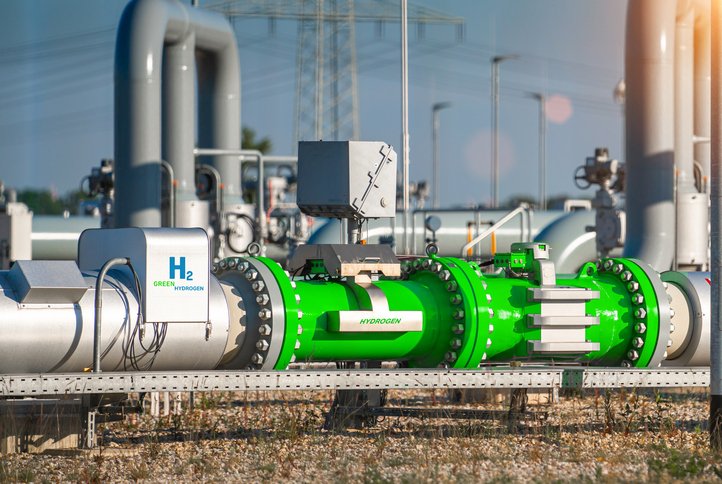
Europe’s drive to develop homegrown clean energy alternatives has taken on a sharper strategic edge, with senior industry figures and policymakers arguing that so-called green molecules – second-generation biofuels and green hydrogen – are no longer primarily a climate story but a matter of industrial survival.
The assessment came at a Euractiv event on 4 June, where Spanish energy company Moeve presented findings from an in-depth report on the role of green molecules in Europe’s energy transition.
According to the report, scaling these technologies could reduce Europe’s energy dependence by half by 2040 and, by 2050, replace up to 50 per cent of current fossil fuel demand, account for roughly one-third of Europe’s energy mix and cut CO₂ emissions by 22 per cent.
Concerted action needed
Maarten Wetselaar, chief executive of Moeve – formerly Cepsa – said the potential was significant but would not materialise without concerted action. “As China races ahead with the clean energy transition, in Europe we need coordinated action between the public and private sectors,” he said, identifying three prerequisites: stable regulatory frameworks that create demand, investment in infrastructure, and support to close the cost gap in the early stages.
“The question” he said, “is no longer whether this transition is necessary or even affordable. The real question is whether we act with enough speed and coordination to make it happen.”
Wetselaar identified the Iberian Peninsula as among the most competitive locations in Europe for green molecule production, citing its abundant solar and wind resources.
The case for urgency was reinforced by Dirk Niemeier, global director for strategy and energy transition at PwC, who argued that the framing of the debate had fundamentally shifted. “The green molecule momentum has slowed over the past year. Geopolitics has brought it back, but with a shifted framing. This is no longer primarily a climate conversation – it’s about whether Europe retains its industrial base,” he said.
Production relocating
In Germany, he noted, power consumption in heavy industry was falling not because of efficiency gains but because production was relocating abroad.
Niemeier identified infrastructure as the decisive bottleneck.
While liquid fuels such as sustainable aviation fuel or methanol could largely be accommodated within existing systems, hydrogen required entirely new supply chains – pipelines or ship-based logistics including terminals and ammonia crackers.
“None of this exists at scale today. Every year of delay means another year in which European industry operates at a cost disadvantage relative to US competitors with cheap gas or Asian producers with cheap renewables,” he said.
Kitti Nyitrai, deputy director and head of the decarbonisation and sustainability of energy sources unit at the European Commission’s Directorate-General for Energy, acknowledged that Europe was experiencing its second energy crisis in five years, both rooted in fossil fuel dependence.
“But with every crisis, Europe has grown more resilient, has built up infrastructures, has diversified and has taken measures,” she said, adding that the accelerated deployment of renewable energy remained a strategic priority. She pointed to the Commission’s AccelerateEU communication as focused on speeding up clean energy deployment and cutting import exposure.
Lower cost, accessing finance
Nyitrai highlighted biomethane as a deployment-ready option, describing it as “a ready, sustainable alternative to fossil gas” that could reduce risks associated with clean energy projects, lower costs, and facilitate access to finance.
Rosita Zilli, policy director at the European Energy Research Alliance, stressed that direct electrification should remain the priority wherever technically and economically feasible, but that green molecules would be “indispensable for hard-to-abate industrial processes, heavy transport, aviation, maritime applications and long-duration energy storage.”
She warned that “a stable and predictable regulatory and investment framework is critical to mobilise private capital, accelerate deployment and provide industry with the confidence needed to invest in Europe’s clean energy future.”
On cost concerns, Wetselaar sought to reframe the scale of investment required. Pointing to the more than €400bn that European governments spent subsidising fossil fuel consumption during the energy crisis triggered by Russia’s invasion of Ukraine, he argued that the cost of the green transition was “totally doable economically, but it requires a lot of political will.”
He described the green molecule opportunity as potentially “one of the most exciting European stories in the coming decade.”
The European Commission’s proposed Industrial Accelerator Act is intended to underpin the shift, aiming to support resilient and decarbonised industrial production across the bloc.
[BM]