


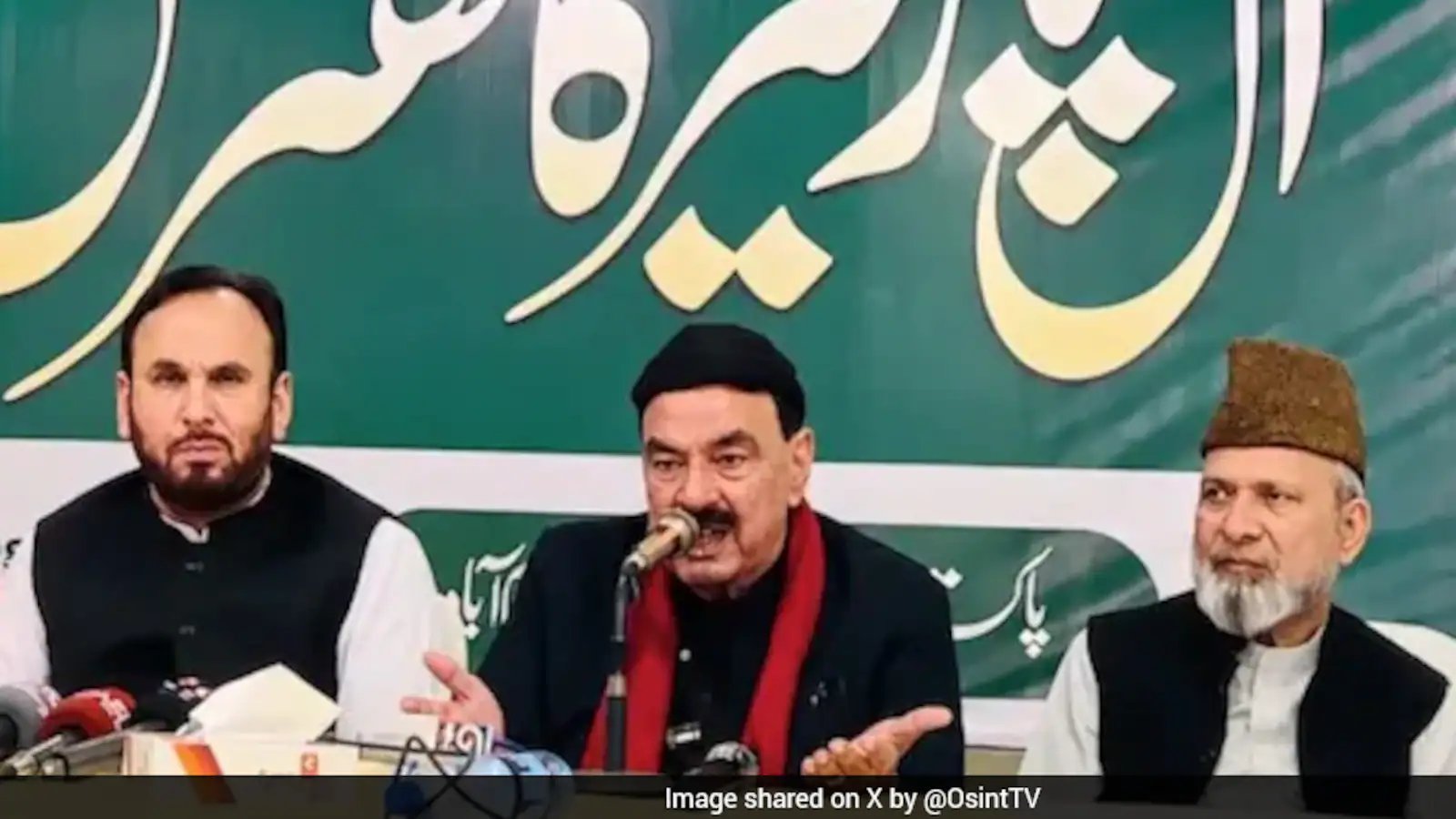
Former Pakistani Interior Minister Sheikh Rasheed Ahmed has ignited a firestorm of controversy following a public appearance where he not only lauded Lashkar-e-Taiba (LeT) founder and UN-designated global terrorist, Hafiz Saeed, but also issued inflammatory threats directed at India. Ahmed, who leads Pakistan’s Awami Muslim League party, was captured in a widely circulated video sharing a platform with prominent Lashkar terrorists, including Khalid Masood Sandhu, a senior LeT commander and president of the Pakistan Markazi Muslim League (PMML), and Qari Muhammad Yaqoob Sheikh, another member of the proscribed outfit. During this event, Ahmed unequivocally declared his allegiance, stating, “Main Hafiz sahab ka ghulam hu” (I am a slave of Hafiz Saeed), a statement that has drawn severe criticism internationally.
Ahmed further elaborated on his alleged connection to Saeed, claiming that his expulsion from the United States was a direct consequence of Hafiz Saeed’s phone number being found in his possession. Following this, he launched into unprovoked threats against India, proclaiming that divine intervention would bring about the country’s destruction if it dared to “even look towards Pakistan.” His rhetoric escalated with the chilling assertion that “No birds will chirp in India, nor will bells ring in a temple,” implying a complete eradication of normalcy and religious freedom in India, and confidently stating that no anti-Pakistan activities could ever originate from within India. He concluded his address by affirming solidarity with both Pakistan and Hafiz Saeed, a statement that implicitly suggests state endorsement of terrorist organizations in Islamabad.
Sheikh Rasheed Ahmed’s political career includes serving as Pakistan’s Interior Minister from 2020 to 2022, during which time he maintained close ties with former Prime Minister Imran Khan’s Pakistan Tehreek-e-Insaf (PTI) party. This is not an isolated incident where Ahmed’s pronouncements have exposed the glaring hypocrisy of Pakistan’s stance on terrorism. In 2022, while still holding the Interior Minister portfolio, he controversially revealed that it was former Prime Minister Nawaz Sharif who had provided India with the Faridkot address of Ajmal Kasab, one of the perpetrators of the horrific 26/11 Mumbai attacks. These remarks were reportedly made in an attempt to discredit Pakistan’s then-opposition as pro-India and to bolster Imran Khan’s narrative of being targeted by foreign conspirators aiming to remove him from power.
For decades, the Pakistani government has consistently denied any involvement in sponsoring terrorist groups operating from its territory, often attempting to frame them as “non-state actors.” However, Ahmed’s latest admission, coupled with his past statements, fundamentally undermines this narrative. Such public declarations from a former high-ranking official dismantle Islamabad’s carefully constructed façade, revealing a deeper, more institutionalized network of support for terror groups, often cloaked under the guise of “freedom fighting.” These revelations provide compelling evidence of Pakistan’s historical and ongoing complicity in nurturing and supporting extremist elements, directly contradicting its international commitments and pledges to combat terrorism. The explicit praise for a UN-proscribed terrorist and the direct threats against a neighboring sovereign nation underscore a deeply troubling reality regarding Pakistan’s relationship with extremist ideologies and its approach to regional security. The implications of a former Interior Minister openly declaring himself a slave of Hafiz Saeed are far-reaching, raising serious questions about the nation’s commitment to countering terrorism.