








A week-long gathering designed to inspire bold action on the climate emergency has begun at the University of Exeter.
Following on from London Climate Action Week, and in a month where record-breaking temperatures have swept the UK and Europe, the Exeter Climate Forum brings together climate researchers, senior business leaders and policy-makers to explore the latest emerging research and to help shape the priorities for COP31.
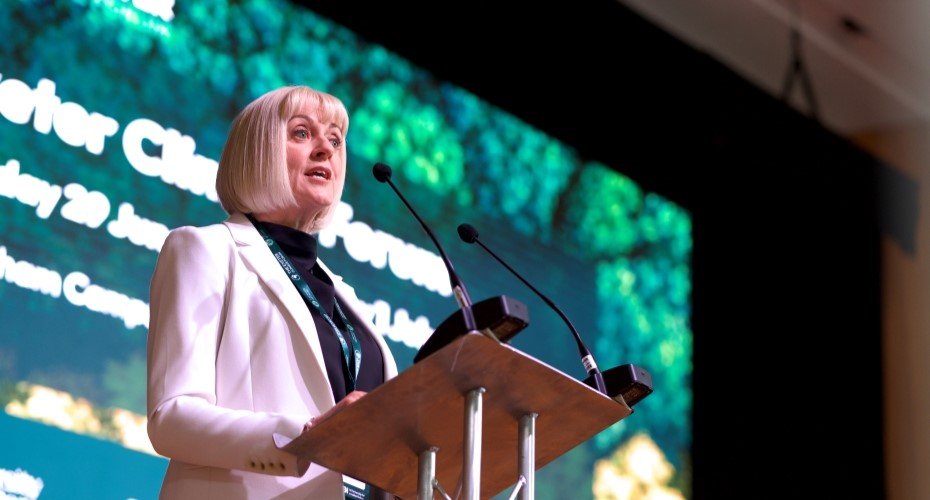
Speaking at the opening session, Professor Lisa Roberts, President and Vice Chancellor of the University of Exeter, said: “The climate emergency is the greatest challenge facing humanity today, so it is vital that we bring to bear the power of our collective efforts to address these challenges with the boldest of actions. The wide variety of delegates here today – drawn from policymakers, business leaders, civil society and researchers – show us just how important it is to engage everybody in this fight.
“Here at the University of Exeter, we are incredibly proud to be playing our part in driving meaningful action on climate change, whether through engaging global policymakers with the latest science; discovering sustainable methods for extracting the critical minerals needed for a low-carbon future; or by interrogating the potential health impacts of a changing climate.
“Together we have come so far in the fight for our planet. And I remain confident that if we continue to engage with each other, and learn from each other, that we will make a real and lasting impact in our quest to turn the tide on climate change.”
The opening session also saw the announcement of a new climate and nature institute, which will harness the full extent of Exeter’s world-leading expertise.
The new institute will draw on areas of excellence from across the University to develop bold solutions to the climate and nature crisis on both a local and global scale.
It will be led by Professor Patrick Devine-Wright, Director of the ESRC-funded ACCESS project (Advancing Capacity in Climate and Environment Social Science) and Professor in Human Geography at the University of Exeter.
Professor Devine-Wright said: “This is an exciting moment as we renew our environment and climate-facing research capabilities with an ambition that matches the scale of the crises we face. The new institute will be oriented towards courageous, interdisciplinary collaborations and inclusive, engaged research in partnership with our stakeholders. Together, we can conduct research of the highest quality, contributing positively to tackling environmental problems in an increasingly divided world”.
The Forum’s events include the Exeter Climate Conference, which will explore cross-cutting themes shaping global climate strategy, including the carbon cycle, positive tipping points, climate and health, and extreme weather and modelling.
It will be followed by a collaboration day, where invited groups will work with partner governments and others on specific challenges such as priorities for COP31 and COP17 and the consequences of missing net zero targets.
Stuart Brocklehurst, Deputy Vice Chancellor for Business Engagement and Innovation at the University of Exeter said: “Meaningful action on climate change requires those who make decisions to engage with the latest research, and for those doing that research to understand what those decision makers need to know. The Exeter Climate Forum creates an environment for collaboration and for reflection, with some hard-nosed working sessions addressing practical issues raised by governments. It’s great to welcome guests from across the world to Devon, and to play our part on this most vital issue.”
The Exeter Climate Forum is taking place at the University’s Streatham Campus in Exeter and is sponsored by the insurance group Howden.
Isabelle Cadignan, Climate Co-Lead at Howden, said: “Climate risk is evolving rapidly, and building resilience depends on the best available science being translated into practical action. We’re proud to continue supporting excellence in climate science through the Exeter Climate Forum and the launch of the University’s new climate and environment institute.
“Insurance sits at the intersection of climate science, investment and decision-making. It plays a vital role in de-risking and unlocking the investments needed for the energy transition while supporting businesses and communities as they respond to a changing climate. By staying close to the latest research, we can better understand physical and transition risks, strengthen resilience, and ensure risk is managed and shared effectively.”
For more information about the Exeter Climate Forum, visit https://exeterclimateforum.com/