








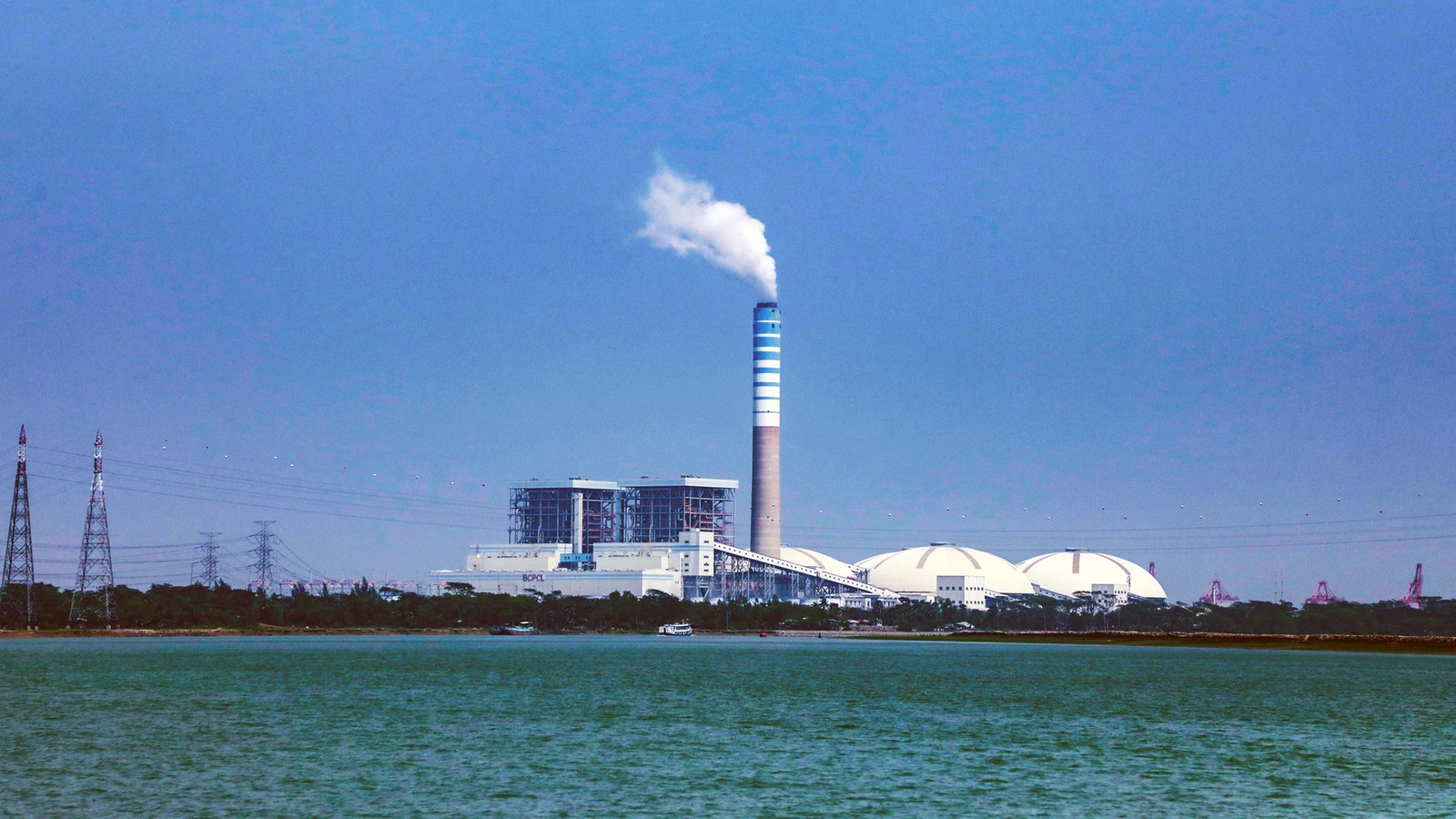
Coastal Bangladesh Communities Suffer as Environmental Safeguards Fail at Major Power Plant
PATUAKHALI, Bangladesh — For years, Riaz Panchayet’s farm in Madhupur village was defined by the seasonal harvest of papayas, cucumbers, and bananas. Today, that rhythm has been silenced, replaced by the persistent, suffocating shadow of the nearby Payra Power Plant.
Panchayet, who now operates a small tea stall near the facility’s gate, says his remaining land is blighted by waterlogged, stagnant discharge, while his crops are coated in a layer of fine, black ash. “I climb the coconut trees for pruning, and my shirt turns black,” he says. “My eyesight is failing, and we suffer from constant skin itching. It is all happening because of the coal plant.”
Panchayet’s experience is not an anomaly. Residents across the Kalapara subdistrict describe a rapidly deteriorating environment linked to the 1,320-megawatt facility, a joint venture between Bangladesh and China that has been consuming 10,000 to 12,000 tons of coal daily since it began operations in 2020.
A Regulatory Vacuum
A recent study has provided scientific weight to these anecdotal accounts, documenting a significant decline in local air and water quality. Despite this, the facility—and the regulatory bodies overseeing it—have come under fire for a series of environmental lapses.
Government records indicate that the Department of Environment (DoE) has failed to conduct regular stack emission tests at the plant between 2021 and 2025. When questioned, officials from the DoE’s Barishal Divisional Office admitted they lack the laboratory capacity to perform the mandatory air and liquid quality tests.
Adding to the controversy, the government issued an “urgent and confidential” order in May 2025, exempting power plants from submitting ambient air quality monitoring results. Officials argued that the latest air pollution rules do not explicitly cover power plants, a stance that has drawn sharp criticism from environmental researchers.
“The exemption from ambient air tests is a blunder,” said Abdus Salam, a chemistry professor at the University of Dhaka. “A coal power plant is inherently hazardous. Emissions and ambient air should be monitored extensively; to do otherwise is highly concerning.”
The “Chimney” Compromise
The plant’s design has also drawn scrutiny. The original Environmental Impact Assessment (EIA) required a 275-meter (902-foot) chimney to ensure the safe dispersal of pollutants. However, inspections in 2020 revealed that the plant’s chimneys stood at just 220 meters (720 feet).
While an expert committee later defended the shorter height, arguing that modern filtration systems—such as flue gas desulfurization (FGD) units—can mitigate the need for such height, critics argue that the oversight reveals a systemic failure in enforcing environmental safeguards designed to protect the public.
Mounting Evidence of Damage
The 2025 study, published in the Bangladesh Journal of Physics, paints a bleak picture of the area surrounding the plant. It found that sulfur dioxide and nitrogen oxide levels consistently exceed national standards. Furthermore, water quality in the nearby Andharmanik and Golachipa rivers shows signs of thermal pollution and high concentrations of toxic heavy metals, including arsenic, mercury, and cadmium—all of which surpass World Health Organization safety limits.
Despite the mounting evidence, the Bangladesh-China Power Company Limited remains firm in its stance. “We emit gases below the standard of the government and in full compliance of the rules,” said Muhammad Mahmud Hasan, the company’s general manager.
For the people of Patuakhali, however, the disconnect between official compliance reports and the reality of their poisoned soil and water is stark. As the plant continues to burn thousands of tons of coal daily, the local community remains caught in the crosshairs of an energy policy that appears to be prioritizing power production over environmental protection and public health.