








Firefox’s Smart Window AI Browsing Mode Gets Smarter with Real-Time Web Info and Enhanced History Search
San Francisco, CA – [Date of Publication] – Mozilla’s experimental Smart Window AI browsing mode for Firefox is receiving a significant upgrade, integrating real-time web information into its AI chat responses and introducing advanced features for managing browsing history. This marks a crucial step in Mozilla’s "agnostic" approach to AI, offering powerful tools to users while prioritizing privacy and user control.
Starting today, AI chats within Smart Window can leverage current web information and provide source links for its responses, thanks to a new partnership with Exa. This enhancement moves beyond simply recalling past browsing, allowing the AI to offer up-to-date and verifiable information, much like a traditional search engine but within the context of a personalized browsing experience.
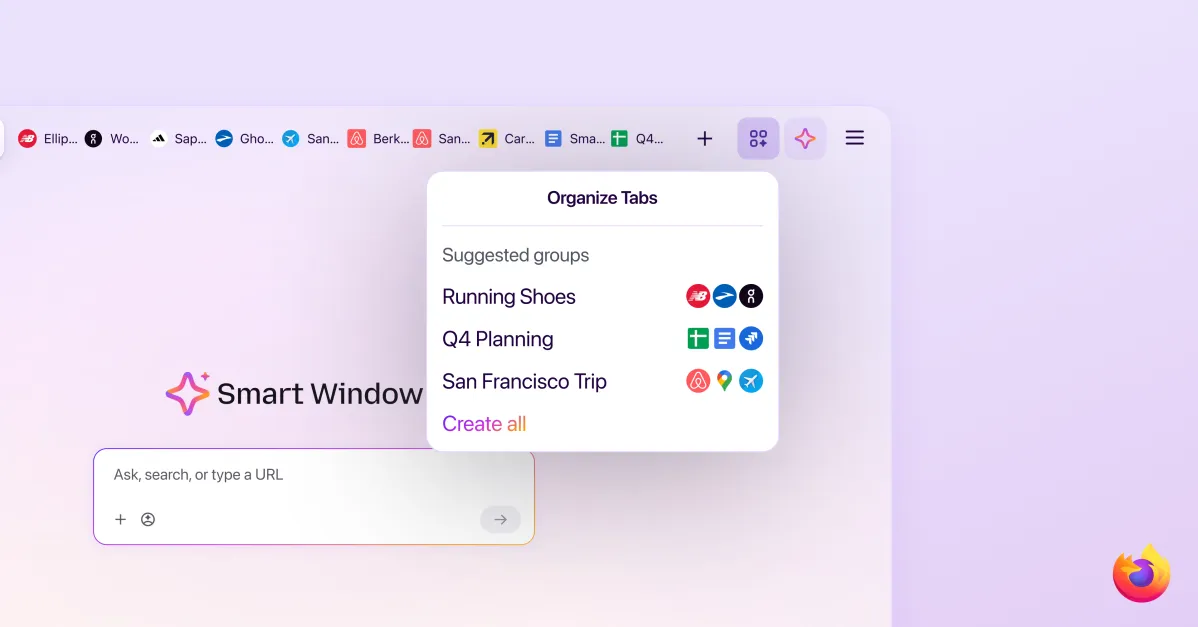
Beyond current web insights, Smart Window also introduces intelligent browsing history management. The AI can now automatically suggest tab groups, helping users organize their open windows more efficiently. Furthermore, a highly anticipated feature allows users to search their browsing history using natural language, with the AI providing visual previews of previously visited pages.
A live demonstration highlighted the practical applications of these new capabilities. The Smart Window AI successfully sorted through a user’s browsing history to locate "running shoes I looked at last week," presenting relevant images directly pulled from previously visited websites. This ability to intelligently sift through past interactions and retrieve specific content marks a departure from traditional search functionalities, focusing on the user’s existing knowledge and context. The tab grouping feature also demonstrates an impressive ability to identify and close duplicate tabs, streamlining the browsing experience and reducing digital clutter.
Mozilla’s blog post announcing the update emphasizes how these features can significantly improve a user’s workflow. The ability to retrieve information from past browsing sessions, even if the user can only recall visual cues rather than specific page names, can be invaluable for maintaining a train of thought or quickly re-engaging with previous research. Early beta user feedback, according to Mozilla, confirms the utility of these features in enhancing focus and continuity. Future updates promise to further refine this experience with Chrome-like surfacing of recent browsing journeys and AI-powered autofill for online forms.
Smart Window remains an opt-in beta feature, with Mozilla’s Head of Firefox, Ajit Varma, indicating that a precise date for its full release is not yet set. Initially unveiled last year as "AI Window," this innovative browsing mode allows users to interact with their open tabs and browsing history using natural language commands. Mozilla has since introduced a dedicated AI Controls section within Firefox settings, empowering users to selectively enable or disable specific AI functionalities, or turn them off entirely.
Varma stressed Mozilla’s "agnostic" approach to AI integration, aiming to provide AI features to those who desire them without imposing them on all users. He contrasted this philosophy with other browser developers, stating, "They didn’t create a browser for you to go to Wikipedia more; they created a browser for you to generate more LLM and chat queries. Whereas for us, we are just looking at more just browser experience, user experience."
A cornerstone of this user-centric approach is the ability for users to choose their preferred AI model within Smart Window. Options currently include Google’s Gemini 3.1 Flash Lite, OpenAI’s oss-gpt-120b, Alibaba’s Qwen3-235B-A22B-Instruct-2507, and even local AI models. Varma highlighted the commitment to "digital sovereignty," allowing users to select AI models from providers that align with their regional preferences or data privacy views, potentially differentiating from larger tech companies.
Steve Truong, Firefox AI senior staff product manager, further elaborated on the stringent privacy measures implemented. He confirmed that all chosen AI models operate under "zero-data-retention contracts." This means that third-party providers, whether offering inference or API calls, process user prompts in memory and are prohibited from storing data for model training, advertising, or human review. Crucially, Mozilla itself adheres to these principles, stating, "We also ourselves do not retain user chats in our servers without user permission to do things like model training — we’re not making models — and certainly not for human review and for advertising."
Varma reiterated Mozilla’s overarching goal: "We want to make sure it’s easy for people to get [Firefox] into the state that they want, but we also don’t want to be prescriptive to say there’s only our way of doing things or only one way to do things. But it’s really recognizing that we’re a neutral party on the internet and we want to cater to everybody." This user-first philosophy is evident in the continuous development of Smart Window, with features like the top navigation bar being added based on direct user feedback, as noted by Truong.