









Fresh Produce India attendees walked away with an optimistic outlook for the sector in India as the programme’s six sessions shared the healthy number of opportunities on offer in the local market, both for Indian products overseas and for the fresh produce category, as consumers prioritise health and nutrition.
Consumer insights

The dynamics of India’s consumer market were discussed across the morning content. The opening panel drilled into the trends shaping behaviour. Wellbeing has become more important than ever for consumers and the rise of e-commerce is changing the way they shop. Combined, the trends are opening more doors for premium and imported produce and brands to facilitate the desire of India’s growing middle class for a healthier lifestyle.
Rahul Kumar of DJ Exports, Rajoo Ramlingha of Star and Varun Kakar of Four Pillars Australia then joined to discuss how to build a fresh produce brand and develop a category, touching on some of the new fruits taking India by storm.
Kumar shared how DJ Exports had developed its own domestic production of blueberries. By selecting the right varieties and controlling quality throughout the supply chain, he said DJ Exports is able to differentiate its brand and deliver on a premium promise.
Kakar noted the shift in the way consumers are interacting with fresh produce brands. While quality and taste were still important, they are becoming more connected to brand stories and enjoyed engaging with products in new ways through recipes or as they looked to improve their health.
Ramlingha said it wasn’t just the premium market that offered opportunities for brand building. He emphasised that even in more commoditised categories like pears, onions or potatoes, there was an opening for businesses to create a differentiated product and extract extra value with a brand.
Southern excitement

The afternoon began with a spotlight on South India, which is home to some of the most dynamic consumption centres for fresh fruits.
Gopi Shankar of Global Victoria explained the unique market dynamics of South India, highlighting its high fruit consumption and urbanisation, robust retail sector, and significant e-commerce growth.
Narinder Singh of Simpli Namdhari’s said the different states and cities of South India each have different market dynamics. Even within a city, there are different customer profiles, and understanding these is key to success.
“What we are experiencing is that the more you are involved with your customers and the more you understand them, it will give you an edge,” said Singh.
Tarun Arora of IG International said businesses looking to develop their presence in South India need strong strategies and good quality management systems because South Indian consumers are demanding and will be punishing if their expectations aren’t met.
Safe supply chains

Food safety was in focus for the next session as Chinmayee Deulgaonkar of Control Union India, Pritee Chaudhary of the Food Safety and Standards Authority of India, Sarthak Jain of Blinkit and Kaushal Khakhar of Kay Bee Exports discussed the evolving landscape in India.
Chaudhary shared how meeting the food safety challenge was a collective effort. While the government machinery is working day in, day out to implement regulations, spreading awareness with growers is just as important.
Jain said Blinkit realised that a lack of control and visibility in the supply chain makes it difficult to manage food safety, which is why the company has established collection centres and employed AI-based quality checks to help its efforts.
Understanding and meeting the food safety requirements of other markets is equally important for exporters, Khakhar added.
Production and export
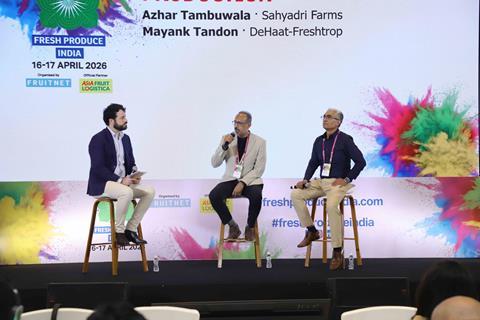
The penultimate session examined the varietal evolution occurring across some categories in India, notably in table grapes, as Azhar Tambuwala of Sahyadri Farms and Mayank Tandon of DeHaat-Freshtrop detailed how production was being taken to the next level.
Tandon noted a delay in IP varieties arriving in India had provided a late mover’s advantage. Growers did not have to start from ground zero and there was a lot of agnomical information available.
“The varieties that these breeders eventually got to India are varieties that are really in commercial demand in international markets,” he added.
Tambuwala shared how Sahyadri Farms has upgraded its operation to help growers succeed when introducing new varieties. It has set up in-house laboratories for soil and water testing and uses localised weather stations to help provide predictive analysis. But both speakers agreed that planting a new variety did not guarantee success and managing grower expectations and guiding them through the right practices was crucial.
Fresh Produce India concluded by turning its attention to exports. India’s exports continue to grow, increasing at an annual rate of 11.9 per cent in volume over the past five years. Exports surged by 23 per cent in 2025, hitting 1,796,316 tonnes, up from 1,459,894 tonnes in 2025.
Dr Sudhanshu, secretary of India’s Agricultural and Processed Food Products Export Development Authority (Apeda), Shoubhit Jain of Vegrow and Robert Mant of Kuehne and Nagel discussed how India can maintain this export momentum.

Dr Sudhanshu shared Apeda’s efforts to support export development, highlighting the work it had done to help growers and exporters to adopt Good Agricultural Practices (GAP), meet market and quality requirements, and identify and introduce new products including GI (Geographical Indication) products.
Jain said India’s export growth would be sustainable as technology adoption enabled the industry to overcome some of its current challenges. It is helping to empower the country’s fragmented growing base and upgrade Indian practices to global practices, he said.
Mant said improving supply chain visibility was vital to developing India’s fresh produce exports, noting the industry cannot improve its supply chains if it cannot identify the problems.
However, he noted there is a “hunger” for Indian fruit in markets like the UK, which showed the potential demand. The evolution of the global banana market could also provide an opening for what is already India’s largest export category.
“Banana production around the world is not increasing, so there are many challenges globally for bananas in terms of disease and productivity, delivery times and other issues that affect distribution. All of that’s going to mean, in my mind, that India becomes more and more important in terms of supplying certain markets,” he said.
Non-stop networking, experiential tours
Fresh Produce India’s content programme took place in the same space as the business networking expo where leading companies showcased a range of innovative products and services. The mix of lively sessions in a shared conference and expo area enabled delegates to connect with customers, buyers and service providers throughout the day.
Fresh Produce India also featured a networking breakfast hosted by Avocados Australia where chef Parvinder Singh Bali, director of the School of European Pastry and Culinary Arts, demonstrated the culinary versatility of avocados while nutritionist Naaznin Husein explained their multiple health benefits.
Westfalia Fruit India also curated an avocado-themed networking lunch while Fruit South Africa hosted an evening drinks reception to close.
Fresh Produce India continued beyond the conference room on day two with a programme of organised tours for delegates. The first stop was Mumbai’s bustling Vashi wholesale market, followed by hosted visits to a selection of Mumbai’s leading modern food retail stores. Stops included Food Square, a gourmet grocery store and experiential food destination where Bollywood celebrities shop for premium imported produce, and Star, a large-scale hypermarket format offering a wide range of fresh produce.
Recognising excellence in India
Fresh Produce India also hosted the Fresh Produce India Awards 2026, presented by Fruitnet Media International to recognise outstanding achievement in India’s fresh fruit and vegetable business. The awards are given in three categories: India Business, India Marketing Campaign, and India Impact.
Westfalia Fruit India scooped India Business for its pioneering efforts to develop India’s burgeoning avocado category. Premium mandarin brand Sweet C took home India Marketing Campaign for its impactful campaign, ’Blue is the new orange’, and Namdhari’s Group was presented with India Impact for its success in building a seed to shelf supply chain in India.