








Date published:
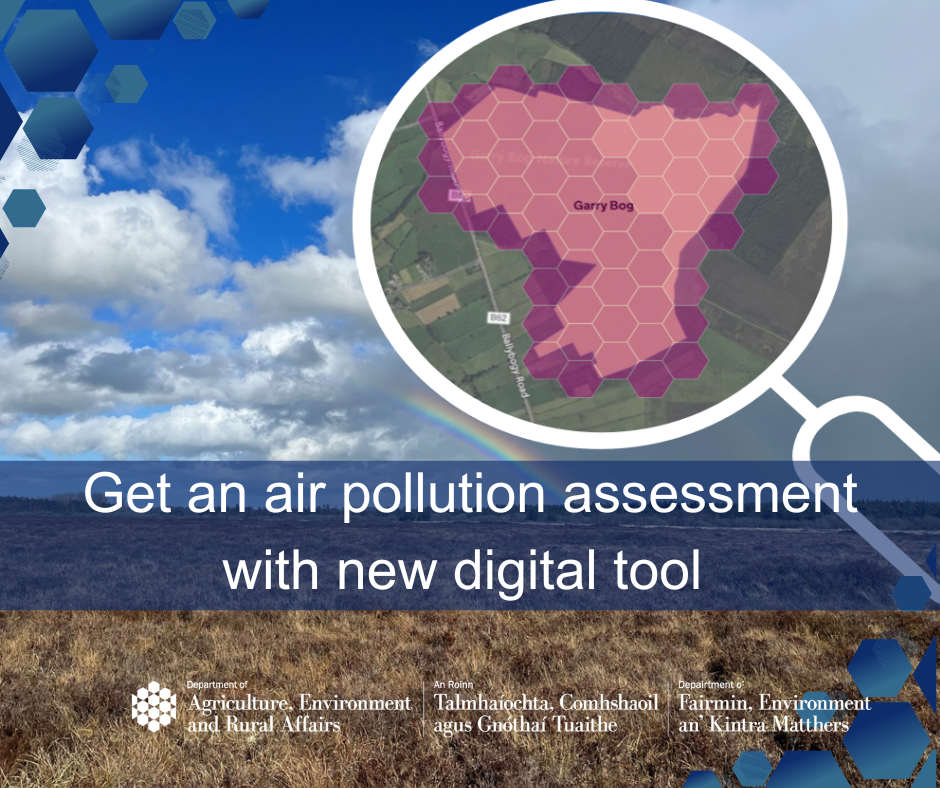
A new air pollution assessment tool which will help the environment, save time, money and help reduce planning backlogs, has been launched as a pilot in Northern Ireland.
Announcing the introduction of the ‘Get an air pollution assessment’ service, known as the UK Air Pollution Assessment Service (UK APAS) during its development, DAERA Minister Andrew Muir said the new technology would help protect sensitive habitats here.
“Good air quality is vital for both our health and our environment hence the importance of finding and implementing new techniques or approaches to improve air quality. I’m grateful that Northern Ireland has been chosen as the first region to introduce the new Air Pollution Assessment Service,” said Minister Muir.
“This digital tool will help us protect the natural environment, reduce planning delays, cut costs for planning applicants and their consultants, as well as provide a detailed analysis of the potential impact proposed developments would have on air quality.
“It will provide robust scientific evidence for NIEA and the planning authorities to assess when considering new planning applications such as large strategic road networks or agricultural livestock buildings. Applicants can also use the new system, which is free, as a design tool and to assess the benefits of any measures they are implementing to reduce emissions such as ammonia and nitrogen oxides.
“My desire is to bring about lasting improvements in the quality of the air we breathe and I believe this new tool has real potential to help us achieve that, so I would strongly encourage applicants and their consultants to use it and maximise the benefits it can offer to them and to our environment,” he added.
Current air quality assessment systems across the UK are standalone, complex and inconsistent, with different modelling tools utilised and relevant information held by many different sources.
The project has been jointly funded by DAERA (Carrier Bag Levy), Defra and other UK environment agencies and led by the Joint Nature Conservation Committee (JNCC), the public body that advises the UK Government and devolved administrations on UK-wide and international nature conservation.
Based on a similar Dutch government air pollution assessment model, the air pollution assessment service will provide detailed air dispersion modelling for calculating aerial emissions, to provide information on habitats and emissions data.
Developers and applicants will be able to find out how much ammonia or nitrogen oxide will be emitted from their development proposal, as well as be able to visualise the dispersion of these pollutants in the air and deposition on protected sites.
Steve Wilkinson, JNCC Director of Ecosystem Evidence & Advice said: “For the first time, this tool can automatically bring together emission footprints from multiple projects that could act in-combination to adversely impact our environment. Whilst the initial focus of the project is on protected sites, there is potential to expand the tool to assess air quality impacts from plans and projects on human health. However, work still needs to be done by the technical experts on this aspect of the service.”
“With ambient ammonia concentrations and nitrogen deposition rates above the levels that cause harm to sensitive habitats at almost all NI’s designated sites, NI has been chosen as the first region to implement the system. We have consulted with key stakeholders, including the agricultural industry and planning consultants and authorities, on the development of the tool. NIEA has also been providing training seminars and has been encouraged with the positive feedback,” he added.
The overall benefits of the scheme include:
- Providing a single consistent and streamlined approach to air quality assessments, at a reduced cost for applicants;
- Facilitating more efficient, consistent and transparent decision-making;
- Improving efficiency within the planning and permitting processes;
- Providing a ‘design tool’, empowering users to make informed choices on sustainable development;
- Helping the spread of best practice and quicker implementation of mitigation measures to reduce aerial emissions;
- Facilitating the development of emission reduction policies.
Access the links to the ‘Get an air pollution assessment’ service.
Notes to editors:
- ‘Get an air pollution assessment’ aligns with the strategic priorities included within DAERA’s Plan to 2050 ‘Sustainability for the Future’, by providing an efficient digital model to aid in the design and development of economically and environmentally sustainable facilities.
- The tool will be part of an overall Departmental package aimed at reducing levels of ammonia across NI. The tool will play a key role in supporting the future Ammonia Strategy by providing a mechanism for applicants to test the implementation of reduction measures and recognise the combined benefit of their low emission best practice.
- In helping to protect the health of the natural environment, for example, peatlands, it will additionally be fundamental in the delivery of other cornerstone strategies such as the draft Green Growth, draft Clean Air, draft Nature Recovery and Peatland Strategies as well as the Environmental Improvement Plan for Northern Ireland.
- The majority of DAERA’s financial contribution is through funding provided by the Carrier Bag Levy. Further information is available here: https://www.nidirect.gov.uk/articles/carrier-bag-levy.
- Follow DAERA on X formerly called Twitter and Facebook.
- All media queries should be directed to the DAERA Press Office: pressoffice.group@daera-ni.gov.uk or telephone: 028 9016 3460.
- The Executive Information Service operates an out of hours’ service for media enquiries only between 1800hrs and 0800hrs Monday to Friday and at weekends and public holidays. The duty press officer can be contacted on 028 9037 8110.