








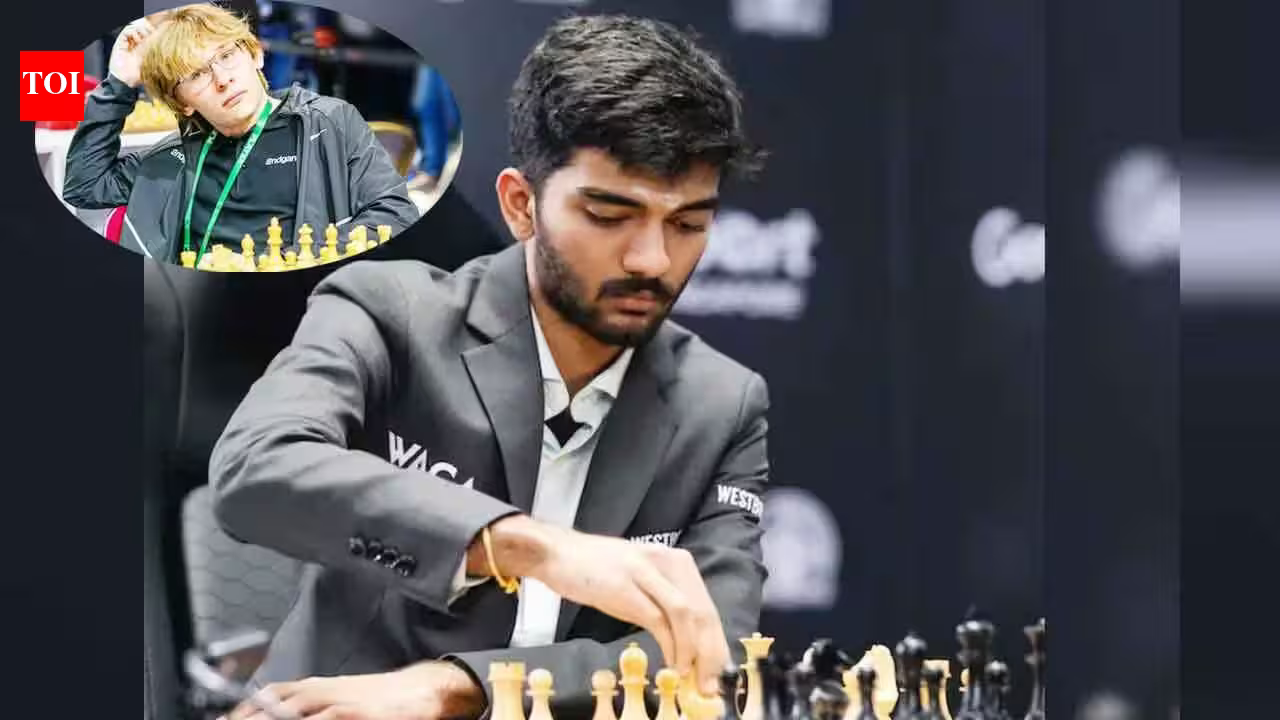
Tension in the world of professional chess has reached a boiling point before a single pawn has even been moved. With the 2026 World Chess Championship set to begin in Geneva on November 24, Belarusian grandmaster Denis Lazavik has injected a volatile dose of skepticism into the proceedings, launching a scathing critique of defending champion D Gukesh while casting Javokhir Sindarov as the inevitable successor to the throne.
In a candid interview with Chess Plus, Lazavik did not merely predict a win for the Uzbek challenger; he questioned the very pedigree of the reigning Indian champion. “I do not see such potential in Gukesh. Neither in his current play, nor in his general human qualities,” Lazavik stated, signaling that this rivalry transcends the 64 squares and has entered the realm of personal scrutiny.
‘I would not count on any long and equal fight’
The Belarusian’s assessment of the upcoming 14-game marathon is bleak for those hoping for a back-and-forth thriller. Lazavik posits that Sindarov’s current form is far superior and that the match is unlikely to be the closely contested battle typically expected at this level.
“I would not count on any long and equal fight,” Lazavik noted. “If Sindarov had dipped a little recently, then maybe I would have changed my point of view, but he is playing very well. So, I expect the match to unfold without much of a fight. Not a crushing defeat, but something around +1, +2, and Sindarov will hold the edge until the end.”
For the casual observer expecting a spectacle, Lazavik’s advice is clear: lower your expectations. He admits he watches chess through the clinical, detached lens of a professional seeking new tactical ideas, rather than as a spectator seeking entertainment, and he expects the board to reflect that cold, technical dominance from Sindarov.
‘We need a great Champion, not just on paper’
The core of Lazavik’s animus appears to be a desire to see the World Championship title held by a player who commands the board with unquestioned authority. He views the 20-year-old Sindarov not just as a challenger, but as a potential figurehead for the sport.
“We need a great Champion, not just on paper, but in reality, who will successfully defend the title and often win tournaments,” Lazavik argued. “I see such potential in Sindarov. He plays well and, perhaps, over time will be able to become an example not only for chess players but for other people as well.”
This sentiment underscores the pressure mounting on Gukesh. Since becoming the youngest undisputed world champion in 2024 at the age of 18, Gukesh has struggled to maintain the aura of invincibility that defined his rise. With his classical rating dipping to 2710 and his recent results in major tournaments failing to match his historic achievement, critics like Lazavik are sensing blood in the water.
Gukesh faces stern test against in-form Sindarov
The narrative leading into Geneva is one of two very different trajectories. While Gukesh has been meticulous in his preparation—even skipping classical legs of the Grand Chess Tour to avoid fatigue—his inactivity has invited doubts regarding his match readiness. He currently sits as the lowest-ranked reigning world champion in the Elo era, a statistic that provides ample ammunition for his detractors.
Conversely, Sindarov is riding a wave of momentum that most young grandmasters only dream of. His unbeaten run at the FIDE Candidates Tournament was a masterclass in consistency, and his success with the gold-medal-winning Uzbek team at the 46th Chess Olympiad in Samarkand cemented his status as a titan of the new generation. Reaching a career-high world No. 4 in classical chess, Sindarov enters Geneva as the clear favorite in the eyes of many peers.
Sindarov leads classical head-to-head record
Statistically, the momentum lies entirely with the challenger. Sindarov boasts a 2-0 record over Gukesh in classical games with one draw, meaning the reigning champion has yet to solve the puzzle of the Uzbek’s defense in a traditional time-control format.
Gukesh, however, remains unmoved by the background noise. During the opening press conference, the Indian champion shifted the narrative, framing the tournament as an opportunity to prove his worth rather than just a defensive maneuver. “I am not approaching the contest simply as a title defence,” Gukesh stated. “I want to win the world championship all over again.”
All you need to know about the World Championship match
The stage is set in Geneva for a high-stakes clash. With a massive prize fund of USD 2.5 million, the stakes are as high as the intensity of the competition. The format, which mandates 14 classical games, aims to reward aggressive play by prohibiting draw agreements before the 40th move. The first to 7.5 points will walk away with the crown, though if the score remains level, the drama will shift to the high-pressure environment of rapid and blitz tiebreaks.
As Gukesh prepared for the opening game by drawing the black pieces, the weight of the moment was palpable. Whether he silences critics like Lazavik by finding his form, or whether Sindarov fulfills the prophecy of the pundits, one thing is certain: the world of chess is about to witness a definitive statement on the state of the game. The 14 games in Geneva will determine if Gukesh can solidify his legacy or if the crown will pass to a new, rising force in the form of Javokhir Sindarov.
Disclaimer: This content is auto-generated for informational purposes only.
Source: Read Original News