





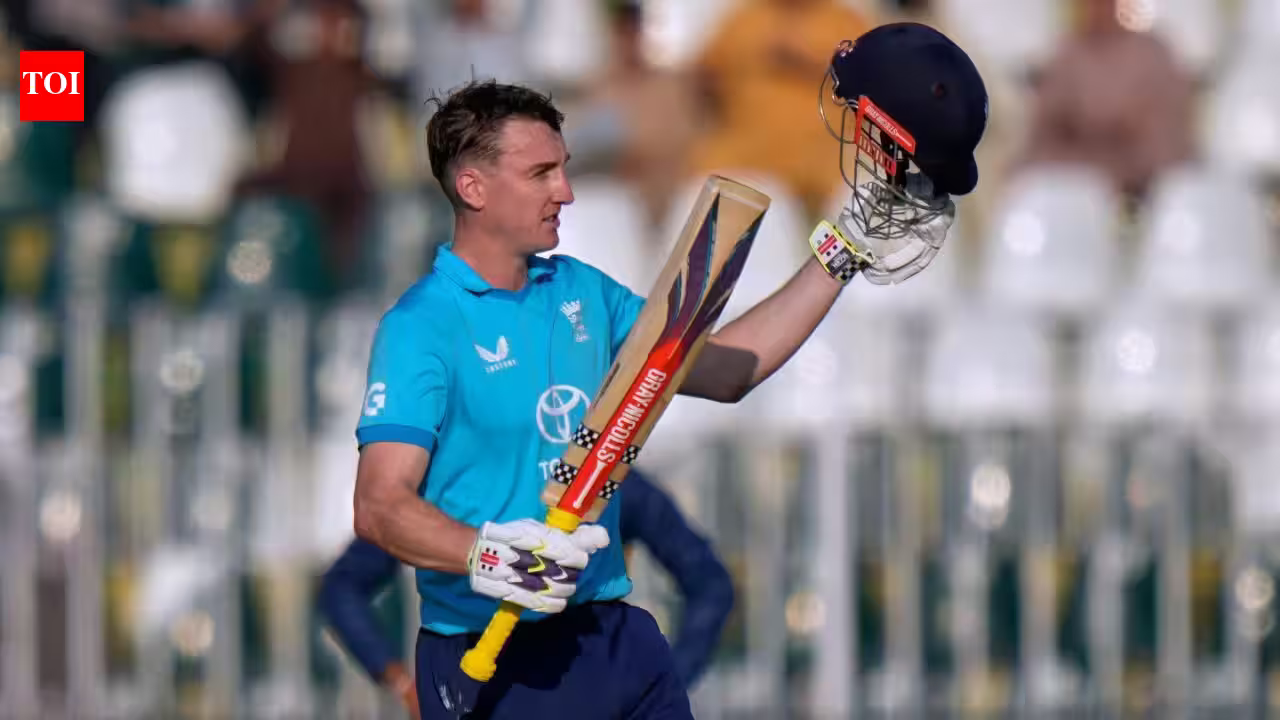
Rawalpindi witnessed a spectacle that defied logic, a match that swung from the pinnacle of individual brilliance to the depths of team despair. In a contest that will be etched into the annals of cricketing history, England captain Harry Brook cemented his place among the all-time greats, joining the legendary Chris Gayle in an exclusive multi-format club. Yet, in a cruel twist of irony, Brook’s magnum opus—the fastest double-century in ODI history—served as the backdrop for one of the most stunning comebacks ever mounted on a cricket pitch, as Sri Lanka successfully hunted down a mountainous 430-run target to snatch victory from the jaws of defeat.
A Historic Milestone: Joining the ‘Universe Boss’
The narrative of the match began with Harry Brook’s ascent to a rare celestial plane of batting. With his blistering 202 off 116 balls, the 27-year-old became only the second player in the history of international cricket to record a triple-century in Tests, a double-century in ODIs, and a century in T20Is.
Brook’s journey to this milestone has been one of consistent, predatory brilliance. His credentials were already firmly established when he hammered a colossal 317 against Pakistan in Multan in October 2024. Added to his T20I pedigree—highlighted by a masterful unbeaten 114 against Sri Lanka in September 2026—the ODI double-ton was the final piece of a jigsaw puzzle that had previously been completed only by the “Universe Boss,” Chris Gayle. Gayle, who famously racked up triple-centuries against South Africa and Sri Lanka, a 215 against Zimbabwe, and a T20I century against the Proteas, finally has company at the summit of multi-format dominance.
Rewriting the Record Books in Rawalpindi
The statistics stemming from Brook’s innings are nothing short of transformative for English cricket. Before this match, the highest ODI score by an Englishman was Ben Stokes’ iconic 182 against New Zealand in 2023. Brook didn’t just eclipse that record; he shattered it with a display of raw power and clinical precision.
Reaching the 200-run mark in just 114 deliveries, Brook eclipsed the previous record for the fastest men’s ODI double-century, which had stood at 117 balls. The mechanics of his innings were a masterclass in acceleration. After a calculated start that assessed the pitch conditions, Brook entered a state of flow, dismantling the Sri Lankan attack with 21 boundaries and 10 towering sixes.
The partnership dynamics were equally lethal. A steady 159-run stand with veteran Joe Root, who contributed a composed 69, provided the structural integrity for the innings. However, the closing act was pure theater. Alongside Will Jacks, who blazed an unbeaten 66 off just 30 balls, Brook helped England pile on a staggering 156 runs in the final 10 overs. England walked off the field with a total of 429/4, a score that, in the history of the sport, usually signals an insurmountable mountain.
The Great Escape: Sri Lanka’s Historic Chase
If Brook’s innings was a portrait of individual dominance, the subsequent four hours of play were a testament to collective spirit and unyielding belief. Facing a target of 430, Sri Lanka faced a task that bordered on the impossible. Instead of folding, they mounted the second-highest successful run chase in the history of men’s ODI cricket.
The momentum was set early, but it was sustained with a level of ferocity rarely seen under pressure. Pavan Rathnayake anchored the pursuit with a magnificent 130, providing the platform for an assault on the English bowling attack. Avishka Fernando and Dasun Shanaka both played pivotal roles, each falling just short of a century with 97 runs apiece, keeping the required run rate within touching distance as the shadows lengthened over Rawalpindi.
The tension reached a fever pitch in the final over. With the match delicately poised, Janith Liyanage emerged as the unlikely hero. Maintaining his nerve as the field closed in, Liyanage struck a decisive, soaring six to seal the win. Finishing unbeaten on 61, Liyanage guided Sri Lanka to 430/8, crossing the line with a solitary ball to spare.
A Night of Contrasting Emotions
For Harry Brook, the result will undoubtedly be a bitter pill to swallow. To produce a record-shattering innings of that magnitude and still end up on the losing side is a cruel irony that highlights the unpredictable beauty of the ODI format.
However, cricket is a game that values the contest as much as the result. Sri Lanka’s victory was not merely a loss for England; it was a defiant statement of intent from the tourists. As the two teams look ahead to the remainder of the tri-series, one thing is certain: the bar for excellence has been raised, both by the bat of the England captain and by the collective heart of a Sri Lankan side that refused to know when it was beaten. The Rawalpindi crowd left the stadium having witnessed a masterclass in batting and, perhaps more significantly, a masterclass in belief.
Disclaimer: This content is auto-generated for informational purposes only.
Source: Read Original News