






Indian Air Force Achieves Milestone with Heavy-Lift Landing at Nyoma Airfield
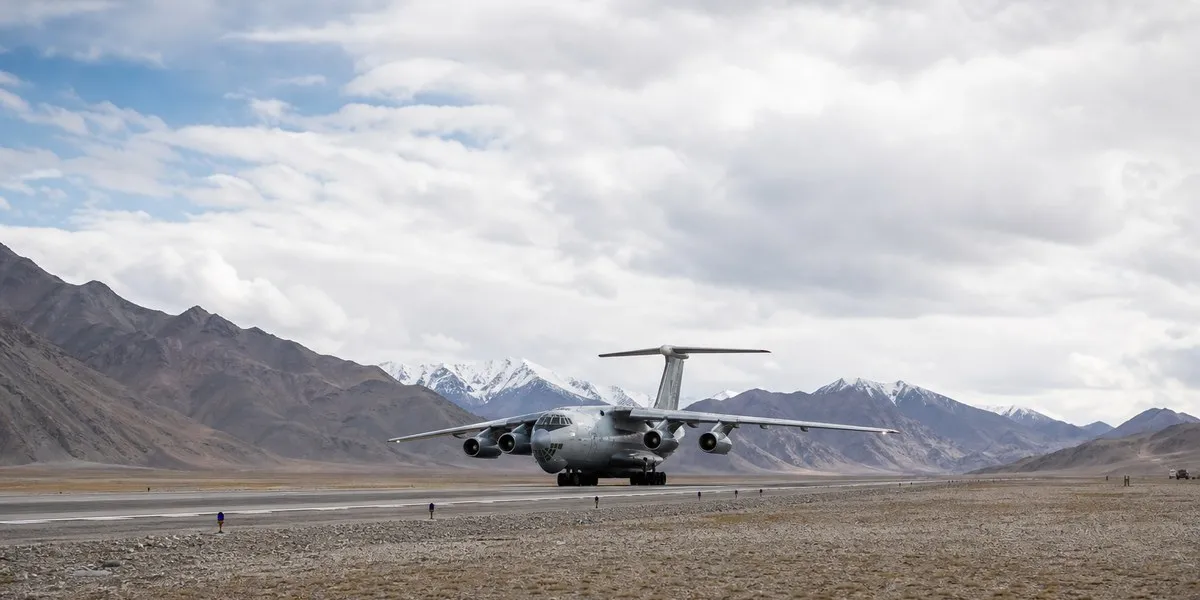
The Indian Air Force (IAF) has marked a historic milestone in aviation and military logistics by successfully landing a heavy-lift Il-76MD transport aircraft at the high-altitude Nyoma airfield in Ladakh. Situated at an elevation of 4,154 meters (approximately 13,630 feet) above sea level, this operation represents the highest altitude ever recorded for a landing of this specific aircraft class globally.
The successful sortie serves as a powerful demonstration of the IAF’s operational capabilities in the challenging, oxygen-thin environment of the Himalayas. Known affectionately within the service as the “Ganjraj,” the four-engine, Russian-origin heavy-lifter navigated the rugged terrain with precision, proving that India’s strategic airlift capacity is capable of meeting the demands of the most extreme frontiers.
A Technical Triumph in Extreme Conditions
The IAF released striking visual evidence of the mission, featuring the massive transport aircraft maneuvering against a backdrop of barren, snow-dusted mountains. The Nyoma airfield sits within a high-altitude cold desert, a region where environmental conditions are notoriously punishing. Pilots and ground crews must contend with temperatures that frequently plummet to minus 20 degrees Celsius, alongside the complex aerodynamics inherent in thin air.
According to official briefings, the landing confirms the structural and technical readiness of the newly upgraded airfield. The ability to bring a heavy-lift platform like the Il-76MD into Nyoma significantly enhances India’s logistical backbone, allowing for the rapid deployment of heavy weaponry, humanitarian aid, and essential supplies to the frontlines in a fraction of the time required by road transport.
Bolstering Infrastructure Near the LAC
The completion and operationalization of the Nyoma airfield stand as a cornerstone of India’s aggressive efforts to modernize its border infrastructure. The project gained immense momentum following the 2020 border skirmishes in the Galwan Valley, a tragic event that resulted in the loss of 20 Indian soldiers and four Chinese personnel, fundamentally altering the security dynamics of the region.
Since that confrontation, India has prioritized the rapid development of airfields, tunnels, and road networks across Ladakh to ensure that its defensive posture remains robust along the 3,500-kilometer Line of Actual Control (LAC). While high-level diplomatic channels between New Delhi and Beijing have seen a gradual, cautious restoration of contact, the region remains a zone of persistent friction. The unresolved territorial disputes along the border necessitate a permanent, alert military presence, and the recent landing at Nyoma is a clear message regarding India’s commitment to maintaining tactical superiority.
As the region continues to serve as a focal point for geopolitical tension, the successful utilization of the Nyoma facility by heavy-lift aircraft ensures that the Indian Armed Forces can project power and sustain operations even in the most remote and inhospitable corners of the high-altitude frontier. This achievement not only underscores the skill of the IAF’s pilots but also cements the airfield’s status as a critical asset in India’s long-term defense strategy.
Disclaimer: This content is auto-generated for informational purposes only.
Source: Read Original News