







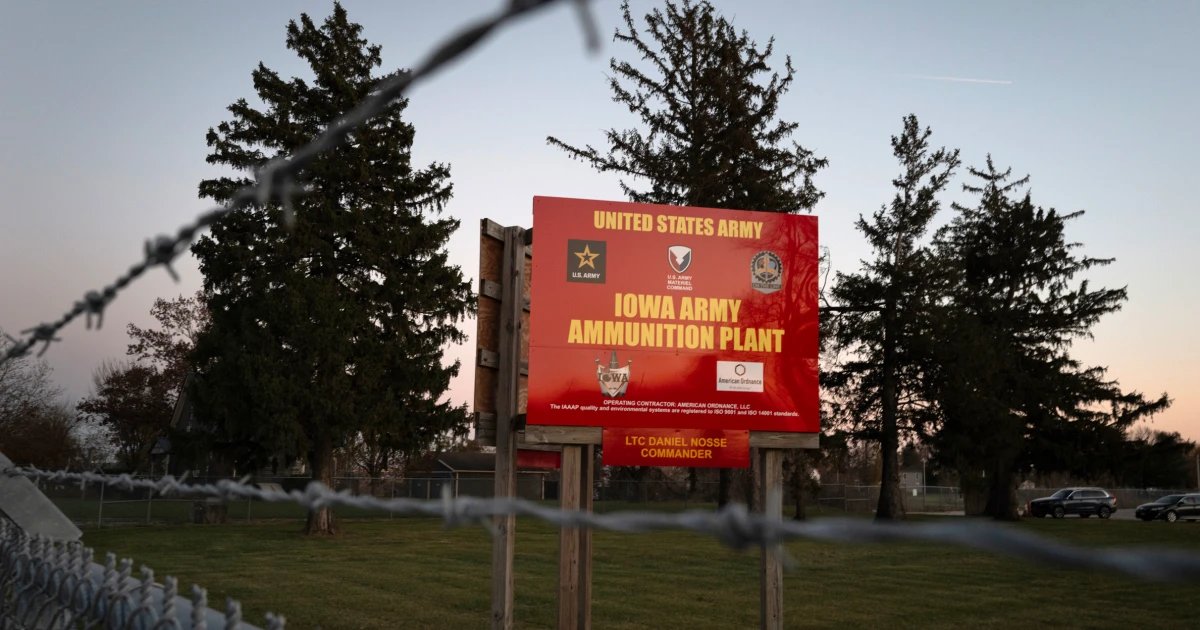
A U.S. appeals court cleared the way Monday for the Army to proceed with a controversial, large-scale detonation of unstable lead azide at the Iowa Army Ammunition Plant, rejecting an emergency request by environmental groups to halt the operation.
The 8th Circuit U.S. Court of Appeals issued an order lifting a temporary stay on the project, acknowledging the hazardous nature of the materials while prioritizing a controlled blast over the risk of a spontaneous, unplanned explosion.
“We are mindful of the very real risks presented by the Army’s planned detonation,” the court wrote in its ruling. “However, we must acknowledge the realities of the situation: the degraded explosives present a risk of an uncontrolled and unplanned explosion, which would occur without the benefit of the safety measures that the permit puts in place.”
The Army maintains that 68 drums of lead azide—a chemical used in bomb triggers—have undergone “recrystallization,” rendering the material highly unstable. Military officials argue that the substance cannot be moved safely and that cold weather could trigger a catastrophic, uncontrolled detonation. By conducting a controlled blast, officials claim they can better manage the dispersal of lead, a potent neurotoxin.
The decision arrives after days of political maneuvering. Earlier Monday, President Donald Trump ordered the Army to pause the detonation until the courts could weigh in, explicitly stating that he would tie the operation to the approval of incoming Governor-elect Rob Sand. Trump warned that if officials blocked the controlled removal, the responsibility for any future “death or destruction” caused by an accidental blast would fall on the state’s incoming leadership.
The court’s ruling effectively overrides the uncertainty surrounding the federal permit. While the detonation had most recently been set for Wednesday, it remains unclear exactly when the Army will initiate the blast.
For residents in and around Middletown, the news brings a mix of frustration and anxiety. The detonation is expected to send a plume of lead dust over the region, raising fears about the long-term impact on air quality, soil, crops, and public health.
Debra Ott, who resides about five miles from the plant, described the constant schedule changes as exhausting. “I don’t want to be sitting at home at midnight and have it go off and not have a clue what’s going on,” she said, noting that she plans to stay indoors for 24 hours following the blast to protect her grandchildren.
Others, like farmer Jill Holler, spent the weekend racing to collect baseline soil samples to measure potential future contamination. “It’s just frustrating,” Holler said. “You’re pretty confident there’s going to be something else changing, and we can’t really believe what the next thing they say is going to happen.”
As the state braces for the impact, local frustration continues to mount regarding the lack of transparency, with Governor-elect Sand calling on the federal government to release the full data behind the Army’s decision-making process.
Disclaimer: This content is auto-generated for informational purposes only.
Source: Read Original News