









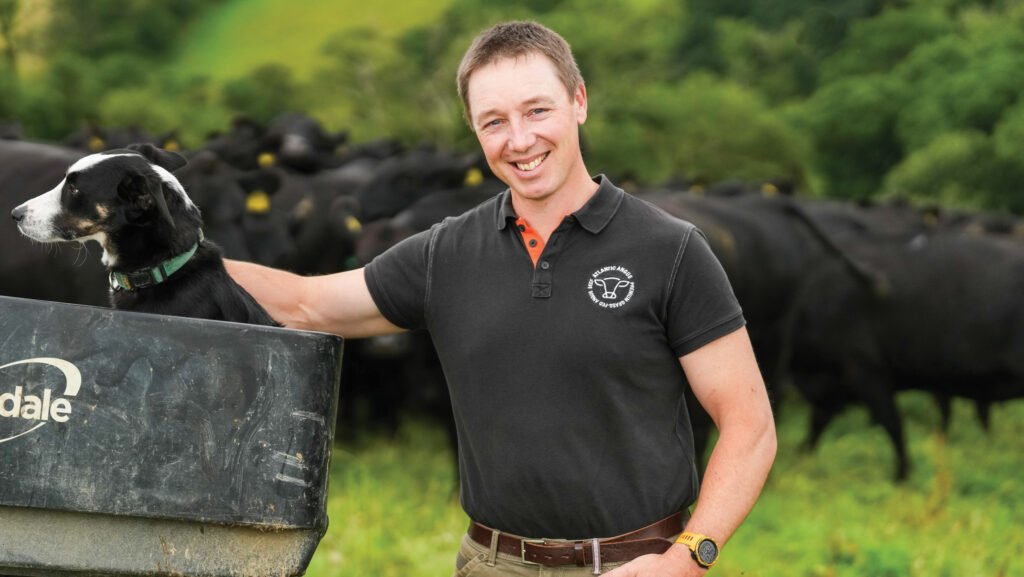
Cornish farmer Jonathan Chapman has shaped his suckler herd to work in harmony with the natural environment, building a system that balances productivity with sustainability.
Farming 350ha (865 acres) alongside his father, Peter, about one-third of the land at Atlantic Angus, Cornwall, is poorer-quality ground, including 28ha (69 acres) of priority habitat Culm pasture.
Rather than pushing production across the whole farm, Jonathan, Farmers Weekly’s 2026 Beef Farmer of the Year and Environmental Champion, has taken a targeted approach.
See also: Farmers Weekly Awards 2025: Beef Farmer of the Year
By breeding for moderate-sized cows with a mature weight of about 650kg, he can use cows to utilise lower-quality land.
Higher-quality ground is then used to produce high-quality grass and forage for youngstock.
Farm facts
Atlantic Angus, Holsworthy, Cornwall
- Farming 350ha – 240ha owned and 110ha rented
- Running 210 Aberdeen Angus pedigree cows plus 450 followers
- Closed herd
- Spring calving
- Selling breeding bulls and females
- Steers and heifers are sold at 18-22 months old through their own farm shop and supplied to Kepak/Tesco
Environmentally focused system
The Chapmans’ involvement in environmental schemes is not new.
They first entered the Countryside Stewardship scheme more than 20 years ago, but their focus has intensified in recent years as direct support payments have declined.
Now, the entire farm is managed under multiple environmental schemes, including the Sustainable Farming Incentive (SFI), of which they were early adopters.
Alongside this, Jonathan is embracing new technologies, trialling carbon credit schemes and using grassland management apps powered by artificial intelligence to better understand pasture performance.
Measuring carbon and soil health
The farm is involved in both the Farm Carbon Toolkit’s Farm Net Zero Project for Cornwall and an AHDB carbon baseline study.
These projects are giving Jonathan valuable insight into how his farm is performing environmentally.
Soil sampling through the Farm Net Zero Project showed the farm sequestered 22t of carbon/ha over three years – something he attributes to changes in management.
These include a shift to rotational grazing, the introduction of herbal leys and a move to direct drilling when reseeding.
However, the project has thrown up some surprising results.
“Bizarrely, the best field is probably the one most intensively farmed that gets the most slurry and fertiliser,” he says.
This field – a mix of ryegrass and white clover – is cut twice for silage before being grazed, and it receives up to 150kg/ha of nitrogen annually, along with slurry applications.
For Jonathan, it highlights an important point: “You can’t build carbon in the soil without growing mass above it.”
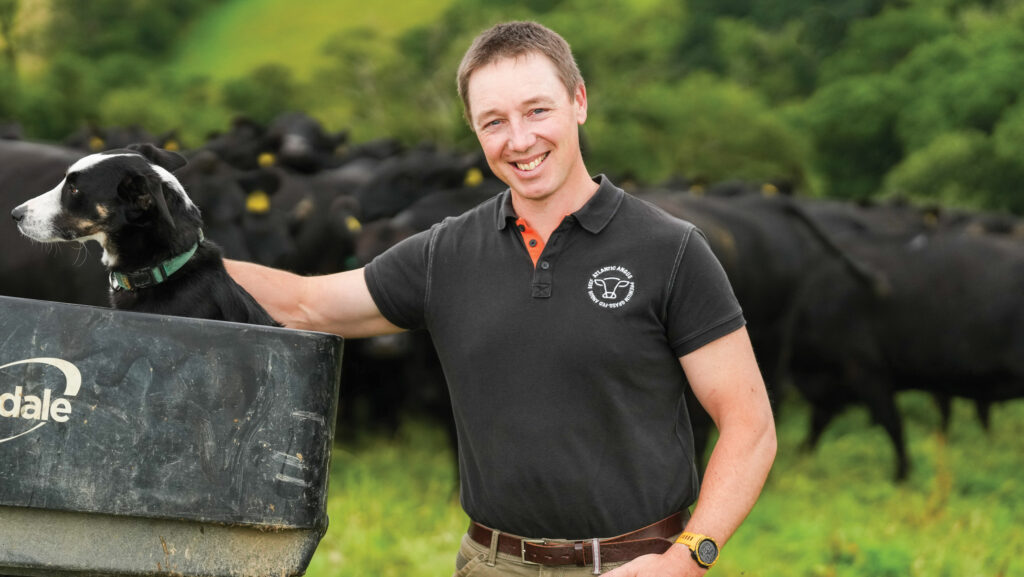
Jonathan Chapman © Emily Fleur
Improving resilience with grazing
Soil health assessments carried out through the projects have confirmed that management decisions are moving the farm in the right direction.
Farming heavy clay soils that are prone to poaching can be challenging.
However, herbal leys have played a key role in improving soil structure and boosting earthworm activity.
“We were finding roots only in the top few inches and capping under the soil,” says Jonathan.
“But deep-rooting species like plantain and chicory have helped, and in a dry year like last, it made us more resilient.”
This focus on carbon capture led him to adopt the Ruumi app, which is being used to monitor progress over a five-year period, with the long-term aim of selling carbon credits.
Using technology to manage grass
Jonathan is also using Ruumi to improve day-to-day grassland management.
The app records stock movements and grass growth, producing grass growth curves, and predicts when stock should be moved.
Monitoring herbal leys can be difficult using traditional plate meters, so he is also involved in developing a system that uses phone imagery to estimate dry matter in these more diverse swards.
He has also applied for funding to introduce virtual fencing collars for 150 cows, which would allow him to manage grazing more precisely.
This would be particularly useful when managing priority habitats, enabling him to exclude areas such as bird nests at the touch of a button.
Managing priority habitats
Priority habitats are typically mob-grazed by suckler cows with calves at foot.
“It’s not high-quality grazing, but it’s plenty good enough for them,” says Jonathan.
Priority habitat areas must not be overgrazed, and topping is delayed until summer to protect nesting birds, while rushes are controlled to encourage species diversity.
“Each habitat needs assessing and approving by Natural England, so it’s quite a lot of work,” he explains.
Concerns over future policy
Despite the progress made, Jonathan has concerns about the direction of future environmental schemes.
Changes to the SFI could risk undermining the work already carried out.
Currently, the farm has multiple agreements with different timelines, and he is worried that new schemes cannot be entered into until existing ones expire under new rules limiting agreements to one for each farm.
The £100,000 payment cap is also a concern.
“I thought it was great when I went into my priority habitat on 15 acres [6ha], but I may not be able to apply on the rest of the farm until that agreement expires,” he explains.
Looking ahead, uncertainty makes long-term planning difficult.
“Our goal is to run a profitable and sustainable business,” says Jonathan.
“But it’s challenging to plan when there is so much instability.”
He hopes future policy will continue to reward farmers who adopt environmentally sustainable practices, allowing businesses like his to keep building on the progress already made.
The 2026 FW Awards
The Farmers Weekly Awards ceremony takes place in London on Thursday 1 October. Book your table at fwi.co.uk/awards-tables