






Picture the climactic ending of James Cameron’s Titanic: Kate Winslet as Rose, promising to “never let go” as Leonardo DiCaprio’s Jack tragically succumbs to hypothermia in the icy Atlantic sea.
Now imagine, instead of slipping beneath the waves, Jack revives, hauls himself aboard the lifeboat, pushes back his floppy hair and embraces Rose — so that the duo may sail away to live happily ever after.
This alternate ending could surely be achieved, in relatively convincing fashion, using some combination of the best visual effects and artificial intelligence tools currently available. But what would the industry reaction be if the Walt Disney Company, rights holder of Titanic, were to alter the beloved classic in just this way and then re-release it in cinemas — over the vocal objections of DiCaprio and Cameron, no less?
A situation of just this kind played out in the Indian entertainment industry last year.
Romantic drama Raanjhanaa, produced by Eros International and directed by Aanand L. Rai, was one of India‘s sleeper hits of 2013. Made for about $3.5 million, it earned $11 million at the Indian box office and became something of a cult classic in the years that followed. The film features Tamil superstar Dhanush and Bollywood royalty Sonam Kapoor in a wrenching romantic tragedy set in Varanasi and New Delhi. Dhanush plays Kundan, a Hindu boy whose lifelong, unrequited love for Zoya (Kapoor), a Muslim woman with political ambitions and another man in her heart, drives him into a spiral of deception, self-destruction, and sacrifice that ends with his heartbreaking death by assassination in the film’s final moments.
Last August, Eros International released a new Tamil version of the movie with its final scenes altered with AI reconstructions so that the romantic lead survives. The new closing sequence — fully synthetic — ends with the opposite of the original’s tragic note, as Dhanush’s character wakes up and smiles in a hospital bed, having survived the assassination attempt.
The film’s director and star were vehement in their opposition to the re-release — “This alternate ending has stripped the film of its very soul, and the concerned parties went ahead with it despite my clear objection,” Dhanush wrote on social media, adding that AI alterations “threaten the integrity of storytelling and the legacy of cinema” — but their protests proved insuffient to stop the release.
Eros responded forcefully, contending that as the “sole financier, producer and rights holder of Raanjhanaa,” it is the “legal author of the film” under Indian copyright law, and thus free to do with the finished work whatever it pleases.
“It was quite painful,” Rai, known for directing some of India’s biggest romantic dramas of the past decade, says of the experience. “I was hurt that the ending of my film was being changed and that someone was playing with the emotions in my work.”
The consensus within the industry was that Eros’ contention was probably legally sound, no matter how morally dubious its treatment of its creative collaborators might seem. The crux comes down to contacting and bargaining power, and most industry agreements in India are currently written in an all-encompassing fashion, lacking specifics, and allowing studios to exploit a work across all modes, mediums, formats and technologies, whether they exist today or are developed in the future.
“In many cases, an actor’s [or director’s] services are rendered on a work-for-hire basis, which means the studio becomes the first owner of the material created,” says Priyanka Khimani, a leading entertainment and music lawyer based in Mumbai. “A studio could argue that it is simply modifying a character that belongs to the film.
The only factor that seemed to give Eros pause was the public reaction from fans of the original Raanjhanaa, scores of whom slammed the AI remix on social media (a non-negligible number of others, however, went to see the re-release out of curiosity, with some even posting that they preferred the happy ending).
Pradeep Dwivedi, Group CEO of Eros Media World, says the studio never intended to “replace” the original film.
“What we explored was a clearly labelled AI-assisted alternate interpretation,” Dwivedi tells THR via email, describing the move simply as an attempt to see whether new technologies could allow audiences to revisit familiar stories in novel ways. But the company nonetheless appears to have become more cautious in the wake of the Raanjhanaa episode. The Eros CEO says the episode left him to reflect on how films are “not just intellectual property” but also “emotional memories” for audiences and creators.
Indian entertainment insiders, however, say the Raanjhanaa controversy is most notable not for the brazenness of Eros’ actions, but for the fact that there was any controversy at all. With a few notable exceptions among established autuers, India’s filmmaking community has been open and vocal in its full-throated embrace of AI. Nearly every stage of filmmaking in the country — from writing and pre-visualization to post-production and fully AI-generated features — is now being reshaped by artificial intelligence as an indispensable collaborator.
The contrast could hardly be starker with Hollywood, where the creative community’s relationship with Silicon Valley has curdled over the past decade — a cumulative bitterness born of the smartphone’s corrosive impact on U.S. political discourse, streaming’s erosion of the theatrical model and back-end profit participation, and the relentless consolidation of an entertainment industry that once sustained a much broader middle class of working artists. Having watched big tech disrupt nearly every revenue stream that once sustained their livelihoods, Hollywood’s creative guilds were not about to be sold another tale of technological liberation. The WGA and SAG-AFTRA strikes of 2023 were fought, in significant part, to establish contractual guardrails around AI — and the guilds continue to push for greater enhancements to those protections.
But while Hollywood remains roiled in debate over whether AI belongs on a film set at all, India has already moved on. The country has no empowered industry unions to push for caution — and much like the U.S., national legislation introducing regulation around AI use and employment protection has been non-existent. Instead, studios, startups, and individuals have been experimenting openly, ambitiously, and, some would argue, recklessly. As a result, the technology is being woven into the production pipeline at every level, with most practitioners unapologetically bullish about its potential.
Dipankar Mukherjee, co-founder and CEO of Mumbai-based Studio Blo, recently announced a sci-fi series, titled Warlord, to be directed by acclaimed Indian filmmaker Shekhar Kapur, but created entirely using AI tools. Mukherjee estimates that around 80 percent of Indian films are already using AI extensively in pre-visualization. His company has built its own platform, Kubrick — named after the legendary director — designed to help filmmakers who may not be fluent in prompting tools. Directors upload a shot breakdown, answer a series of questions about characters and locations, and the system generates a storyboard that can be refined from there. The technology is also compressing timelines dramatically. “For a feature-length film made entirely with AI, our production timelines are typically between six and 12 months,” Mukherjee said. “To put that into perspective, a traditional animated feature might take two to three years.”
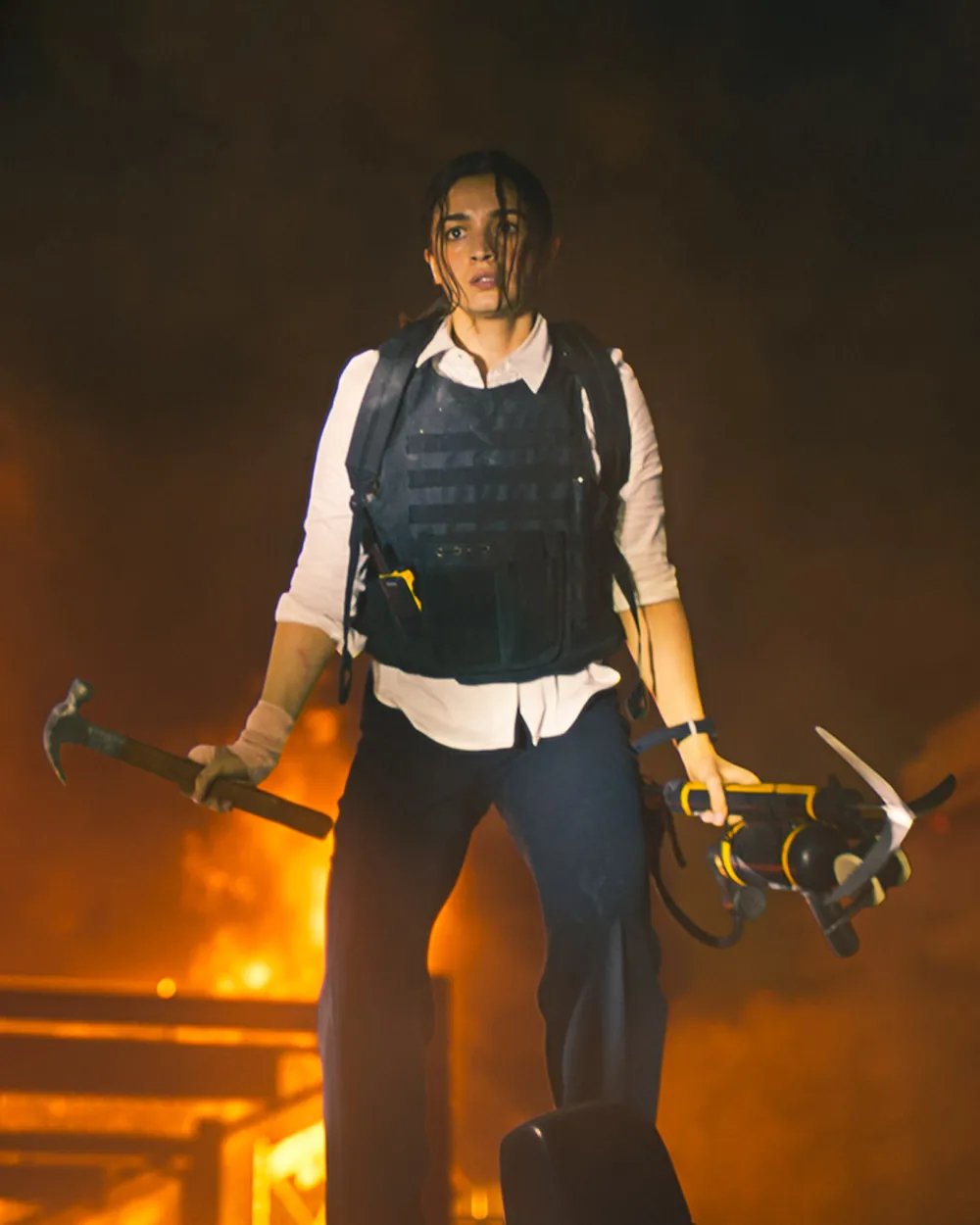
Colorist Sidharth Meer, whose credits include India’s 2025 Oscar entry Homebound, relies on AI-powered tools such as DaVinci Resolve and Baselight to reduce tasks that once took hours to a fraction of that time. On the 2024 action film Jigra, his team used face-tracking tools to isolate and subtly enhance Alia Bhatt’s eyes — work that would previously have required painstaking frame-by-frame rotoscoping. “Without tools like this,” Meer says, “you would have to manually track those elements frame by frame, which is extremely time-consuming.”

Colorist Sidharth Meer used face-tracking tools to isolate and enhance Alia Bhatt’s eyes in 2024 action film Jigra.
Courtesy
Cinematographer Siddharth Diwan — known for his striking visuals in Bulbbul (2020) and Qala (2022) — has found AI particularly useful when trying to communicate ideas that resist verbal description. Working on an ambitious mythological epic, he wanted moonlight to appear golden for biological reasons relating to how the eye perceives light. “When I explained it verbally, people weren’t sure how it would look,” he says. “So I generated images using AI to demonstrate the concept, and that worked.”
Meanwhile, in the Malayalam film industry, the 2025 feature Rekhachithram went further still — deploying a de-aged AI composite of 74-year-old superstar actor Mammootty, created by feeding more than a thousand photographs of the actor from his younger years into an AI system. The team also used AI to alter the lip movements of the late John Paul, the celebrated Malayalam screenwriter who died in 2022 and who appears in the film via archival footage in scenes recreating the production of Bharathan’s 1985 classic Kathodu Kathoram, for which Paul wrote the screenplay. Using AI, the filmmakers adjusted Paul’s lip movements in the found footage to make him appear to deliver new lines of dialogue.
Audiences didn’t flinch. Rekhachithram became the first superhit of 2025 in the Malayalam industry, grossing more than ₹57 crore ($6.7 million) worldwide against a modest budget. The AI elements provoked no discernible backlash; if anything, the novelty of “AI Mammootty” fueled audience curiosity and media coverage that amplified the film’s commercial run.
Nobody has pushed the technology further, or more cheaply, than director Rahi Anil Barve, the cult filmmaker behind Tumbbad, a visually ravishing 2018 folk-horror hit. His 80-minute AI feature Mann Pisahach was completed for under ₹33,000 — roughly $360. Barve shot two actors on his iPhone, then used AI to generate their costumes, production design and the entire world around them. To work around AI’s well-documented limitations with facial expression and dialogue, he designed the film without spoken words, relying instead on a narrator’s voice.
“Instead of trying to force AI to generate everything from scratch — which often looks unreal — I tried to recreate what I had already shot,” Barve explained. “If the machine can replicate something that already exists, the result becomes more believable.” The experience convinced him that filmmakers who want to use AI seriously will need to develop “an entirely new storytelling language.”
That kind of creative rethinking is exactly what drives writer-director Shakun Batra (Kapoor & Sons, Gehraiyaan), one of the earliest mainstream Indian filmmakers to experiment with AI tools. Through his company Jouska AI, Batra’s team is using generative systems including Midjourney, Google Veo and ElevenLabs — not just for mood boards, but for full advertising productions and early-stage feature development.
“Ideally, the future is hybrid,” Batra said. “You might still shoot actors and performances in traditional ways, but use AI for world-building, environments, or sequences that previously required enormous budgets. But speed alone does not guarantee meaning. Just because something can be generated quickly does not mean it has emotional depth. The real work still lies in intention.”
The commercial logic is hard to argue with. Vijay Subramaniam, founder and CEO of Collective Artists Network, believes AI could fundamentally alter the cost equation of Indian cinema. “Can you realistically make a $200 million film in India today? Probably not, because the screen capacity cannot support that level of budget,” he said. “But if technology allows you to tell the same scale of story for $50 million instead of $200 million, everything changes.” His company’s tech arm, Galleri5, has a team of more than 50 engineers developing what Subramaniam calls “India’s largest AI slate” — micro-dramas, digital avatars of celebrity talent, theatrical films and web series.
Hollywood’s top creatives, for the most part, are watching from a distance. James Cameron has called AI-generated actors “horrifying.” Steven Spielberg has said he’s against any use of AI that replaces creative individuals. Guillermo del Toro has perhaps gone farthest, telling NPR he would “rather die” than use generative AI in his work. Batra understands those concerns — but argues that they come from a position of extraordinary privilege. “They are speaking from the top of a very established industry,” he said. “An 18-year-old in the state of Madhya Pradesh who wants to be a filmmaker is in a very different position. That person might not have access to studios, actors or budgets. They are not going to wait ten years for permission to make their first film.” Filmmaking, he suggests, may eventually resemble music production — where what once required orchestras and large studios can now be done in a bedroom.
Not everyone finds comfort in the democratization narrative, though. Skeptics point out that this argument, almost beat for beat, repeats the false promise that has accompanied every stage of the internet’s development — transformative potential for individual creators, followed by a ruthless consolidation that proves arguably worse than the old system and its gatekeepers: a handful of all-powerful platform winners presiding over legions of low-cost content producers, with nearly everything in the middle that once sustained a humane creative economy hollowed out. The most ambitious AI bets in Indian entertainment are being placed not by bedroom auteurs but by India’s conglomerates and industry giants like Reliance, Prime Focus and well-capitalized production houses — companies with the resources to build proprietary pipelines and acquire the smaller numbers of talent needed to run them.
But as the debate over AI’s creative merits continues, some corners of the Indian entertainment sector may already be past the point of negotiation.
India’s dubbing industry — a vast ecosystem of roughly 20,000 freelance voice artists servicing a film market that spans more than ten major languages and dozens of regional star systems — is confronting an existential threat. The corporate logic is merciless: if AI-generated dubbing is truly indistinguishable from the human original, and can deliver a Hindi blockbuster in Telugu, Tamil, Kannada, Malayalam, and half a dozen other languages simultaneously, at a fraction of the traditional cost, the business case for employing large pools of human voice talent is over.
This scenario is no longer hypothetical. Veteran voice artist Ghazal Khanna, who has dubbed titles for Netflix in India, such as the hit Korean mystery series The Frog, estimates that around 70 to 80 percent of brand voices for major Indian TV and video commercials have already been replaced by AI. A similar progression is underway in narrative film and TV dubbing. Yash Raj Films’ action sequel War 2, released in late 2025, became a landmark demonstration of AI use in the sector: filmed in Hindi, the movie was released across multiple languages using NeuralGarage’s “VisualDub” tool, which subtly adjusts actors’ lips and facial expressions so that Hrithik Roshan’s Hindi dialogue appears to be spoken naturally in Telugu. Even co-star Jr. NTR — himself a Telugu-language star who delivered his lines in Hindi on set — had his own voice and perfectly synced face restored in the Telugu version. The Amarinder Singh Sodhi, general secretary of India’s Association of Voice Artists, has sounded the alarm. “If AI takes over, we are finished,” he has said.
The biggest players are moving fast. Reliance’s streaming platform JioHotstar, the country’s biggest local video service and a joint-venture partner with Disney, has announced it will integrate its AI-powered “Voice Print” technology at platform scale, using voice cloning and lip-sync tools to localize its library of films, series, and sports commentary across languages at high speed and low cost. Director M.G. Srinivas was so impressed by AI voice cloning — which he used to dub actor Shiva Rajkumar’s voice from Kannada into three other languages for the film Ghost, with results he says audiences couldn’t distinguish from the original — that he co-founded his own AI dubbing company, AI Samhitha.
The implications reach well beyond the livelihoods of those who work in recording booths. India’s film industry has always been defined by its linguistic geography — separate star systems, separate audiences, separate power bases, each sustained by the natural barrier of language. Pan-India releases were already a growing trend before AI; now, with the technology capable of producing day-and-date multilingual releases that are virtually seamless, that trend could become the default. What this means for regional industries, regional fandoms, and the actors whose stardom was forged within a single linguistic market remains deeply uncertain — but the disruption is likely to be profound. And it carries global implications: if AI dubbing can unify India’s fragmented linguistic marketplace, the technology will likely do the same for international entertainment, accelerating a future already coming into focus on Netflix, where language is no longer a barrier to seamless content consumption anywhere. No more subtitles or overdubs, just digitally altered face movements with synthetic speech in the international actor’s own voice — and content from everywhere effectively competing on the same linguistic plane.
India’s legal framework is struggling to keep pace. The Screenwriters Association of India has flagged the use of copyrighted material to train AI models without consent or compensation. A lawsuit currently before the Delhi High Court sees news agency ANI suing OpenAI for alleged copyright infringement — with the music industry filing an intervention, arguing that its work may have been used to train these systems too. Khimani warns that clarity may only come after expensive litigation. “The learning curve in India may come after someone realizes: ‘Oops! This required a license.’”
Amid the ferment, a growing number of voices argue that the only viable path forward is coexistence.
Producer Danish Devgn, who launched the technology-forward production studio Lens Vault Studios’ with Bollywood star Ajay Devgn, says his team is using generative AI primarily during early development — for concept art, environments, character design and battle sequences — while remaining mindful of the originality debate.
“At LVS, we approach AI as a tool within a responsible creative framework. The ideas, narratives, characters and direction always originate from our writers, filmmakers and designers,” Devgn says. “AI assists the creative process; it doesn’t replicate someone else’s work. But as the technology evolves, the industry will need clearer standards around training data, attribution and licensing.”
Lens Vault Studios’ Bal Tanhaji is a prequel to the 2020 hit Tanhaji: The Unsung Warrior.
Courtesy
The studio is currently developing several projects across formats, including episodic series, digital-first short-form universes and feature-length narratives — including Bal Tanhaji, a prequel to 2020 hit theatrical epic Tanhaji: The Unsung Warrior, starring Ajay Devgn — all made by its in-house generative AI division Prismix Studios.
“The key thing is AI is amplifying filmmakers, not replacing them,” Devgn adds. “AI simply gives us a much bigger creative playground at the earliest stages of filmmaking.”
But the responsible-use framework has its skeptics — and some of them are among India’s most respected filmmakers.
Acclaimed director Anurag Kashyap (Gangs of Wasseypur, Dev.D) has been at the forefront of experimentation in Indian cinema for over two decades, but he’s one of many high-profile local industry figures who have expressed strong reservations about the use of AI.
“My issue with AI is that it comes at a cost. It takes away, for me, a lot of things creatively,” he says. “It has an environmental cost and a human cost — and that always stays in my mind, and I cannot ignore it … To make a film, you don’t need all these things. All you need is a camera — and that’s way more inspiring for me.”
After the Raanjhanaa incident, Rai wrote to the Producers Guild of India and the Indian Film and Television Directors’ Association urging that directors’ contracts include a clause requiring filmmakers’ consent before any future changes to their work. Despite finding themselves on opposite sides of that particular battle, both Rai and Dwivedi agree on one thing. “Ultimately, we believe the future of cinema will be shaped by those who use AI responsibly — with transparency, respect for creators, and a deep commitment to preserving the cultural integrity of storytelling,” Dwivedi says.
Rai, who used AI himself for pre-visualization on his most recent film, puts it plainly: “If it is used in the right direction, it can be beneficial — otherwise it’s destructive. It all depends on how good we are as students. My fraternity [of filmmakers] is a good learner, so we will be able to explore more across genres and expand the possibilities of storytelling with AI.”
As of now, India is becoming something nearly unprecedented in the history of the moving image: a vast, live experiment in what happens when one of the world’s most prolific film industries deploys the most disruptive technology since the advent of television, or the transition from celluloid to digital — with no unions to slow the collision and scant regulation to help with the aftermath. The results, for better and worse, might offer the rest of the global entertainment industry a preview of its own future: what is gained and what is lost when an art form built on human creativity and collaborative craft is supplanted by the output of machines.
This story appears in The Hollywood Reporter’s AI Issue. Click here to read more.