









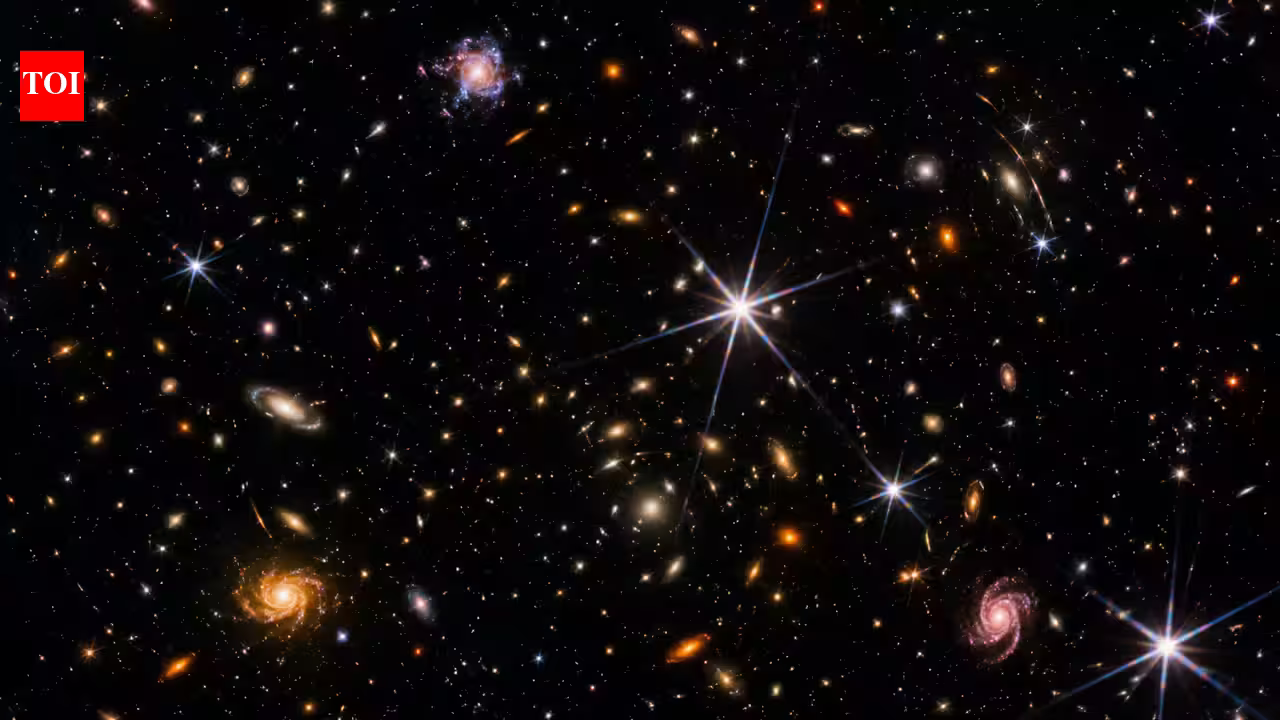
For billions of years, the cosmos has zealously guarded its profoundest secrets, unveiling them only through the faint, ancient light that permeates its vast expanse. Now, a groundbreaking discovery by the James Webb Space Telescope (JWST) may have unveiled one of these cosmic enigmas: an object originating from the universe’s infancy that defies conventional astrophysical classification. This mysterious entity presents itself as a gigantic red star, yet its luminosity dwarfs that of ordinary stars, hinting at a power source far more potent. Researchers posit that this could, in fact, be a black hole cunningly veiled by an expansive shroud of hydrogen.
Dubbed MoM-BH-1, this object could represent an entirely new class of cosmic source, a "black hole star." Scientists hypothesize that a black hole, roughly 100,000 times the mass of our Sun, is embedded within a colossal envelope of dense hydrogen. This unique configuration would render the object roughly the size of our solar system and astonishingly, 100 billion times brighter than an average star. At the heart of this extraordinary discovery is Rohan Naidu, a Hyderabad-born astronomer and the lead author of the pivotal study published in Nature*. His own trajectory to this remarkable finding is nearly as singular as the object itself: at 18, he departed from engineering school, subsequently discovering his passion for astronomy in Singapore, eventually leading him to Massachusetts Institute of Technology (MIT) where he now meticulously investigates some of the universe’s earliest galaxies and black holes.
MoM-BH*-1 was initially identified through the Mirage or Miracle (MoM) survey, an ambitious initiative designed to detect some of the most ancient and distant galaxies in the universe. During their meticulous examination of JWST observations, researchers encountered a celestial source that exhibited exceptional brightness and an unusual red hue. While initially it might have been mistaken for a distant galaxy, its light presented several peculiar characteristics that set it apart. Its extraordinary luminosity proved challenging to reconcile with a typical population of stars. Furthermore, its striking color and spectral analysis revealed features indicative of an extremely dense environment. The estimated size of this object, roughly equivalent to our solar system, coupled with its immense brightness—approximately 100 billion times that of an ordinary star—compelled researchers to consider explanations beyond conventional stellar processes. This intensive investigation ultimately led them to a remarkable and compelling possibility: a black hole ensconced within a massive envelope of gas.
The term "black hole star" describes a theoretical configuration rather than a conventional stellar body. Researchers believe MoM-BH-1 could house a central black hole, approximately 100,000 times the Sun’s mass. This central behemoth would be enveloped by an immense and dense cloud of hydrogen, extending to a scale roughly comparable to our entire solar system. In this proposed model, the black hole serves as the energetic engine, while the hydrogen envelope dictates how this energy manifests to distant observers. As matter spirals into an actively feeding black hole, its gravitational energy is efficiently converted into prodigious amounts of radiation. This resulting energy release can far surpass the power generated by ordinary stars through nuclear fusion. In the case of MoM-BH-1, scientists hypothesize that the dense hydrogen so completely surrounds the black hole that the entire structure adopts a star-like appearance. Consequently, researchers have characterized this object as a potential black hole star, a powerful black-hole-powered source cleverly obscured by a colossal, stellar-like layer of gas.
The sheer luminosity of MoM-BH-1 provides one of the most compelling clues for scientists, strongly suggesting the presence of an unconventional phenomenon. Normal stars, including our Sun, derive their energy from nuclear fusion. However, researchers estimate that MoM-BH-1 is approximately 100 billion times brighter than an ordinary star, a level of brightness that is exceedingly difficult to account for through conventional stellar fusion processes. A rapidly accreting black hole, on the other hand, offers a robust alternative explanation. As matter is relentlessly drawn into the black hole, it becomes intensely heated, releasing enormous quantities of energy. In this scenario, the black hole functions as the engine, while the surrounding hydrogen effectively conceals this powerful engine from direct observation. The outcome could be an object that superficially resembles a colossal star but is, in reality, powered by the insatiable appetite of a black hole.
Further critical evidence emerged when researchers meticulously analyzed the object’s spectrum. MoM-BH-1 exhibited an unusually deep Balmer break, a distinctive spectral feature associated with hydrogen absorbing specific wavelengths of light. According to the researchers, this break was exceptionally pronounced, making it challenging to interpret the object as a mere collection of ordinary stars. Its chemical composition also presented an anomaly. The observations revealed minimal clear evidence of heavier elements, with hydrogen and helium dominating the discernible signatures. This finding is particularly significant because the object originates from the early universe, a period before repeated generations of stars had enriched the cosmic gas with substantial quantities of heavier elements. The confluence of extreme brightness, unusual redness, a deep Balmer break, and a scarcity of heavier elements collectively differentiated MoM-BH-1 from typical stars or galaxies.
To ascertain whether a dense hydrogen envelope could accurately reproduce the observations made by the JWST, researchers subsequently employed sophisticated simulations. While one possibility considered was that dust accounted for the object’s reddish appearance, the team rigorously investigated whether hydrogen alone could produce this effect. The simulations indicated that extremely dense hydrogen could indeed behave almost like the surface of an enormous star. Rather than functioning as a tenuous cloud of interstellar gas, it could become so incredibly dense that it forms an opaque outer layer. When researchers incorporated an accreting black hole into this model, the resulting object remarkably closely matched several of the properties observed by the JWST. This model, therefore, offers a compelling explanation for MoM-BH*-1, though further meticulous observations will be indispensable before scientists can definitively establish whether black hole stars genuinely represent a novel class of astrophysical objects.
The significance of MoM-BH-1 extends beyond merely one unusual source. Since the JWST commenced its observations of the early universe, astronomers have detected numerous compact objects that appear unusually red. These enigmatic objects have come to be known as "little red dots," and their true nature remains one of the telescope’s most actively debated discoveries. A plausible explanation is that at least some of these objects are powered by rapidly growing black holes encircled by dense gas. The black hole star model could provide a crucial framework for understanding why these little red dots are so exceptionally bright and why they exhibit such distinctive colors and spectra. MoM-BH-1 is particularly valuable because its apparent brightness is sufficient to overwhelm the light from its surrounding host galaxy. This characteristic allows researchers to study the black-hole-star-like component in isolation, without the complex challenge of fully separating it from the much fainter glow of an accompanying galaxy. Should similar objects be identified in the future, they could profoundly assist astronomers in unraveling the dynamics within young galaxies during the universe’s formative epochs.
Naidu’s journey to this pivotal discovery is almost as extraordinary as the cosmic object itself. According to his MIT biography, he grew up in Hyderabad and initially pursued studies in engineering. However, at the age of 18, he made a dramatic decision to discontinue his engineering education. What ensued was a profound shift in direction. Naidu embarked on a journey to Singapore, marking his first-ever plane trip, and became part of the founding class of Yale-NUS College. It was there that his burgeoning interest in astronomy truly took root. Subsequently, he engaged in research on blazars in the majestic Chilean Andes alongside Professor Charles Bailyn and further honed his research skills with esteemed astronomers such as Iva Momcheva and Pascal Oesch. Naidu later pursued his PhD at Harvard under the tutelage of Professor Charlie Conroy. His doctoral research meticulously explored the ancient history of the Milky Way, utilizing the H3 Survey to investigate some of the oldest stellar systems and galaxies that had been gravitationally absorbed into our own galaxy over the vast stretches of cosmic history. His work gradually transitioned towards the study of the early universe, specifically focusing on the very first galaxies and the earliest black holes that materialized shortly after the Big Bang. Today, his research broadly delves into fundamental questions such as when the first galaxies emerged, their contribution to the reionization of hydrogen, and how the early universe produced the fundamental elements that ultimately became the building blocks of planets and life.
MoM-BH*-1, while a compelling candidate, is not yet a definitive answer. Scientists acknowledge the necessity of further observations to rigorously validate whether the black hole star interpretation withstands thorough scrutiny. Nevertheless, the implications of this possibility are immense. If these extraordinary objects existed in significant numbers, they could offer explanations for the perplexing little red dots, shed light on the rapid growth of black holes in the nascent universe, and potentially illuminate the origins of the colossal black holes found at the centers of most galaxies today. For Naidu, this discovery represents yet another significant milestone in a career dedicated to unraveling the universe’s most ancient structures. The journey that commenced with an 18-year-old leaving engineering in Hyderabad has now led him almost to the very dawn of cosmic history. And in the faint, ancient light so meticulously captured by the JWST, astronomers may well have uncovered compelling evidence of something that superficially resembles a star, radiates with unimaginable power, but could, in fact, be a black hole cunningly concealed beneath a colossal, impenetrable cloak of hydrogen.