






I was very surprised to see this cormorant perched on a slim branch on a dull day recently in the Phoenix Park. Surprised, that is, because with webbed feet I didn’t think that this seabird would settle on a tree of all places. Is this its normal behaviour or was it a once-off landing? Frank Russell, Ballyvaughan.
This is not a mad Dublin abnormality – cormorants are well able to perch in trees as their feet are not webbed the way ducks’ feet are but have webbing between all four toes and strong claws at the end. Not only can they perch on tree branches, but they build large, shallow nests in tree forks using twigs, branches and debris. They tend to nest on sea cliffs and rocky islands but in some cases use trees in inland areas, typically on lake islands, to nest in colonies. They create so much guano that they eventually kill the trees.

Richard Burke
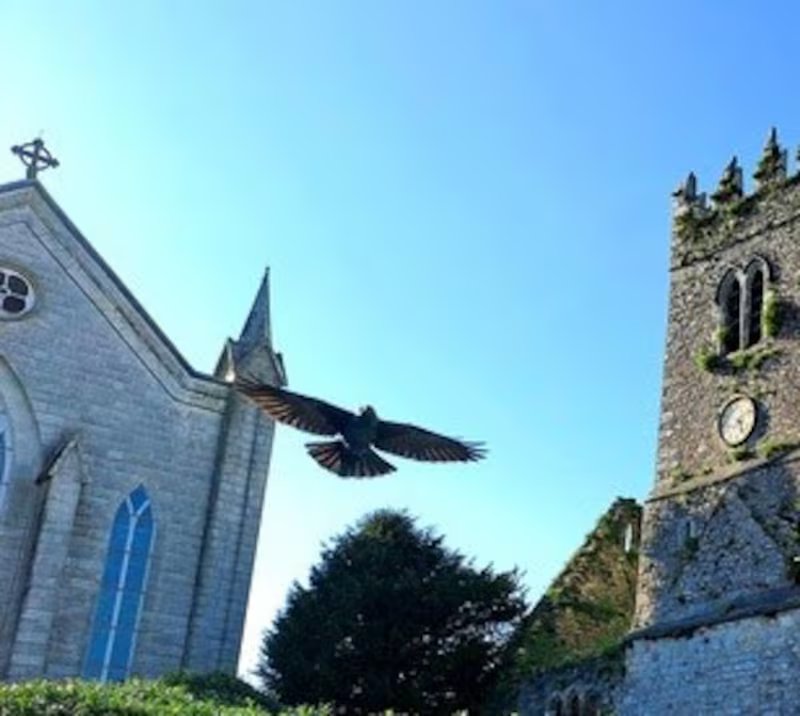
This guy popped up as I took an ecclesiastical snap in Inistioge, Co Kilkenny. Richard Burke
It has most certainly upstaged the surrounding built environment. This is a raven, which is our largest crow species and can sometimes be even larger than a buzzard. The fan-like tail is a very distinctive characteristic in this silhouette shot against the sky.
Ravens also show obvious primary “finger-like” feathers in flight. Usually birds of mountains and moorlands, ravens will also forage over farmland searching for any carrion that might be around.

I took the attached photo of two woodpeckers – a male (on left) and a female – in our garden in early April. When taking it, I hadn’t noticed the spectator until I looked at the photo on a bigger screen later. It’s a greenfinch, (see red arrow), which I had heard are becoming rarer. I feel I have seen them around the garden quite often. Fintan Mc Phillips
Your photo demonstrates very well how important gardens with trees and well-stocked feeders can be for biodiversity. It is great to see a pair of woodpeckers. You are right about greenfinches; their populations have dropped by more than 30 per cent compared with a decade ago and they are now amber-listed.
This decline has been caused by a parasitic disease called trichomoniasis, which can be spread from infected birds at bird feeders. To minimise this possibility, it is important to clean all feeders and water dishes thoroughly on a regular basis (at least every two weeks).

It is amazing how nature moves in when you let it. A mini-ecosystem in a fish box containing dandelion, nettle, daisy, ferns, rushes, moss, cleavers, buttercup, alder sapling and sycamore sapling. Denis Quinn, Killala, Co Mayo.
There is a huge seed bank in the soil and wind-dispersed seeds get established very easily too, especially with high rainfall and lack of grazing. No need for fancy packets of wild seeds – particularly packets which may contain species not even native to Ireland.
Your situation won’t last, however – you can observe how competition and survival of the fittest works out. My money is on the sycamore – which is not even native at all but has become naturalised since its introduction to Derry in 1610.

I saw this butterfly warming itself in the Japanese Gardens in Powerscourt on April 3rd. Mary O’Doherty, Dublin.
This is a comma butterfly – a recent arrival to Ireland. It was confirmed breeding here in 2014 and climate change has meant that it is able to survive and spread. It overwinters as an adult and this one has just emerged and will feed on dandelion nectar. It will mate and lay eggs on nettles.
Please submit your nature query or observation, ideally with a photo and location, using the form below or by email to weekend@irishtimes.com