





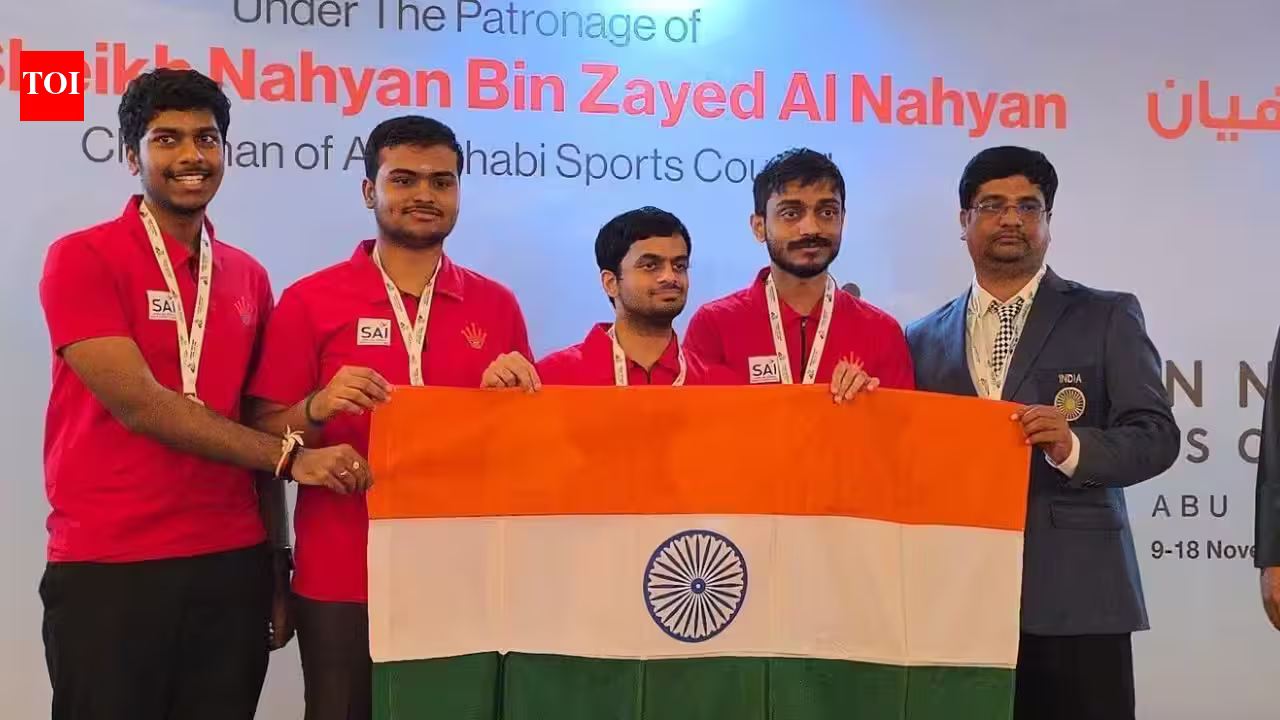
INDIA’S CHESS contingent etched a remarkable chapter in the annals of the 2026 Asian Nations Chess Cup, clinching a prestigious silver medal under conditions that would have tested the resolve of even the most seasoned global squads. Despite operating as a “bare-bones” unit—devoid of reserve players, a dedicated coach, or an official team captain—the Indian quartet displayed grit, technical brilliance, and unrelenting stamina to stand tall on the continental podium.
The men’s squad, comprised of Grandmasters Nihal Sarin, Pranav Venkatesh, Pranesh M, and Aravindh Chithambaram, concluded their campaign with a tally of 15 points from nine grueling rounds. Their performance was as consistent as it was courageous, finishing just a solitary point behind the eventual champions, Russia.
A Masterclass in Grit
Competing at an international level usually demands a deep squad rotation to mitigate the psychological and physical exhaustion inherent in high-stakes chess. However, the Indian men were forced into a relentless rhythm, playing every single round without the benefit of a rest day or a substitute. This structural disadvantage made their consistency all the more impressive.
The only blemish on their record occurred during a demanding double-round day, where the team suffered a loss to the powerhouse Russian side. Fatigue, it seemed, had finally caught up with them. Yet, the response from the Indian camp was immediate and clinical. Rather than allowing the defeat to derail their momentum, they regrouped with surgical precision, culminating in a dominant 4-0 whitewash of Syria in the final round. This emphatic victory not only secured their podium spot but also pushed them ahead of China on tiebreaks to claim the silver. China, who matched India’s 15-point total, was forced to settle for the bronze medal.
Individual Brilliance on the Board
Beyond the team success, the tournament served as a showcase for the individual prowess of the Indian players, three of whom returned home with personal hardware for their board-specific performances.
Aravindh Chithambaram was the standout performer for India, delivering a championship-level effort on the fourth board. With an incredible 8 points out of a possible 9, Chithambaram was awarded the gold medal for his board, proving to be the backbone of the Indian lineup. His ability to consistently convert positions into points was pivotal in keeping India in the hunt for the top prize.
The momentum continued with Pranesh M, who secured a well-deserved silver medal on the third board after accumulating 7.5 points. Rounding out the individual honors, Pranav Venkatesh showed nerves of steel on the second board, battling through tough pairings to earn a bronze medal with 6 points. Nihal Sarin, though missing out on an individual medal, provided the tactical consistency that allowed his teammates to flourish, underscoring the collective synergy of a group that operated without external coaching staff.
Russia’s Dominance and the Women’s Campaign
While India celebrated a triumphant silver, Russia affirmed their status as a global chess superpower by remaining unbeaten throughout the tournament. Finishing with 16 points, the Russian team’s gold medal was a testament to their deep preparation and tactical stability.
In the women’s section, however, the narrative for India was one of frustration and missed opportunities. Entering the final round with hopes of a high finish, the Indian women’s team suffered a narrow 1.5-2.5 defeat at the hands of Kazakhstan. This result caused the team to slip down the standings to seventh place, finishing with seven match points overall.
Much like the men’s division, Russia dominated the women’s category, reeling off six consecutive victories before settling for a draw in their final match against Uzbekistan. Their 13-point total secured a comfortable gold, while China took home the silver with 11 points, and Kazakhstan claimed the bronze with 10.
Despite the team’s difficult finish, there was a bright spot for the Indian women as well. WFM Shubhi Gupta showcased immense potential under pressure, securing an individual bronze medal on the third board, providing a glimmer of optimism for the future of the women’s program.
The Road Ahead
The story of the 2026 Asian Nations Chess Cup will be remembered for the resilience of the Indian men. To finish as the second-best team in Asia—without the support structure usually provided to national squads—is a feat that speaks volumes about the quality of talent currently emerging from the Indian chess circuit.
As the dust settles on this tournament, the focus will undoubtedly shift to how India can build on this success. With a depth of talent that can overcome even the most logistical of hurdles, the Indian team has sent a clear message to their rivals: they are not just competing; they are contending for the top of the podium, regardless of the odds. The resilience shown in this tournament is a clear indicator that the future of Indian chess is in capable, and remarkably strong, hands.
Disclaimer: This content is auto-generated for informational purposes only.
Source: Read Original News