







India-UK trade deal takes effect New framework meant to make Indian exports competitive, make British imports cheaper US senators introduce bill to impose 100% tariffs on India, China and others over Russian oil Millions converge on India’s coastal town Puri for one of the world’s largest religious gatherings Shipping Ministry launches ‘Seafarer-First’ initiative as Indian sailors die in Gulf waters
Here’s a roundup of the biggest headlines from India on Wednesday, July 15:
Tired of missing our real-time updates? Click here to add us as a Preferred Source on Google. Then tap the “Star” or “Preferred” to keep DW News at the top of your feed.
India launches ‘Seafarer-First’ initiative to safeguard sailors amid Iran war
As Indian sailors face the brunt of the conflict in the Middle East, India’s Shipping Ministry has launched a “Seafarer-First” initiative to track and safeguard them.
After a review meeting with stakeholders on Tuesday evening, Indian Shipping Minister Sarbananda Sonowal announced the measures in a post on X.
“I have ordered real-time, vessel-by-vessel monitoring and 24×7 coordination across Gulf waters and a comprehensive operational dashboard to account for every Indian on every vessel, operating in the Persian Gulf, Strait of Hormuz and Gulf of Oman,” he said.
Sonowal said a dedicated liaison officer would act as “single-point-of-contact for every affected Indian seafarer” for coordination and assistance to their families.
“Every Indian seafarer in the affected region will be individually accounted for, irrespective of the vessel’s flag,” he said.
The initiative comes after an Indian sailor was killed when Iran attacked two UAE-linked vessels as they passed through the Strait of Hormuz. Ten other Indian sailors were injured in the attack, two of whom were seriously hurt.
On Wednesday morning, Reuters reported that an Indian sailor who went missing after the GFS Galaxy was attacked off the coast of Oman, had died. The Report cited the sailor’s Father-in-law and did not elaborate on how he knew of the death.
Indian nationals make up around 12% of the global merchant shipping workforce, leaving them especially exposed to the risks of the escalating conflict in the Middle East.
US reveals revised bill with 100% tariffs on India over Russian oil
On Tuesday, US senators unveiled a revised version of the Russia sanctions bill that would impose a 100% tariff on five countries, including India, for their purchase of Russian oil.
This version eases a previous threat of a 500% proposed tariff.
The bill, backed by Republicans, Democrats and the White House, seeks to sanction Russian officials and pressure countries like India and China into reducing their dependence on Russian energy.
If it is passed, the bill would impose tariffs on major purchasers of Russian oil.
The top five Russian energy purchasers are India, China, Slovakia, Hungary and Azerbaijan.
India’s import of Russian oil has long been a point of contention with the US.
In 2025, US President slapped an additional 25% tariff on India for buying Russian crude, causing significant strain on diplomatic ties between New Delhi and Washington.
India has since diversifiedhas since diversified its oil Imports to Venezuela but also maintained that India’s policy on Russian oil is based on “cost and availability.”
In June, Indian’s Foreign Minister Subrahmanyam Jaishankar rejected western nations’ criticism at an event in Helsinki. Jaishankar accused the United States of hypocrisy on Russian oil, saying that “the US specifically asked India to buy Russian oil to help stabilize the world markets.”
“After first imposing tariffs on us last year for buying Russian oil, the US then lifted its sanctions on Russian oil. Let’s not pretend there is some great principle involved here,” he said.
The proposed US bill comes at a time when India and the US have been negotiation the first tranche of a Bilateral Trade Agreement.
Experts and reports have said that one of the reasons for the deal’s delay is that New Delhi wants assurance of no new tariffs from Washington.
What changes under the trade deal?
The deal is expected to boost India’s exports to the United Kingdom, make British imports cheaper and streamline social security contributions for expats in both nations.
Here’s what has come into effect:
British products such as cosmetics, medical devices, Scotch whisky and English gin will be cheaper Lowered duties on Indian clothing, footwear and food products and spices exported to the UK UK universities have approval to open new campuses in India Indians temporarily living in UK will continue social security continue social security contributions in India without contributing to schemes in UK. And vice versa.
India-UK trade deal goes live
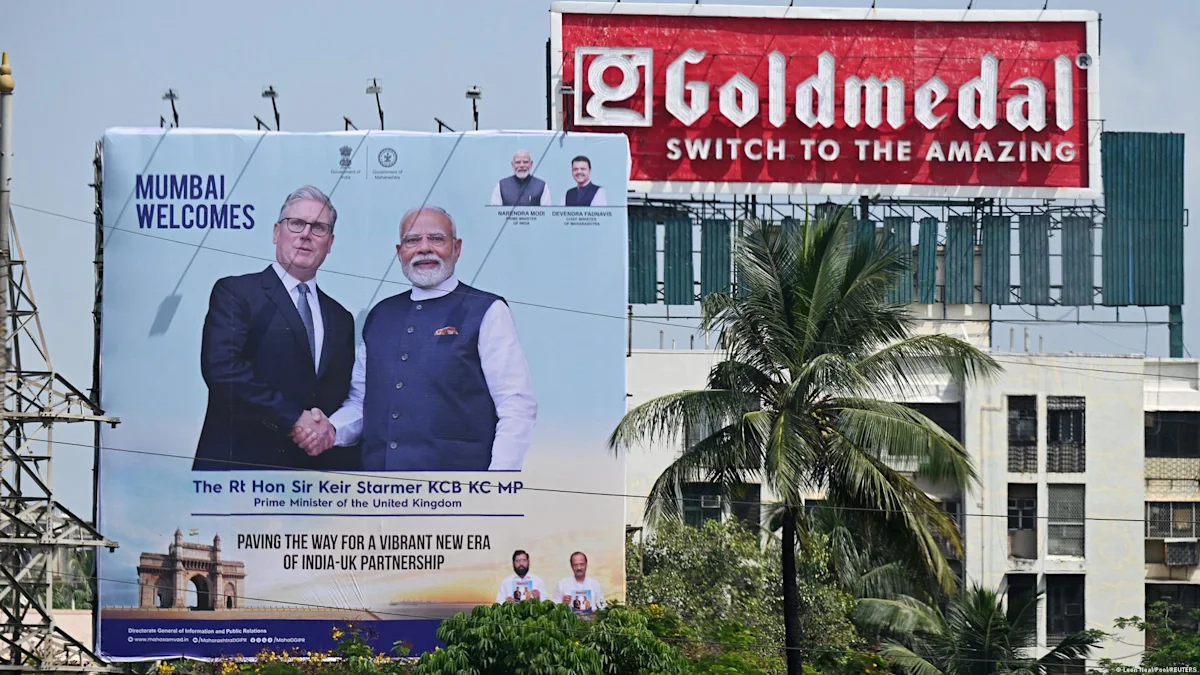
Nearly a year after it was signed, a landmark free trade agreement between India and the United Kingdom took effect on Wednesday.
“The India-UK Comprehensive Economic and Trade Agreement (CETA) and the Agreement on Social Security, have come into force, delivering, covering almost 100% of trade value,” India’s trade minister, Piyush Goyal, wrote on social media.
It reduces 90% of tariffs on UK goods imported by India.
British Prime Minister Keir Starmer had called it “a new era for trade and the economy” while announcing the deal in 2025. Negotiations on the deal began in 2022.
Hours before the deal went live, India’s Commerce Secretary Rajesh Agrawal said the agreement was a “gold standard” and one of the “most ambitious and aspirational free trade agreements” signed by New Delhi, as per The Hindu.
Welcome to our coverage
Hello! and welcome to DW’s India news blog.
This is Mahima Kapoor reporting from the Delhi Bureau and I will be your guide through the noise of everything that’s happening in the world’s most populous country.
At the stroke of midnight, a landmark India-UK trade deal came into effect.
Among other things, the deal is expected to boost Indian exports.
In other news, US senators have unveiled a revised bill which, if passed, will impose 100% tariffs on India and four other countries for its import of Russian oil.
And at home, millions of devotees have reached or are on their way to the coastal town of Puri where the Jagannath Rath Yatra will take place on Thursday. Along with managing crowd safety, authorities are also fighting a COVID threat.
Keep reading for all of this and more.