








Parts of rural northern India are currently exploding in color. Not just from the coming of spring, but seasonal festivals characterized by folk music, dancing, farmers in traditional dress, and dishes like sweet saffron rice.
Among them is Vaisakhi, which is an important festival date on the Sikh calendar. Held in the northern province of Punjab, it marks the successful growth of winter wheat, and crops like mustard, chickpeas, lentils, barley and sunflower seeds.
“When the crop is fully ready for harvest, all the farmers come together to celebrate,” Ashwani Ghudda, a local social worker told DW. “They offer prayers, visit fairs, and then prepare to begin the harvesting.”
Punjab, which currently produces 10% of India’s wheat and 15% of its rice, is a historically agrarian state, so farming has long been a way of life. “A lot of folklore and festivities have emerged from that,” said Harindar Grewal, environment adviser with the central India-based nonprofit Citizens for Change Foundation.

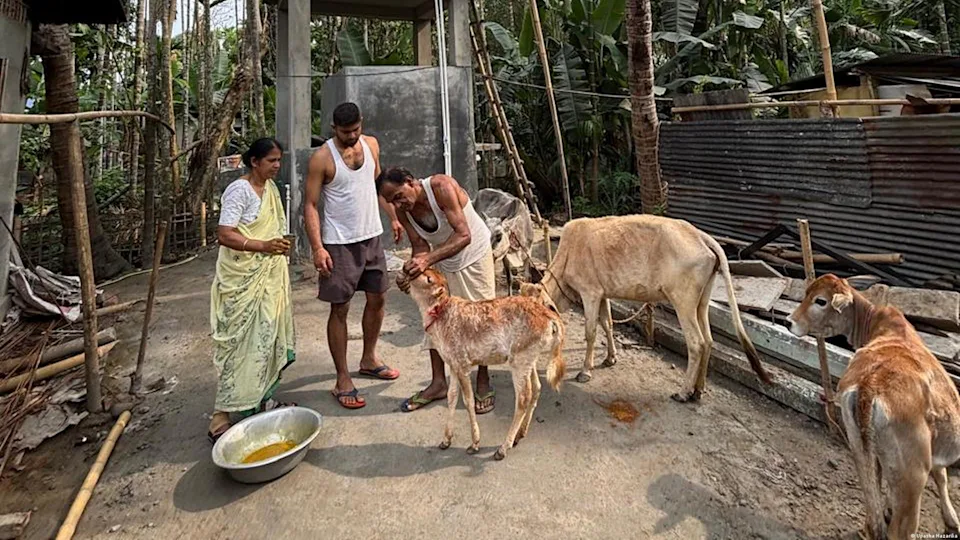
Cattle are washed and fed special dishes as part of spring festivities in AssamUpasha Hazarika
It’s a similar picture in the eastern region of Assam, where the Bohag Bihu festival marks the transition from the dry season to the onset of the agricultural cycle with singing, dancing and rituals that focus on the care of cattle. Chandana Sarma, associate professor in anthropology at the state’s Cotton University says the celebration is rooted ancient fertility rites and serves “as a ritual calendar marker of ecological renewal where agriculture, sexuality and social reproduction are integrated.”
She says this reflects the deep interdependence between humans, nature and subsistence systems in local communities.
Climate pressure behind the celebrations
This year, the festivals are taking place against a backdrop of climate-related challenges that have damaged crops in both regions of the country.
In Assam, about 20,000 acres of crops have been lost to floods and hailstorms over the past year which the regional government has linked to hydrometeorological disasters. And this month, unseasonal rain and hailstorms have damaged wheat crops across more than 135,000 acres in seven districts of Punjab.
Grewel says farmers can no longer rely on precipitation to arrive in December and January when it would help wheat to grow. If it comes when the grain is forming or maturing, “it brings a lot of misery,” he said.

Flooding in parts of India has been connected to rising global temperatures that lead to more intense bouts of rainfallBiju Boro/AFP
But the state’s farming system is under not only pressure from climate stress. There are also long-standing structural problems.
The widespread practice of rotating between wheat and rice crops has led to groundwater depletion, which Grewel says has been exacerbated by the state providing free electricity that encourages farmers to pump excessively to feed thirsty plants. “Punjab was never a natural area for raising paddy, unlike northeast India where you have plenty of rainfall.”
Assam, which is one of the wettest states in India, is facing its own climate challenges. Average temperatures have risen in recent years and the state is vulnerable increasing episodes of intense and erratic rainfall.
Since 2020, 1.32 million acres — nearly seven times the size of New York city — of crops have been damaged by floods, storms or hailstorms. Some farmers are changing crop varieties and improving irrigation in order to meet the challenges of a warming world, but a recent study found many are struggling to adapt. Researchers say limited access to credit as well as land shortages and inadequate government support are holding back more widespread diversification.
What support do farmers need?
Authorities in Punjab have deployed a large team to assess recent crop damage, and Assam officials say they and the central government have released support to the tune of $439 million (€405 million) to support farmers affected by climate‑related disasters.
Still, Grewal says stronger institutional support could support farmers, and thereby food security. One way would be to provide shelter for farmers who take their crops to local agricultural markets in search of buyers, rather than them having to wait outside with a trailer full of produce.
“At the onset of rain, it destroys their crops,” he said. “If they have sheds and other things, that can be mitigated.”
For the longer term, Grewal suggest rethinking farming practices, including reducing dependence on rice grown in paddy fields.
“They can diversify into agro‑farm forestry and horticulture, including greenhouse farming used in many countries to raise productivity,” he said, stressing that changes must protect the long‑term sustainability of agricultural land.
“Punjabi farmers are enterprising, and it was this human effort that drove the Green Revolution. What is needed now is strong intent,” he said.
Even as conditions change, festivals continue to frame agricultural life.
“Today, Bohag Bihu functions less as a direct agricultural ritual and more as a cultural framework,” said Chandana Sarma of Cotton University.
“The festival mediates between past agrarian lifeworlds and present mixed economies, sustaining cultural meaning even as material farming practices evolve.”
Edited by: Tamsin Walker