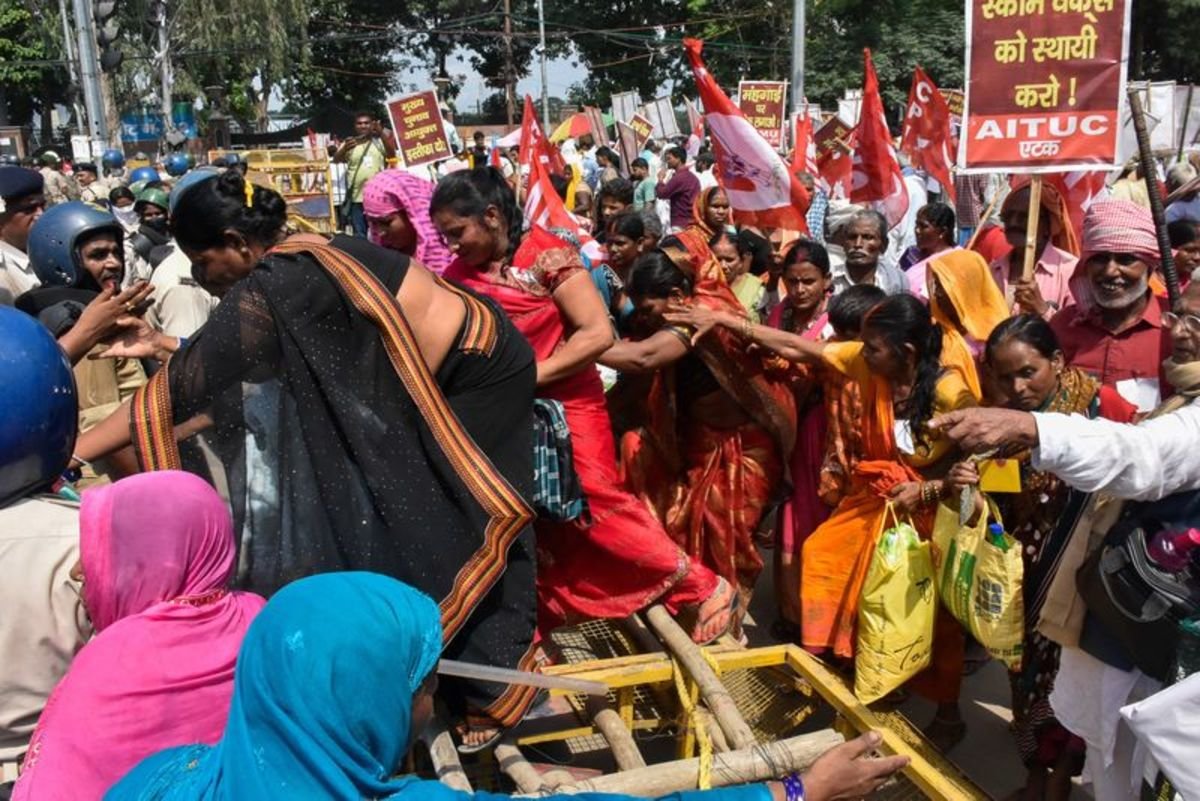







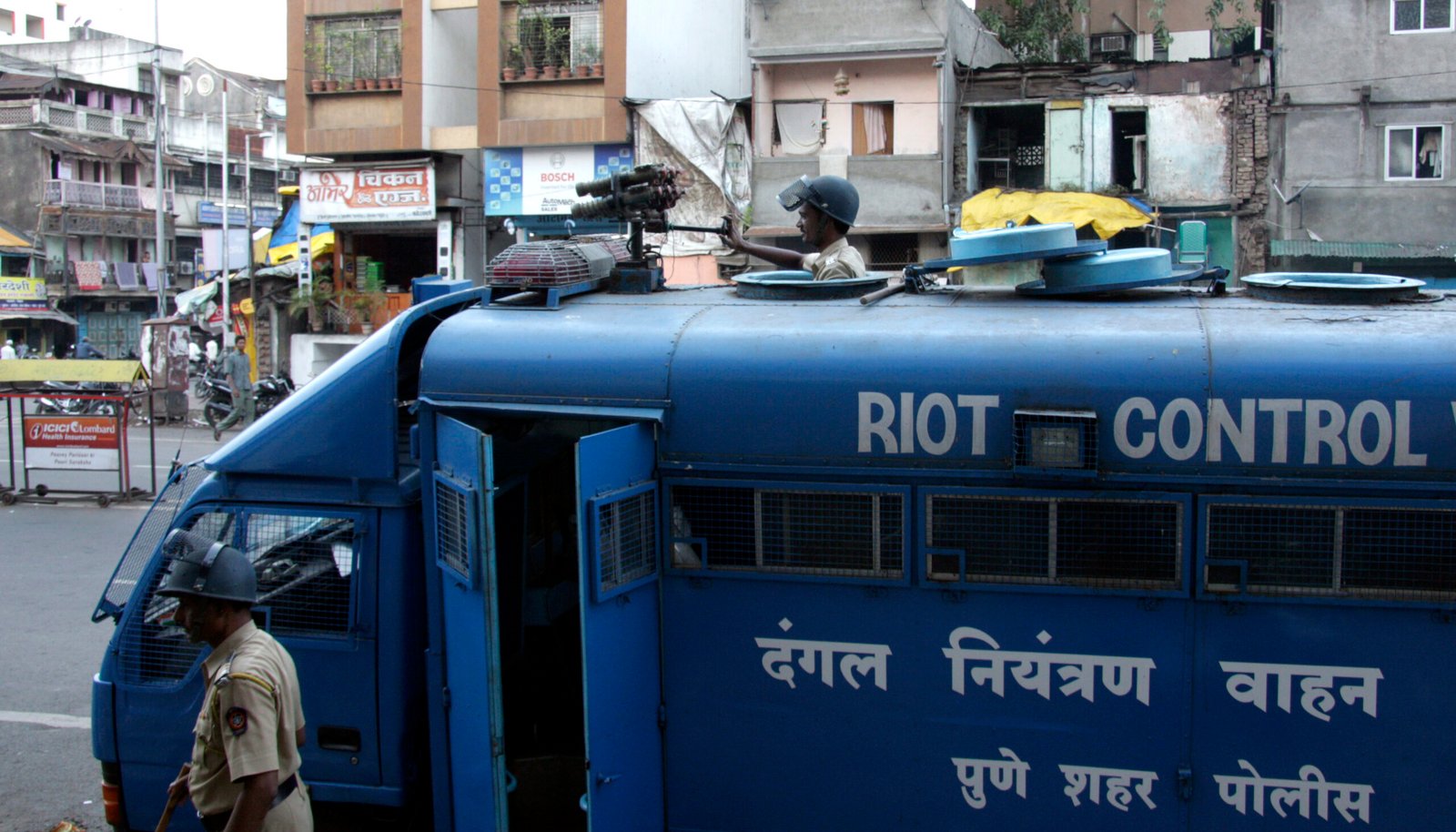
Delhi Police confirmed the men swinging lathis at student protesters were its own officers, but confirmation after the fact cannot supply what the statute requires at the moment force is used.
Men in plain clothes swung lathis — the long wooden batons Indian police carry for crowd control — at student protesters on New Delhi’s Parliament Street on July 20, striking them alongside uniformed officers while wearing nothing that marked them as police. Indian law conditions a police officer’s immunity from a citizen’s right of private defense on precisely that: being recognizable as an officer at the moment force is used. The students were marching over the National Testing Agency paper-leak scandal, demanding the education minister’s resignation.
Delhi Police did not deny that the men were its officers. A senior officer told reporters they were “special staff,” drawn from “teams which are not part of active policing duties,” deployed as reinforcements — and that this was “neither illegal nor unprecedented.” A member of Parliament went further, publicly demanding that the force identify one such man, named in press reports as Honey Dagar, and account for the authority under which he struck a student.
That admission settles a fact. It does not settle the law. The force’s after-the-fact confirmation that these men were genuine officers cannot retroactively supply what was missing at the moment force was used: a means by which the person being struck could know who was striking him. On that narrower, more exacting question, the statute book already has an answer — one the police’s public defense skips past.
What Section 37 Actually Requires
Section 37 of the Bharatiya Nyaya Sanhita, 2023, is usually invoked as though it grants blanket immunity to anyone in the business of law and order. It does not. It withdraws the right of private defense only against an act that does not reasonably cause apprehension of death or grievous hurt and is done by a public servant acting in good faith under color of office. Read in isolation, that clause does most of the work the police want it to do.
But Section 37 does not stand in isolation. Explanation 1 states plainly that a person is not deprived of the right of private defense against a public servant’s act unless he “knows or has reason to believe” that the person acting is in fact a public servant. Explanation 2 addresses a parallel case: where a person acts on a public servant’s direction, the right survives unless the citizen knows or has reason to believe the person is acting on such direction, or unless that person states the authority under which he acts or, having written authority, produces it on demand. Since Delhi Police says the men were its own officers, Explanation 1 is the operative test — but both Explanations share a premise. The citizen must be able to tell.
This is not a technicality tacked onto the provision. It is the provision’s central limiting principle, carried forward without dilution from Section 99 of the Indian Penal Code, 1860. Parliament did not exempt “the police” as an abstraction from private defense; it exempted the recognizable public servant, on the theory that a citizen confronted by a visible officer of the state has recourse to law rather than to force. Strip away the visibility, and the theory — and with it the exemption — collapses.
A bare verbal claim of authority, made by a man in a T-shirt with no badge, no ID card and no uniform, does not on its own generate the “reason to believe” that Explanation 1 demands. If it did, the safeguard would be self-defeating: any assailant could assert police status in the moment and have that assertion vindicated later by a press briefing, long after the beating is over. The statute asks what a reasonable person could know when the baton fell — not what the department chooses to disclose once the videos have gone viral.
The Constitutional Backing
This reading is not a novel argument built to fit an inconvenient set of facts. It tracks a constitutional instinct the Supreme Court has already articulated. In D.K. Basu v. State of West Bengal (1997), the court held that police personnel carrying out arrests and interrogations must wear clear, visible identification bearing their name and designation — precisely because a citizen cannot be expected to submit to force from a person indistinguishable from a private aggressor, and because unidentifiable state violence forecloses every downstream safeguard, from the arrest memo to the right to inform a relative, that the law otherwise guarantees. Parliament later gave that requirement statutory form, obliging the officer making an arrest to bear accurate, visible and clear identification.
D.K. Basu concerned custodial procedure rather than crowd control, so it cannot be transplanted wholesale onto a lathi charge on Parliament Street. But the logic transfers cleanly, and arguably applies with greater force here: if identification is indispensable when a person is in custody and has nowhere to go, it is at least as indispensable on an open street, where the only thing standing between lawful policing and vigilante violence is the badge the citizen is being asked to trust exists.
A Second Problem: Good Faith
There is a second problem the police’s defense does not confront. Section 37 protects only conduct undertaken in good faith — a term the Sanhita defines to exclude anything done without due care and attention. Deploying personnel with sticks into a crowd of students, in plain clothes, with no visible means of identification, is difficult to reconcile with good faith so defined. It is a deployment structured, whether by design or negligence, to make accountability impossible after the fact.
The department cannot invoke “color of office” to claim immunity from private defense while declining to make that office visible at the point where the citizen would need to recognize it. Nor does confirmation after the event cure the defect. Section 37 caps the right of private defense at proportionality, and withdraws it where there was time to seek the protection of the public authorities — but neither limit is triggered by an authority disclosed only after the fact. Nothing in the provision makes the right retrospectively defeasible by a badge produced at a press conference.
Where the Line Actually Falls
None of this is an argument for treating every plainclothes officer as fair game, or for romanticizing resistance to lawful policing. Where an officer identifies himself, produces a card or is otherwise recognizable as such, Section 37 operates exactly as Parliament intended, and the citizen’s remedy lies in a complaint, not a counter-assault. But where force is used by someone offering no uniform, no badge and no authority produced on demand, the statute itself withholds the shield the police are claiming — not out of sympathy for the protesters, but because the legislature deliberately conditioned that shield on visibility.
This is the accountability gap the Supreme Court sought to close in Prakash Singh v. Union of India (2006), which directed the creation of independent Police Complaints Authorities to investigate grievances of this character. Two decades on, most states have implemented that directive only cosmetically — a large part of why a name like Honey Dagar can reach the headlines before anyone can establish who he was or under what authority he acted.
What Follows
If law-and-order operations are to rely increasingly on plainclothes reinforcements, the legal minimum that follows is not complicated: visible identification at the point of contact, not a clarification issued to reporters once the outrage has already trended. Anything less does not merely invite public criticism. It forfeits, by the terms of the very statute the police are relying on, the immunity they are claiming.
Sahil Najar is a final-year B.A. LL.B. student at the School of Legal Studies, Central University of Kashmir.
Opinions expressed in JURIST Commentary are the sole responsibility of the author and do not necessarily reflect the views of JURIST’s editors, staff, donors or the University of Pittsburgh.