






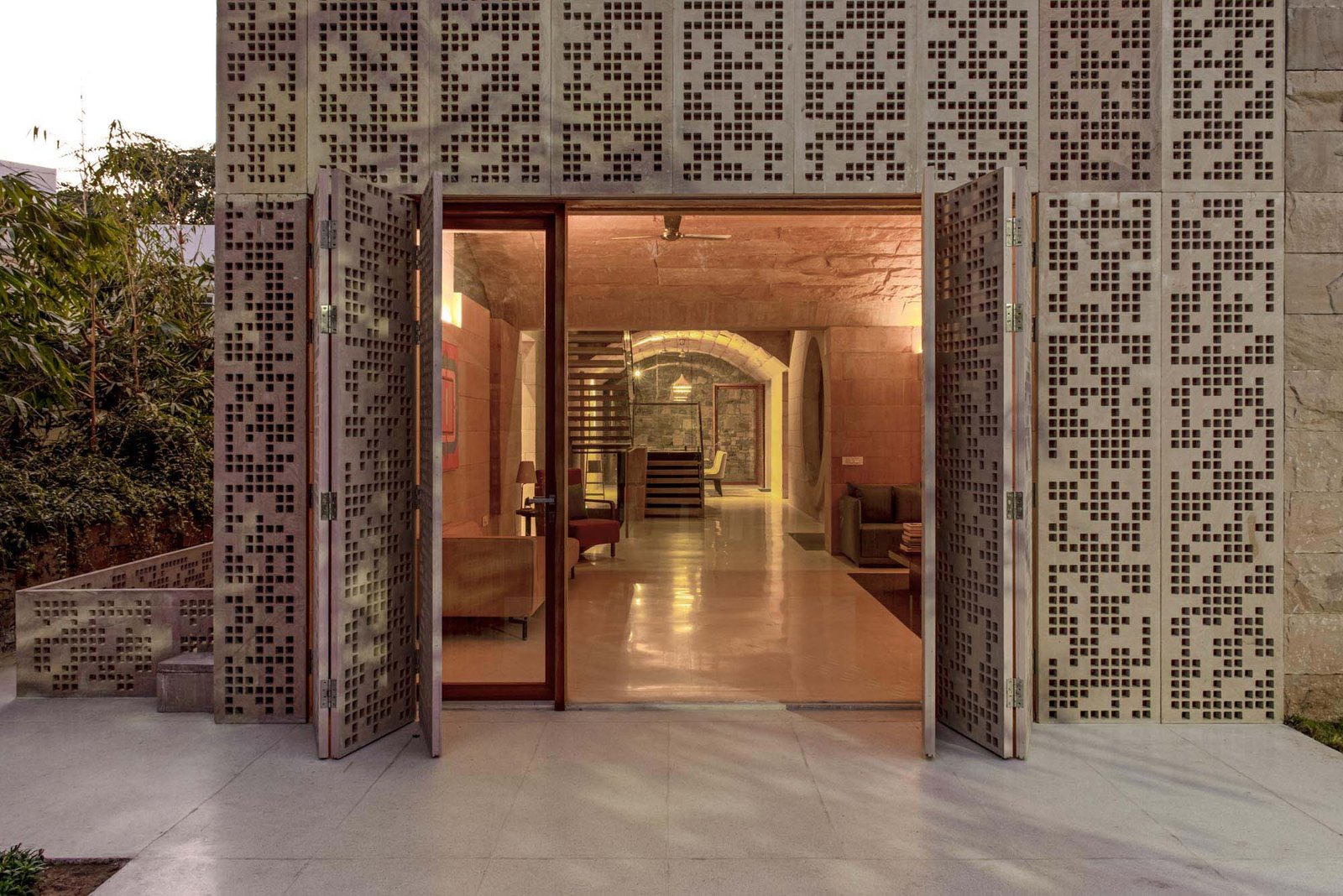
“We’ve used basalt, which has very high heat resistance and compressive strength,” says Taha. “It meant we could use a lot less of the material than if we had used limestone, saving the client money and lowering transport emissions.”
The building is an evolution of his Clerkenwell Close building, a seven-story, mixed-used landmark with a limestone superstructure that once housed his home and office. Clerkenwell Close has a rougher, more expressive face to Finchley Road’s smooth facade. When Groupwork couldn’t find quarries that could cut stone to the requisite size in the UK, he looked across the channel to those spanning the same limestone seam in France, a country that has maintained some of its stonemasonry tradition. This is thanks, in part, to a boom in building with structural stone in the post-war period due to a shortage of steel and concrete.
“On our quarry tour we discovered that the giant slabs coming out of the ground weren’t the homogenous tones and textures you see on the small samples that arrive in your office,” he says. “They have fossils and bands of green and orange in them.” Taha was drawn to the pieces with a rich patina. “We wanted to reveal the spirit of the material in the building’s superstructure,” Taha adds. Modern technology meant that the columns and beams could be cut in a way that minimizes waste.