










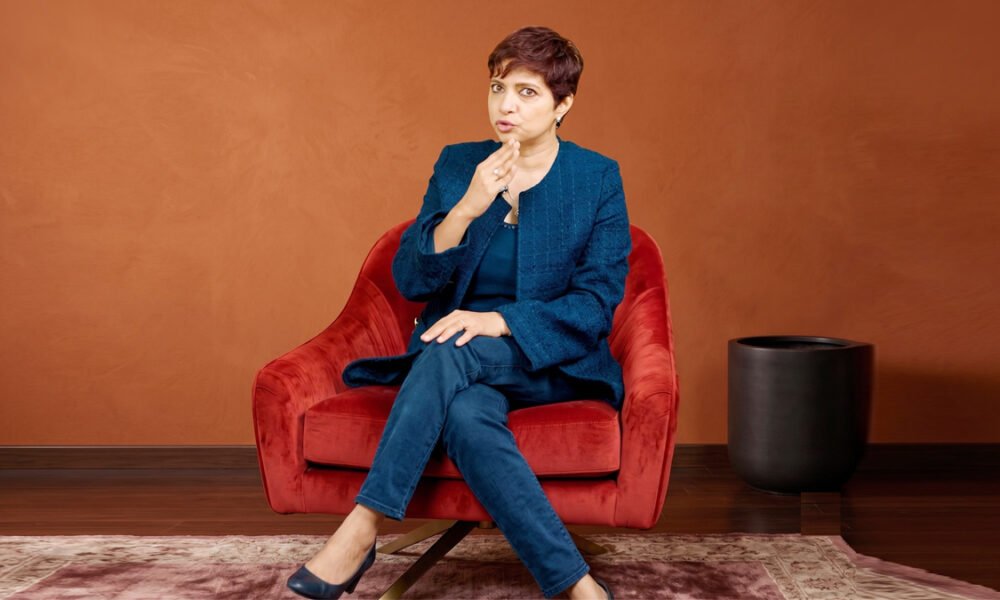
MUMBAI: Every industry loves a formula. The media and entertainment business perhaps more than most. But according to Jyoti Deshpande, it is precisely those formulae that need to be broken.
Speaking at the 16th edition of Fortune India’s Most Powerful Women (MPW) 2026 summit during a fireside chat with Fortune India editor-in-chief Sourav Majumdar, the Reliance Industries media and content business president said the Indian entertainment industry must stop chasing predictable hits and start backing stories that surprise audiences.
And if anyone needed proof, she pointed to Dhurandhar.
The film, she said, violated almost every rule that has guided Hindi cinema greenlights for the past three decades, and that was exactly why she backed it.
“There were a series of unfortunate instances that led to this colossal success and a great deal of divine intervention,” Deshpande said. “What interested me was that it broke every conventional norm laid down over the last 30 years of storytelling.”
Drawing a parallel with business analytics, she argued that the biggest breakthroughs often come from projects that don’t fit established patterns.
Dhurandhar, she explained, tackled the rarely explored concept of the “deep state”, disguising it as a gangster drama to make a complex geopolitical narrative accessible to mainstream audiences.
“It was more deeply patriotic than many films that pretend to be patriotic. That is why I greenlit it. It was bold, different and clutter-breaking,” she said.
Yet bold didn’t mean exclusionary.
Knowing the film would carry an adult certification because of its violence and gritty tone, the creative team consciously worked to ensure it appealed beyond young male audiences.
“We didn’t want it to become a male-testosterone film. We wanted everyone, including female audiences, to enjoy the film,” she said.
One film became two
One of the biggest revelations from the session was that Dhurandhar was never conceived as a two-part franchise.
The turning point came midway through production.
The crew recreated Karachi’s notorious Lyari district in Thailand by securing access to buildings that were due for demolition within 60 days, a logistical coup that saved the cost of constructing elaborate sets.
But ambition comes at a price.
Forty days into production, costs had climbed well beyond the original budget while just a handful of scripted pages had expanded into hours of footage.
“It was not conceived as two parts. We had already busted through our budget,” Deshpande admitted.
Rather than compressing the sprawling narrative into an unwieldy five-hour film, she took what she described as a bold bet, approving additional investment and working with the director to reshape the project into two films.
Sometimes the edit isn’t just about trimming scenes. It is about changing the destiny of the story.
There is no formula for a phenomenon
Asked whether Dhurandhar‘s blockbuster success would create pressure on Jio Studios’ next big release, Deshpande dismissed the idea that popular culture can be manufactured.
“When something becomes part of popular culture organically, no marketing guru or advertisements can architect that. When audiences make something their own, it becomes part of popular culture,” she said.
After following the success of Stree with Dhurandhar, she smiled when asked what comes next.
“We’ll think of something.”
For Deshpande, the industry’s biggest competitive advantage is not bigger budgets or louder marketing campaigns, but sharper listening.
“You have to keep your ear to the ground and understand what people are talking about and where the youth is. It is important to tell stories that are relevant.”
In a world overflowing with content across every screen imaginable, she said audiences will leave home, and pay for a cinema ticket, only if filmmakers offer something they cannot ignore.
“Stories are everywhere. It is just important to keep your eyes and ears open and execute them well.”
If there was one message from the Fortune India stage, it was this: safe stories rarely become cultural earthquakes. Sometimes, the biggest hits begin by breaking every rule in the book.
Why Dhurandhar became a blockbuster
- It broke conventional Hindi cinema storytelling formulae.
- It tackled the complex “deep state” theme through a commercial gangster narrative.
- It blended patriotism with mainstream entertainment instead of relying on jingoism.
- It was designed to appeal to both male and female audiences despite its violence.
- The production embraced scale, authenticity and ambitious world-building, including recreating Karachi’s Lyari district in Thailand.
- The makers chose to expand the story into two films instead of squeezing it into an overlong feature.
- Jio Studios backed creative conviction over conventional risk calculations.
- The film connected organically with audiences, turning into a popular culture phenomenon rather than a marketing-driven success.