







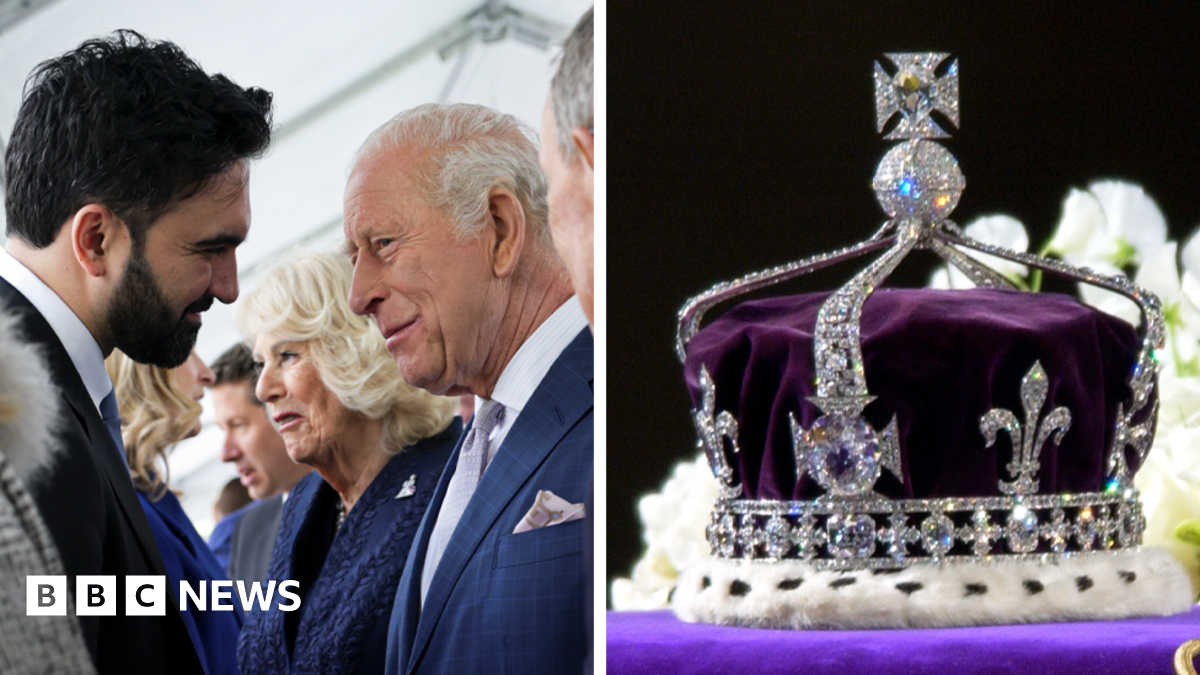
Mamdani later met King Charles at the ceremony but it’s unclear if he brought up the diamond.
Photos show the mayor and the King shaking hands at the public event. Neither Mamdani’s office nor Buckingham Palace have shared details about the interaction.
India has repeatedly sought the return of the Koh-i-Noor, describing it as a “valued piece of art with strong roots in our nation’s history”, while many Indians view Britain’s possession of the gem as a symbol of colonial plunder and injustice.
Former prime minister David Cameron said in 2013 that returning the gem was not “sensible”.
The Koh-i-Noor, meaning “Mountain of Light” in Persian, has been the subject of conquest and intrigue for centuries, passing through the hands of Mughal princes, Iranian warriors, Afghan rulers and Punjabi Maharajas.
The stone was originally found in India’s Golconda mines and measured 186 carats when it was eventually handed to the British in 1849 under the terms of a punitive treaty following the Anglo-Sikh war. It was signed by the 10-year-old Sikh ruler, Duleep Singh, after his mother was thrown in jail.
However, the diamond’s traditional rose cut did not impress visitors to the Great Exhibition – a massive world fair held in London – in 1851 and so it was re-cut as an oval brilliant, gaining sparkle but losing about 40% of its weight in the process.
The 105-carat stone – the size of a hen’s egg – is currently set in the crown of Queen Elizabeth the Queen Mother. Queen Elizabeth wore the crown for the 1937 coronation of her husband, King George VI.
She later wore it during her daughter Queen Elizabeth II’s coronation.
The controversial diamond was not used in the coronation of Queen Camilla as there reportedly were concerns about a diplomatic row with India if it had been used.
She was crowned instead with Queen Mary’s Crown, which was taken out of the Tower of London especially for the event.