









A damning new report from the United Nations has warned of the environmental impact of data centres
By Camilla Royle
Downloading PDF. Please wait…
Wednesday 03 June 2026

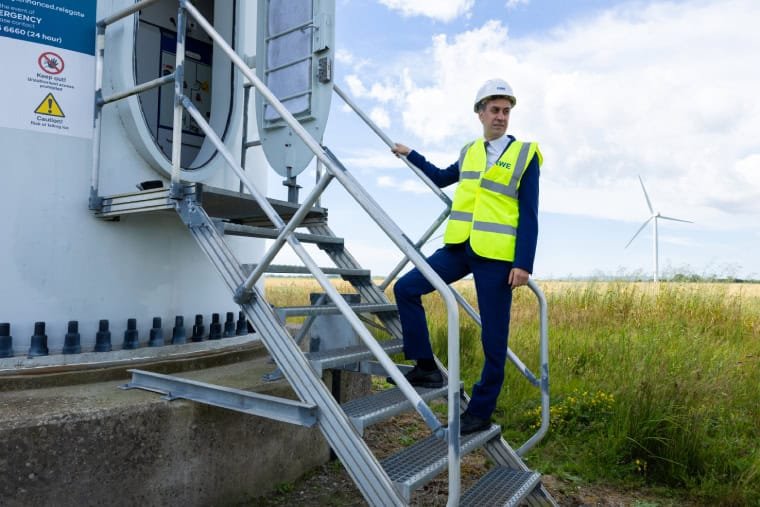
Energy secretary Ed Miliband (Photo: flickr/UKGovernment)
The Labour government says it wants to turbocharge investment in artificial intelligence (AI).
Yet the data centres the technology needs will soak up vast amounts of water and energy—and trash the government’s already weak promises over climate change.
A new report from the United Nations, published on Wednesday, concludes that countries must do more to address the environmental impacts of AI.
It says that the market in AI is predicted to grow 25-fold to nearly five trillion dollars by 2033. The breakneck pace of growth, as investors pour money into the technology, means that “unintended social, economic, geopolitical and environmental consequences” are rapidly accumulating.
AI currently accounts for about 25 percent of the workload of data centres, according to the report. But this is expected to rise to 40 percent by 2030.
By that point, energy consumption related to AI will be the equivalent of the residential energy needs for the whole of sub-Saharan Africa for two years.
It will drive us further towards climate disaster by releasing 400 million tonnes of carbon dioxide globally, more than the current emissions of the whole of Britain.
Data centres need large volumes of water to keep their vast arrays of servers cool. The UN’s report says AI will use about 9.3 trillion litres of water by 2030 and that this is equivalent to the world’s drinking water needs for 1.6 years.
The report also points out that AI is entrenching global inequality. Most of the infrastructure for AI is hosted in wealthier countries. Some 90 percent of it is in the US or China.
But the Global South sees more of the costs, with the burden of millions of tonnes of e-waste and expansion in mining for critical minerals to produce computer chips.

Data centre developers have tried to burnish their green credentials by saying they will use renewable energy. But these promises have come to nothing.
New data centres are currently scrambling to get themselves connected to the gas network. They are increasingly planning to use fossil fuels as their main source of energy.
But people are turning against the new data centre plans. In the US, Gallup polling shows that seven in ten people oppose the construction of a data centre in their area. Local people and county councils blocked or stalled 48 new data centre proposals worth $156 billion last year.
Residents of La Pine, Oregon, successfully blocked permission for a data centre last month. They said it would use about 15 times as much electricity as the households of this small city and bring only a limited number of jobs.
In North Carolina, the Eastern Band of Cherokee Indians Tribal Council also passed a complete moratorium on data centres last month due to their environmental impact.
In Britain the fight is on to stop dirty data centre expansion. For example, in Bethnal Green in east London, campaigners are organising against proposals to build a data centre at the site of what was the Truman Brewery.
The example of the US shows these campaigns are popular and can win.