






Over the past decade, global companies have spent more than $90 billion in Louisiana building new liquefied natural gas export facilities and petrochemical plants — investments that have been largely driven by the state’s cheap, abundant natural gas.
At the same time, job growth in Louisiana has remained flat and the state’s population has declined by 52,000 people.

That disconnect is the subject of a new report from a New Orleans-based nonprofit research organization, The Data Center, that looks into the relationship between the explosive capital investment in the state in recent years and the continuation of a decadeslong, outmigration trend.
But with all the activity, the report questions whether the new wave of projects, which state officials say will total $100 billion in additional capital expenditures, will address longstanding problems.
“Nobody is reckoning with the fact that what has happened over the past decade did not create jobs,” said Alison Plyer, chief demographer at The Data Center. “Instead, they’re doubling down.”

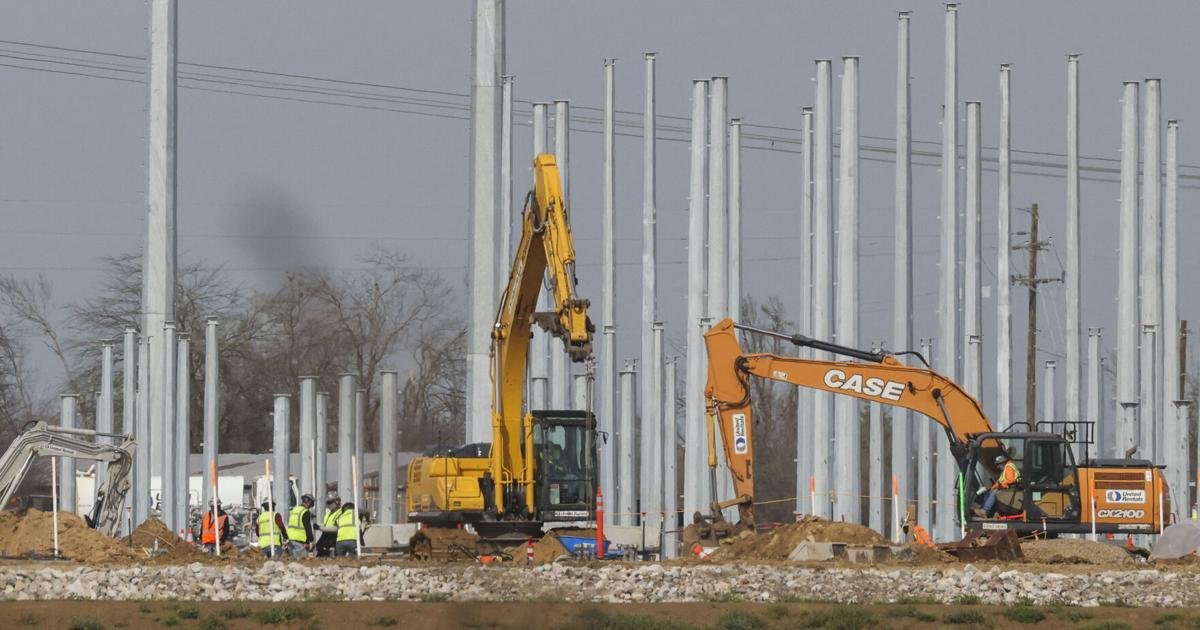
The construction of the Meta data center site photographed in Holly Ridge, La., Tuesday, March 10, 2026. (Photo by Sophia Germer, The Times-Picayune)
Susan Bourgeois, Landry’s top economic development official, said the administration has not shied away from the realities of the state’s stagnant growth and population loss.
On the contrary, she said the mega projects her agency has successfully courted are part of a broader strategy. The administration is trying to leverage the state’s traditional strengths in energy and refining to attract new sectors, like logistics and life sciences, with better paying jobs.
“We know about the population loss and the continued slowing of GDP,” said Bourgeois, secretary of Louisiana Economic Development. “That is why we are doing so much to change all that.”
Sobering statistics
The Data Center report combined a variety of economic indicators that paint a bleak picture of Louisiana’s financial well-being.
The study notes that while job growth in the U.S. overall increased more than 10% between 2015 and 2023, employment in Louisiana grew just under 0.2% during that time. Median household income in the state remained flat at around $61,000, while the cost of living jumped 19% between 2018 to 2022 alone.

A sheriff directs traffic on Far Far Away Ln. outside the Meta data center construction site in Holly Ridge, La., Tuesday, March 10, 2026. (Photo by Sophia Germer, The Times-Picayune)
The report attributes much of the job loss in those years to the fracking boom in the early 2010s that caused oil prices to fall, gutting Louisiana’s offshore industry.
Between 2014 and 2024, the number of oil and gas extraction jobs in the state was cut nearly in half — from 50,000 to 27,000.
The abundance of cheap natural gas helped fuel the major investments in LNG and petrochemical refining that followed. But the report says that those projects have diminishing returns because they increasingly rely on automation, which means fewer jobs.

The Venture Global Plaquemines LNG Export Terminal on La. Hwy. 23 in Port Sulphur, Friday, April 10, 2026. (Staff Photo by David Grunfeld, The Times-Picayune)
At the same time, skyrocketing insurance premiums have outpaced the national average, causing real estate values to fall. In 2015, Louisiana’s property values ranked 26th among the 50 states. By 2024, they were third from the bottom, behind Mississippi and West Virginia.
The report also highlighted an array of health and environmental data that shows the state has some of the highest rates of air and water pollution in the country with the sickest population and the worst outcomes — key quality-of-life indicators that impact where families choose to live.
“We need to develop clusters that build on our strength, like water management, or that take a whole different tack because large corporations are increasingly going to replace workers with automation,” Plyer said. “We should be very critical in our approach.”
Making a difference?
Since taking office, Landry has said he wants to pursue a variety of industry sectors to grow the state’s economy. In his first year, he started by making the state what he argued was more business friendly, by enacting a package of bills that eliminated the corporate franchise tax and established a flat corporate income tax rate, among other things.

Gov. Jeff Landry reacts after welding on a boat keel during an event at C&C Marine and Repair in Belle Chasse on Friday, April 17, 2026. Landry announced that Woodside Energy has awarded a $300 million contract to Louisiana-based Green Tug Towing to build four new tugboats to be built at C&C for its Louisiana LNG project. (Staff photo by Brett Duke, The Times-Picayune)
His administration has also created new incentives to attract mega projects like Meta to the state, discreetly rewriting a bill about rural broadband, for instance, into a sales tax exemption on digital equipment — something Meta made a condition of coming to Louisiana.
Bourgeois has said such tax breaks are justified and are a needed part of economic development, arguing that “you have to spend money to make money.”

U.S. House Majority Leader Steve Scalise and other members of the congressional delegation tour the Venture Global Plaquemines LNG Export Terminal on La. Hwy. 23 in Port Sulphur, Friday, April 10, 2026. (Staff Photo by David Grunfeld, The Times-Picayune)
The administration has also unveiled a new economic development strategic plan focused on priority sectors that it sees as primed for growth, including energy and process industries, logistics, aerospace and defense, agribusiness, professional services, life sciences and tech.
The plan calls for a new incentive program for businesses that offer jobs with wages above the regional benchmarks, creation of a dedicated fund for site development, an increased focus on rural areas and small businesses, and more support for regional economic development organizations.
It also says Louisiana should seek to have the highest wage growth among Southern peer states and achieve population growth and migration into all regions.
Bourgeois said her agency is making a difference.
“From a project perspective, we continue to bring opportunity,” she said. “From a narrative perspective, we have to tell the story that we are making gains in things like education and public safety. Reversing the perception is the only way we reverse the outmigration.”
Multipronged approach
In New Orleans, a report from the Brookings Institution and The Data Center issued in the fall found that while small businesses and entrepreneurs thrived after Hurricane Katrina, they are struggling today and need sustained investment if they are to continue to survive.
Small businesses, the report notes, are key to a thriving economy and growing population.
That report’s policy recommendations included establishing a permanent business recovery and resilience fund, expanding and incentivizing commercial real estate ownership, revising land use policies to get more vacant buildings back into commerce and promoting community wealth building.

Crews walk alongside the Artemis III core stage as it is slowly rolled out of the Michoud Assembly Facility in New Orleans on Monday, April 20, 2026. (Photo by Chris Granger, The Times-Picayune)
New Orleans Mayor Helena Moreno’s administration has also emphasized several of those initiatives as part of her approach to economic development.
Robert Travis Scott, who headed the Public Affairs Research Council for a decade in the 2010s and has followed growth in other southern states, said a successful economic development strategy has to fire on multiple cylinders at once.
“The whole game is to diversify and regionalize and try keep and attract the right talent for what we need,” he said. “It isn’t just a matter of what the tax situation is but of building livable, walkable communities where people want to live.”