








We asked Guardian readers in the US how they get around if they don’t have a car in such a car-dominated country. Several of those who responded described the benefits and many challenges of going by foot, bike or public transit.
‘I arrange my life within the system that exists in LA’
When Ellen first moved from New York to Los Angeles, she decided not to own a car as a “test”, she says. “I grew up without car culture in Vancouver, and I wanted to try it out for a year.”
Five years on, she still has no plans to buy one. “It’s certainly a stereotype that you can’t not drive [in LA], but a lot of people do get around without them. I sometimes dream of getting one for road trips, but I think I’ll just rent for now.”
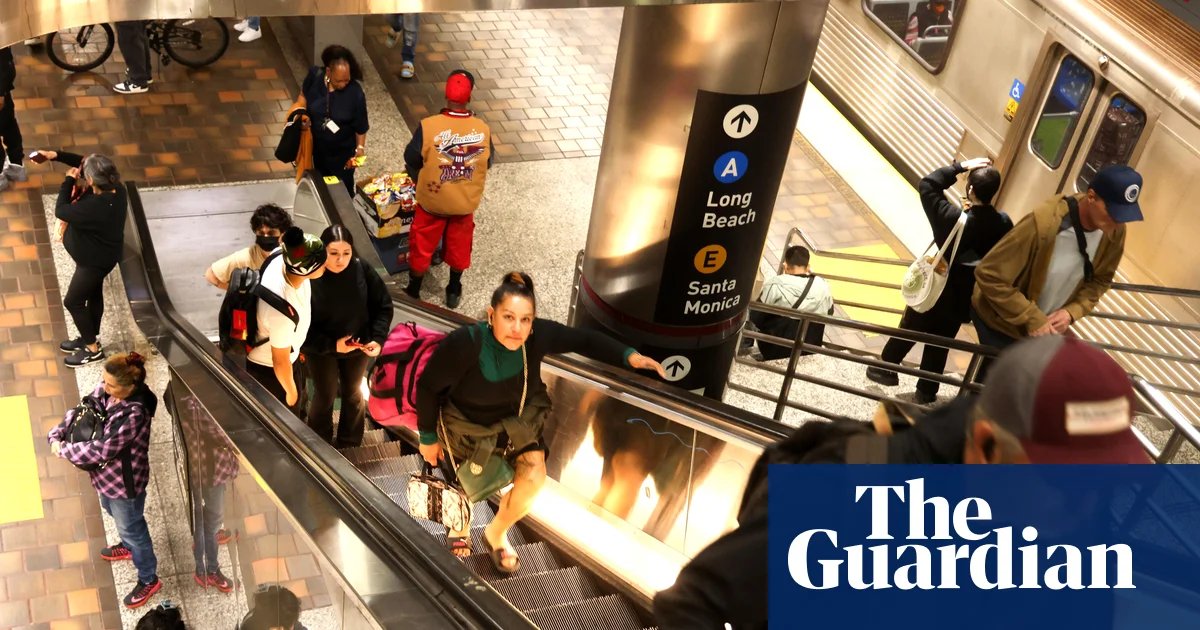
However, Ellen does find getting around in LA frustrating. Public transit is “all over the place”, she says. “I minimize travel time by using a bike and train combo most of the time. It still takes me at least 45 minutes to an hour to get to work, but without my bike, it could be as long as an hour and a half. To get to the hipper parts of town, I’ll either bus through the gruesome hell of MacArthur Park, or bike up the Union bike route.”
She adds: “There’s a secondary aspect, which is that the fentanyl crisis that we are dealing with is kind of bleeding on to public transit. A lot of drug-addicted and sometimes psychotic people, especially late at night, will ride transit as an alternative to sleeping in a shelter.”
Practical concerns aside, Ellen says there is a cultural bias against driving in the city. “Angelenos don’t respect pedestrians. I literally have to lie to people at work and in social situations, because they are extremely judgmental.”
Ellen says she has “reorganized” her social habits around where she lives. “I do arrange my life and schedule by trying to work within the system that exists, which is far from perfect. I often carpool with friends as well. There are also some services which go further afield, like the Metrolink, which is our version of a suburban rail system, which is actually quite extensive. And then there’s buses. But there are times when I don’t want to deal with that, so I’ll either just not go or I’ll pony up the money for a car share.”
‘I’m always struck by how old the stations in Chicago feel’
Nathaniel Knize, 30, a librarian from Chicago, exclusively uses public transport and walking to get around the city. “I don’t ride a bike because I don’t want to get hit by a car, or worry about bike parking or bike theft,” he says.
“Outside of commuting, I rely on the CTA (Chicago Transit Authority) for social events and doctor’s appointments. I sometimes take as many as 10 unlinked passenger trips per day.”
Knize considers transportation in Chicago to be “world class”. But traveling out of town is less easy. In these cases he will usually take a ride in a family member’s car. “I grew up in a large family. Many of them are now spread out along the outer reaches of the city. It can be really challenging getting to their houses for holidays and birthdays and most of those trips take an hour and a half. American metro systems were designed for commuters to get to and from work, not for people to get to the houses of loved ones.”
When traveling even further afield on vacation, Knize says he avoids places without public transit. “I only visit places that have metro systems that I can use to get around the city as a non-driver. I’ve ridden the subway in cities like Rio de Janeiro, Paris and Toronto. The thing I’m always struck by is how old the stations in Chicago feel in comparison. Many of ours were built over 100 years ago by private companies before the CTA even existed.”
Oakland is ‘one of the best US cities to live without a car’
Enzo Mthethwa, 38, is a train conductor who lives car-free in Oakland, California. He travels by first hiring a Lyft bike, then catching a Bay Area Rapid Transit (Bart) train, or a bus.
Oakland is “one of the best cities to live in without a car in the country”, he says, besides New York and Chicago. But, he adds: “The Bay Area pales in comparison to major cities in the rest of the world, where rail is more frequent.”
Whenever his workday starts in the early morning on a Sunday, for instance, Bart isn’t an option as it opens at 8am. “That could be really inconvenient because then I would have to take an expensive Uber or Lyft to get to work. I believe the purpose of having a train, having a subway, having a metro, isn’t just for commuters. It’s to get all people from point A to point B at any time.”
Having grown up in Florida, where he used to drive a car, Mthethwa is enthusiastic about living in a relatively walkable area. “It’s just normal that everyone has to have a car to get around in [most parts of the US]. And just the concept of not needing a car, being able to walk everywhere, being able to take a train somewhere or a bus to get around easily was just interesting.”
‘Living without a car takes some doing’
Kevin Ducey, 67, a college teacher from La Crosse, Wisconsin, hasn’t owned a car since 2004. La Crosse has less public transit infrastructure than cities like Chicago, but he says living without a car can still be practical. “It just takes some doing,” he says. “I bike for three seasons and in the winter I use the bus system, or I’ll walk about a mile downtown.”
Ducey says it is seen as unusual not to get around by car. “It’s like when I was a vegetarian in my 20s and I seemed to always end up in conversations about eating meat. Folks have a hard time getting heads around it. ‘Really? You don’t drive?’”
Ducey says the bus service “is not bad” for a US city in the midwest. “During the workweek, buses run every 30 minutes until 5.30pm, at which point they go once-an-hour until 10pm and weekends. Weekend service ends at about 6pm. So late-night outings in the winter take some planning.”
Intercity bus services have reduced over the years. He recalls: “There used to be a Greyhound bus system that would service little towns outside the city. And that kind of went away over the last 50 years. And so when you want to go out of town, you rent a car. After Covid, the prices tripled on car rentals. So as far as regional [travel] goes, it’s pretty tough. If you want to get from La Crosse city to one of the surrounding little towns, you can’t really do it without a car.”
Ducey says the city has long neglected other modes of transportation in favor of cars. “This city is on the Mississippi River, for instance, but you wouldn’t know it. Yes, in the summer we get on our private pontoon boats, but there’s no ferry from town to town on the river, or water taxis from the suburbs to La Crosse for commuters. The city turned its back on the river when the car showed up 100 years ago and now we may as well be Des Moines.”
‘When you grow up with cars, it’s hard to divorce yourself from that’
Sam Haiken, 30, a university researcher from Boston, Massachusetts, uses trains and buses to get to work. “As someone who doesn’t own a car, or even have a driver’s license, my perception is that in some ways it’s harder to own a car in Boston than not to,” she says.
“Owning a car only adds to the financial stress that a lot of particularly young people feel living here. And there’s not a ton of parking. There’s a lot of snow in the winter, so you have to dig out your parking spot. Fights break out because people perceive that others are trying to take their spot from them. So the idea of having a car here doesn’t appeal to me at all.”
Haiken grew up in New York, where it’s normal for young people not to own a car. “I have friends here who grew up in places that are more car dependent. I think they have a hard time wrapping their heads around the idea of not having a car, even though in my opinion it’s not really necessary. But when you grow up in that environment, it’s hard to divorce yourself from that.”
However, public transit in Boston is “not very reliable”, she says. “Our infrastructure is old and hasn’t been properly updated or maintained. It’s very common for signal issues, track issues or broken-down trains to impact service. It’s going to take a lot of time and money to fix the infrastructure, and we don’t really have either. Some of the Boston suburbs are lovely, but it’s tough to get out there and back.”
‘It’s difficult to do things spontaneously’
Dominic Ross, 29, a scientist in Oakland, California, travels to work in Livermore by walking or biking to the train station, riding it to the end of the line, then catching a connecting bus. “The whole journey takes about an hour and a half to two hours door to door. I also frequently take Bart and the bus to visit my partner in San Francisco, and use local buses to run daily errands.”
Ross says he would like more dedicated bus infrastructure in the area. “My bus to work only has four trips a day – two in the evenings and two at night – which gives limited flexibility for leaving and coming to work. This makes scheduling doctors appointments or anything off normal difficult.”
Having grown up in the suburbs in Ohio, where he never used public transit, Ross is “grateful” for the services he has access to. Living without a car in his area is undeniably limiting, though. “It’s difficult to access hiking and nature, and doing things spontaneously,” he says. “Particularly getting between San Francisco and Oakland. The trains stop running around midnight, and then your only option is a very infrequent bus.”
Ross feels that public investment should be more focused on transit. “Public transit systems here are essentially facing these huge deficits.” If the situation gets worse, he says: “The transit will get infrequent and bad enough that I will probably have to buy a car.”