







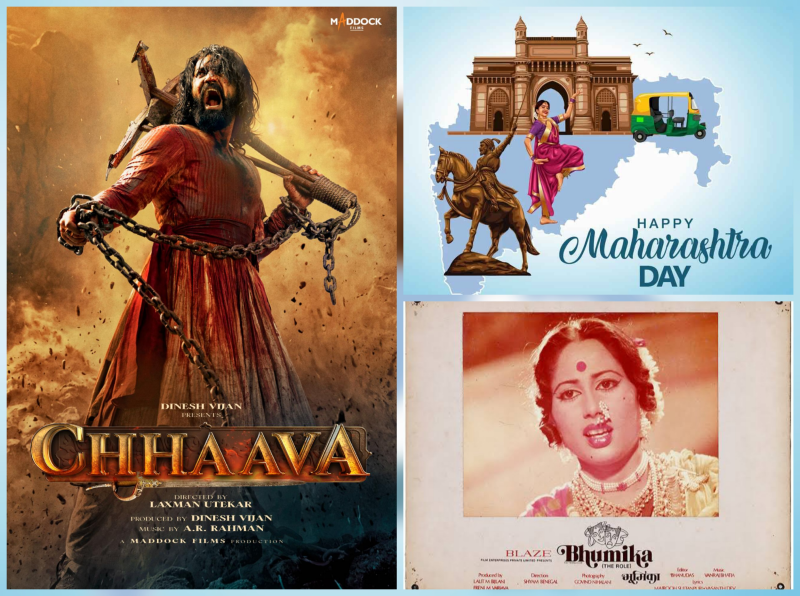
Maharashtra Day is observed in order to commemorate its formation as a state on May 1, 1960. Be it Ajanta and Ellora, its valorous forts or its pre-eminent position in India’s economic system, culture and capitalism have always coexisted in Maharashtra. Among the modern contributions of Maharashtra’s legacy is cinema, which subsequently established Mumbai as the heart of Hindi as well as Marathi studios.
Hindi cinema, in particular, has flourished in Mumbai. Additionally, many of its well-known dream merchants have regularly turned to Marathi literature for bringing new narratives to the screen. This cross-pollination has not only amplified Marathi voices, but also proved that good stories can transcend barriers of language in terms of being memorable and artistically relevant.
In honor of Maharashtra Day 2026, this article recaps five titles from Marathi literature that shaped notable movies in Hindi cinema:
Duniya Na Mane/Kunku (1937)
This V Shantaram bilingual is counted among the most powerful social dramas of its time. Based on Narayan Hari Apte’s Na Patnari Goshta, the plot is led by Nirmala, an educated young girl who is forced into marriage with an elderly man called Kakasaheb.
The film faithfully retains the novel’s critical tone against child marriages and its visual grammar and motifs remain a case study in meaningful camerawork. Shanta Apte’s fine acting as the protagonist Nirmala was appreciated by the critics. Even Keshavrao Date was appropriately vain and vulnerable as the ageing Kakasaheb.
Bhumika (1977)
Shyam Benegal took legendary Marathi actress Hansa Wadkar’s memoir (Sangtye Aika) and transposed it to great effect for the Hindi screen. Wadkar thus became Usha (Smita Patil), who traces a turbulent trajectory of relationships with her emasculated husband Keshav (Amol Palekar), costar Rajan (Anant Nag), director Sunil Verma (Naseeruddin Shah) and partner Vinayak Kale (Amrish Puri). On screen, their performances retained the bite of the memoir. Themes like agency, ambition and female exploitation from a bygone, conservative era dominated the screenplay of Bhumika.
Smita Patil’s incandescent acting won her the National Award for Best Actress. Bhumika also won a National Award for its Screenplay, in addition to the Filmfare Award for Best Film.
Main Tulsi Tere Aangan Ki (1978)
Raj Khosla, the George Cukor of Hindi cinema, was always in touch with the cultural activities of his karma-bhoomi, Mumbai. His writer, GR Kamath, would always keep him updated with promising stories and novels from the Marathi world that could become screenplays. Main Tulsi… is based on one such Marathi novel named Ashi Tujhi Preet by Chandrakant Kakodkar. The novel’s USP is that it offered sympathetic views on disparate themes like familial honor, legitimacy, the other woman and the wife without losing the thread of the narrative.
Raj Khosla’s direction and fine music sense amplified the promise of the plot. Strong performances by Nutan (the aristocratic wife, Sanjukta) and Asha Parekh (the dancer Tulsi, whence the film gets its title from), coupled with star wattage from Vinod Khanna, took the film to super-hit status at the box office (It was a record grosser in North India). It even won Filmfare Awards for Best Film, Best Dialogue and Best Actress (Nutan won her record-setting fifth Filmfare Award at 42).
Bajirao Mastani (2015)
This Sanjay Leela Bhansali film is based on the Marathi novel Rau by N.S. Inamdar. Rau remains a respected literary title for its layered writing which depicts the era’s politics as well as its character’s personal graphs.
Bhansali fortified these themes with his baroque brand of aesthetics and aberrations. The end result was a Rs. 145 crore film that went on to mint Rs. 356 crore at the box office and swept seven National as well as nine Filmfare Awards, among other accolades. Amongst the cast, Ranveer Singh (Bajirao), Priyanka Chopra-Jonas (Kashibai) and Tanvi Azmi (Aaisaheb) delivered great performances that brought out their characters’ sense of love, duty and social stigma with accuracy.
Chhaava (2025)
This Laxman Utekar film is based on Shivaji Sawant’s novel, Chhaava. The plot follows the fierce resistance of Chhatrapati Sambhaji Maharaj (Vicky Kaushal) against Mughal emperor Aurangzeb (Akshaye Khanna). Chhaava received mixed reviews for its inaccuracies, but did justice to the themes of war, realpolitik and sacrifice outlined by Sawant in his novel.
Vicky Kaushal delivered a terrific performance as the eponymous hero, with Vineet Kumar Singh providing good support as Kavi Kalash. Both actors respectively won the Zee Cine Award in the Best Actor and Best Supporting Actor categories. At the box office, Chaava roared like a lion with estimated earnings of Rs. 800 crore.
Questions relevant to the article
- What makes Marathi literature adaptations like Chhaava culturally significant?
- When did Bhumika release?
- Where did Main Tulsi Tere Aangan Ki do record business?
- Who adapted Rau into Bajirao Mastani?
- How did Chhaava balance spectacle, history, and cinematic storytelling?