






There’s always more to the landscape than what we first see. I have always loved the natural world, but my recent project has made me look at it differently. I’ve discovered a landscape shaped not only by recovery, but also by ongoing environmental harm that often goes unseen.
I’m Lynsey, and I’ve lived in Teesside all my life. Over time, I’ve become increasingly aware of the histories and environmental stories within the landscape, something that has come to shape me both as an artist and as a person. As a mature art student, having just completed my Foundation Diploma in art, progressing to an Illustration degree, my work has been shaped by a lifelong fascination with both nature and art.
This perspective became the starting point for my final project, where I explored the relationship between wildlife and Teesside’s industrial landscape. I was particularly interested in the idea of recovery. How nature can return and adapt despite Teesside’s industrial impact, but also in the less visible ways that industry continues to affect the environment. Initially, I expected the project to focus more on positive restoration, but as my research developed, a more complex story began to emerge.
Teesside’s industrial past
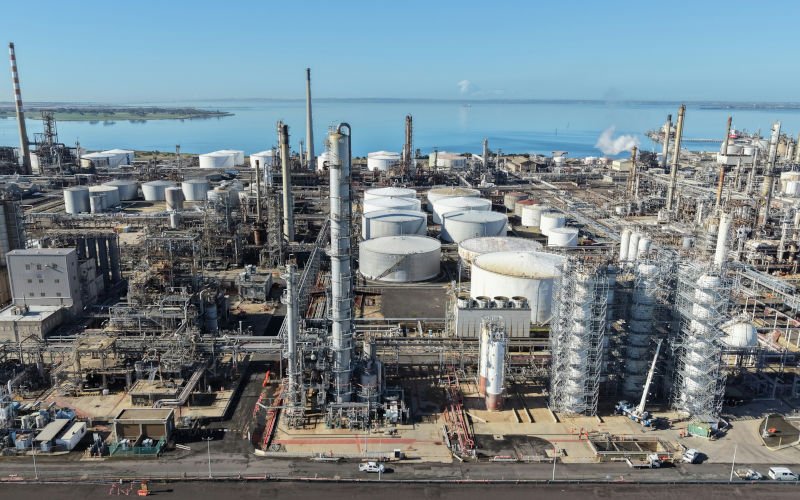
My research explored Teesside’s industrial past and the lasting impact it has had on the local environment. Historical sources, including newspaper reports and documentaries, reveal that concerns about pollution have existed for well over a century. From early reports of chemical contamination to the large-scale industrial activity of the 20th century, pollution became an accepted part of everyday life for many in Teesside.
Alongside chemical pollution, land reclamation from the mid-1800s reduced important wildlife habitats by almost 90%, as land was built up using slag from iron and steel works, enabling further industrial expansion.
I was already aware that industrial pollution had a devastating impact on wildlife over the years. In the early stages of my project, I intended to create an illustration that celebrated the recovery of wildlife through the work of local charities and organisations. I carried out my own research, including speaking with those involved and undertaking fieldwork around the Tees, South Gare, North Gare, and Seal Sands.
Environmental impact
As my research progressed into the more recent years, I began to uncover the environmental impact of the demolition of the Redcar steelworks and the construction of the South Bank Quay by Teesworks. Both appear to have had significant effects on marine life, including harbour seal pups and crustaceans. Research by various experts suggests a strong connection with these events, which led me to rethink my approach. I realised I needed to create a piece of work that showed both sides of the story: the recovery, but also the ongoing harm that is being overlooked. The resulting piece, Below the Surface, explores both the recovery of wildlife and the environmental issues that continue to affect Teesside today.
Below the Surface
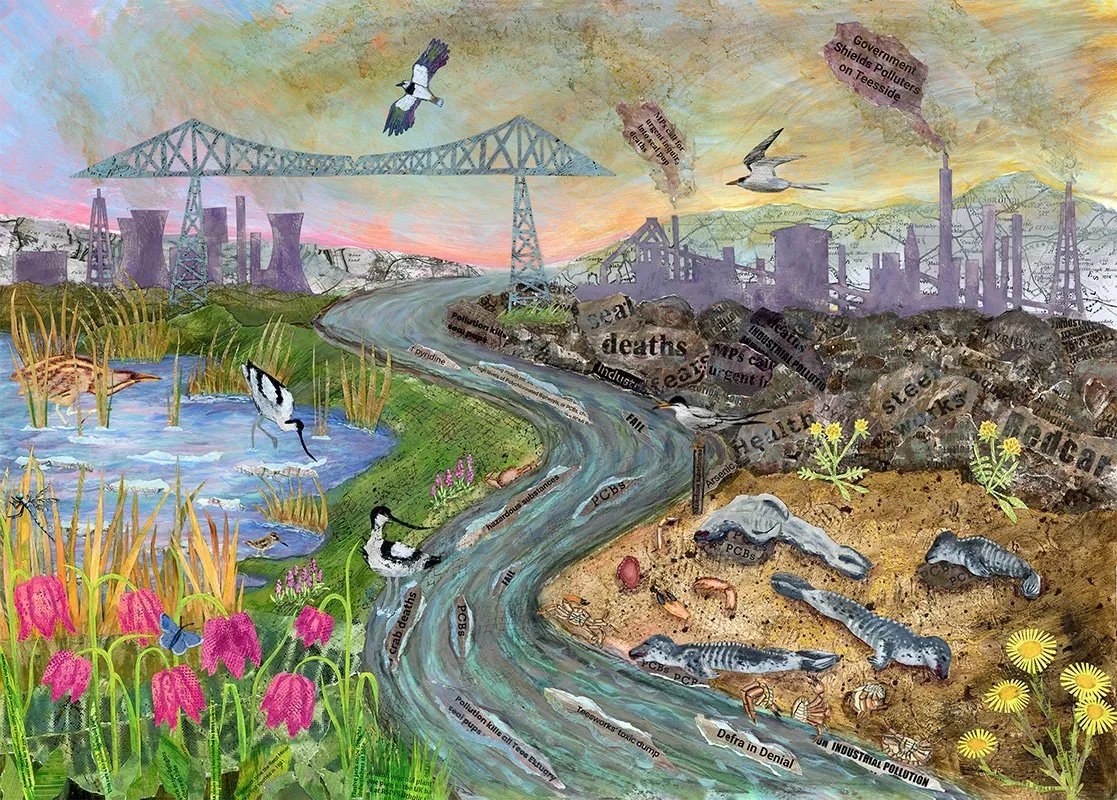
Working on an A2 canvas, I decided that collage and mixed media offered the most effective way of exploring these ideas. For me, collage acts as a metaphor for something being covered up or obscured. I used news headlines to introduce subtle layers of meaning, while allowing certain headlines, such as ‘Defra in Denial’, ‘Teesworks’ Toxic Dump’, and ‘Government Shields Polluters on Teesside’, to stand out more prominently. These contrast with the more subtle positive references to Saltholme, reinforcing the tension within the piece.
The work is not intended as a literal representation of a single place along the Tees but instead brings together different elements to reflect the wider landscape and its stories. Place names appear in the distance through the use of maps, alongside the familiar yellow haze of pollution in the sky and the iconic Transporter Bridge connecting both sides of the river.
On the left-hand side, I have included ICI, with Saltholme in the foreground to highlight some of its more positive narratives. Within the grasses, I have incorporated headlines such as ‘The Elusive Jack Snipe’, ‘Rare 460 Million Year Old Plant Found at Saltholme’, referencing the endangered Bearded Stonewort, and ‘Dragonflies Thriving at Former Teesside Industrial Site’.
On the right-hand side, the steelworks sit in the background, with the reclaimed land beneath it. In the foreground, the most significant element is the dying seal pups lying amongst washed-up crustaceans. I wanted to clearly convey the impact of pollution, showing the seal pups as severely underweight and affected by contamination.
Ultimately, this project has allowed me to look more closely at the place I’ve always called home, and to question how its industrial and environmental histories continue to shape it today. It has strengthened my confidence in using art as a way of exploring complex issues, while also reflecting on the relationship between nature and industry in Teesside. I hope the work encourages others to look a little more closely at their surroundings, and to consider the stories that may not always be immediately visible.