





Jaishankar Advocates for Two-State Solution at UNGA, Calls for Global Multipolarity
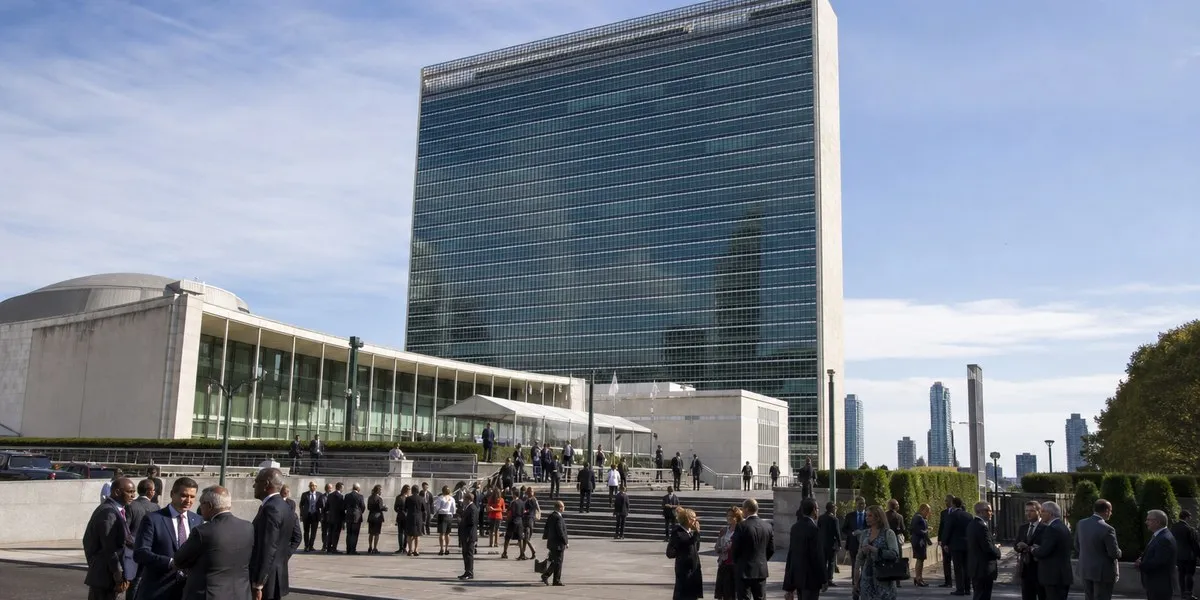
NEW YORK – Addressing the 79th session of the United Nations General Assembly (UNGA) on September 27, India’s External Affairs Minister Subrahmanyam Jaishankar delivered a robust vision for global stability, emphasizing the urgent need for a two-state solution to resolve the Middle East conflict and calling for a reimagining of multilateral governance in an increasingly multipolar world.
Stance on the Middle East Conflict
Amid the escalating violence in Gaza, Minister Jaishankar reiterated India’s principled position regarding the Israel-Palestine conflict. He underscored that “lasting peace” in the region is unattainable without the implementation of a two-state solution, where Israel and a sovereign Palestinian state can coexist peacefully.
The Minister urged all parties involved to exercise maximum restraint to prevent further regional destabilization. Beyond political messaging, Jaishankar highlighted that India remains committed to the welfare of the Palestinian people, noting that New Delhi continues to provide critical humanitarian aid and support measures to assist those affected by the ongoing hostilities.
Protecting Maritime Security
Turning his attention to the rising threats in international waters, the External Affairs Minister strongly condemned recent attacks on commercial vessels in the Gulf and along the vital sea lanes stretching from the Red Sea to the Black Sea.
“The security of shipping and the lives of seafarers must never be compromised,” Jaishankar stated. He expressed deep concern over the loss of life, specifically noting that Indian sailors and nationals from various other countries have fallen victim to these maritime threats. His comments serve as a clear directive that the safety of the global supply chain and maritime navigation is a non-negotiable priority for New Delhi.
Global Conflicts and Technological Sovereignty
Addressing the ongoing war in Ukraine, Jaishankar described the protracted conflict as a deeply alarming situation for the international community. He reaffirmed India’s support for peace initiatives, emphasizing the country’s willingness to contribute toward resolving crises related to energy and food security, which have been severely strained by the war.
On the subject of emerging technologies, the Minister framed Artificial Intelligence (AI) as a transformative force capable of fostering economic prosperity and solving complex global challenges. However, he advocated for “AI sovereignty,” asserting that every nation must have the autonomy to develop its own models and strategies that align with unique national goals and priorities, rather than adhering to a one-size-fits-all global model.
A Call for Multilateral Reform
Concluding his address, the External Affairs Minister spoke to the shifting nature of global power. He observed that the international order established in 1945 is no longer reflective of 21st-century realities.
“The world is moving toward multipolarity,” Jaishankar remarked, noting that the traditional post-WWII structures are buckling under the weight of new geopolitical challenges. He argued that under these current conditions, the demand for “reformed multilateral cooperation” is more pressing than ever, positioning India as a leading voice for a more equitable and representative global governing architecture.
Disclaimer: This content is auto-generated for informational purposes only.
Source: Read Original News