








Only when Yorkshire’s landscapes are linked does nature thrive, from the haunting call of a curlew to a lapwing’s cry.
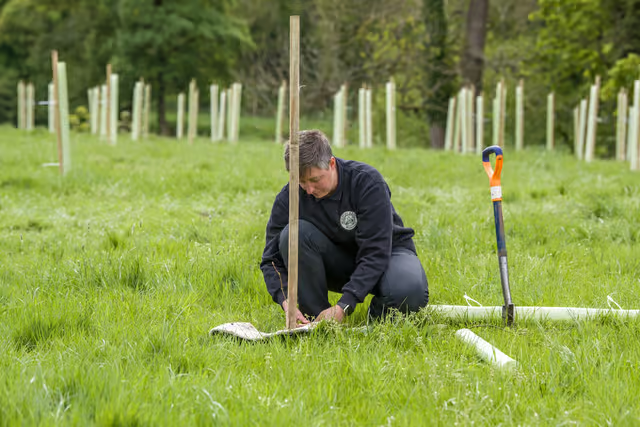
Now a new forest, with 80,000 trees at Bolton Abbey, is to help build a revival. The huge project, over 90 hectares, could also help the River Wharfe‘s waters run clear once more.
Estate Manager, David Barrett, said nature cannot stand as a “pocket” in isolation.
“This is a beautiful place,” he added. “We are not out to change it, but enhance it as best we can. To make some more space for nature.”


This is a 30,000-acre estate in the Yorkshire Dales, as famous for its abbey ruin as it is for its rich natural landscapes.
The forest project began last year with the first planting of trees. Now this second phase will see 10,000 more added.
The hope is that it could slow water runoff, sequester carbon, and support wildlife corridors.
But there are so many benefits here.

Stabilising the riverbank, stopping livestock from entering the water, and creating shaded areas for species like trout.
It began with a realisation, amid water quality campaigns, of just how important trees are to the River Wharfe above Ilkley.
“At the bottom of the Strid, the water quality is nearly as good as it is at the river’s source,” said Mr Barrett. “It has effectively cleaned itself.”
The question then, he added, is: “If the Strid is doing that, how can we do more of it?”.

The estate is working with tenants, who are all keen. And there is another, rather lovely, problem to have. It comes in the shape of lapwing and curlew, golden plover, or nesting merlin.
There are thought to be as many as 300 breeding pairs of curlews alone on the Bolton Estate – more than in the whole of the south of England.
“We have an embarrassment of ground nesting birds, which is testament to our keepers,” he said. “It does come with its challenges. This has been trying to find areas for tree planting, that wont impact on them. That is why a lot of the planting goes up the river corridor, it cuts a spine.”
There are to be riparian woodlands, along the watercourses, high-canopy woods, native scrubland, and open glades.
Head Forester, John Everitt, said this isn’t “just” planting trees, but shaping a landscape for generations to come.
And backed by funding through the Northern Forest scheme, teams are also restoring historic field boundaries and lost hedgerows.
This is an estate that is hundreds of years old, said Mr Barrett. When it comes to shaping its future, it isn’t with 10 years in mind, or 20, but many hundreds more.
“It’s about passing it on as a better space,” he said.