









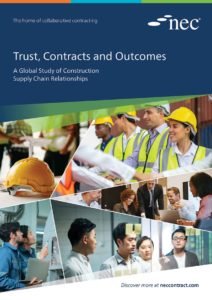
NEC Contracts has published Trust, Contracts and Outcomes: A Global Study of Construction Supply Chain Relationships, a major piece of exclusive research exploring the factors shaping supply chain relationships across the built environment.
Drawing on the views of more than 1,000 industry professionals in the UK, Australia, Peru, Singapore and Hong Kong, the report provides a detailed picture of current attitudes to trust, collaboration and contracting, and the gap between where the industry is and where professionals believe it should be.
The state of the industry
 The research paints a clear picture of an industry under significant commercial pressure. On average, respondents estimated that only 58% of projects they had worked on in the last three years were delivered on schedule and to budget. Poor estimating and job costing (42%), uncontrolled changes in project scope (39%) and late payment culture (33%) were identified as the biggest causes of business instability, financial stress and disputes across supply chains.
Adversarial dynamics are widely recognised as a structural feature rather than an occasional problem. Globally, 61% of respondents agreed that built environment projects create inherently adversarial supply chains, with just 11% disagreeing. 68% agreed that commercial and contractual pressures make project delivery more difficult, while 75% agreed poor supply chain relationships risk business continuity.
The UK data highlights specific pressure points. 63% of UK architects reported that formal external dispute resolution had been often or very often necessary in the past five years, more than double the global average of 26%. 59% of UK main contractors identified late payment culture as their single biggest source of instability, the highest figure for any sector in any market surveyed.
Trust and collaboration: widely valued, inconsistently practised
Despite these challenges, the research reveals strong and consistent belief in the value of collaboration across all five markets. 83% of respondents agreed that trust between parties is critical to successful project outcomes, 81% agreed that higher levels of collaboration help issues to be resolved more quickly, and 78% agreed the most effective supply chain relationships are built on trust and cooperation.
When asked what factors matter most in minimising disputes, effective communication (48%), clear boundaries and processes agreed from the start (39%), positive supply chain relationships built on trust and cooperation (34%) and contracts that support transparency and risk-sharing (34%) emerged as the leading responses globally. In the UK, strong client leadership also featured prominently.
A significant knowledge and adoption gap
One of the most important findings of the report is the scale of the gap between positive attitudes toward collaborative contracting and actual adoption. Globally, 79% of those familiar with collaborative contracts felt positive about their more widespread use, yet fewer than one in eight respondents in any country said they actively drove for their adoption.
Among those familiar with collaborative contracts, the perceived benefits are clear and commercially significant: 76% agreed collaborative contracting helps protect their business, 74% agreed it improves project delivery timescales, 71% agreed it reduces legal disputes and improper risk allocation, and 69% agreed it improves project profitability.
Yet awareness and experience remain uneven. In the UK, one in five respondents (20%) had never heard of collaborative contracts, the highest figure across all five markets, and only 27% had worked on projects using them, compared with 40% in Hong Kong and 38% in Australia. The predominance of traditional contract forms is driven overwhelmingly by client specification, pointing to the critical role client organisations must play in accelerating change.
Rekha Thawrani OBE, Global Director at NEC Contracts, said: “The findings of this report confirm what many of us working in collaborative contracting have long understood: that the industry knows what better looks like, but has not yet found a consistent way to get there. The connection between collaborative contracts and better outcomes is clearly evidenced in this research, and the appetite for change is real. What is needed now is decisive action from clients, who have the greatest power to shift the dial. NEC Contracts is committed to supporting that change and to helping supply chains build relationships that deliver better projects for everyone.”
The full report, Trust, Contracts and Outcomes: A Global Study of Construction Supply Chain Relationships, is available to download at https://www.neccontract.com/insights-supply-chain