







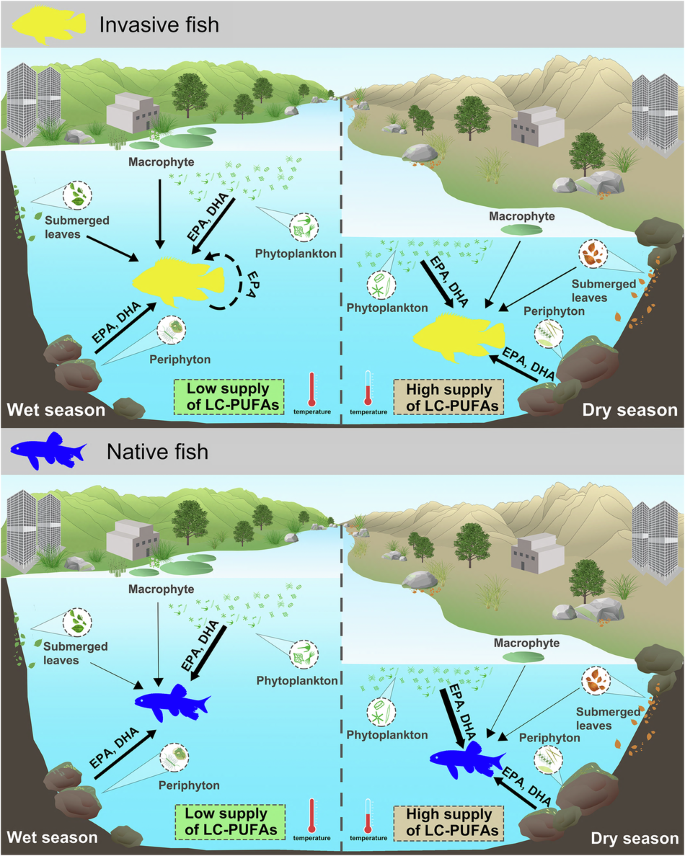
Biological invasions are often explained by species traits and environmental tolerance, but the nutritional quality of available food is rarely considered. Here we show that the invasive fishes in subtropical streams were less tightly constrained by seasonal declines in food quality than native fishes. During the dry season, both the invasive fishes and native fishes relied strongly on high-quality algal resources. During the wet season, the invasive fishes shifted more strongly toward lower-quality plant resources, whereas native fishes remained more closely associated with algae. Despite this dietary shift, tissue levels of essential long-chain polyunsaturated fatty acids remained relatively stable in the invasive fishes, while native fishes showed a decline in eicosapentaenoic acid. These patterns suggest that the invasive fishes examined here maintained nutritionally important internal states despite temporal variation in external supply. We describe this capacity as nutritional resilience, a potentially important but underappreciated dimension of invasion ecology.