






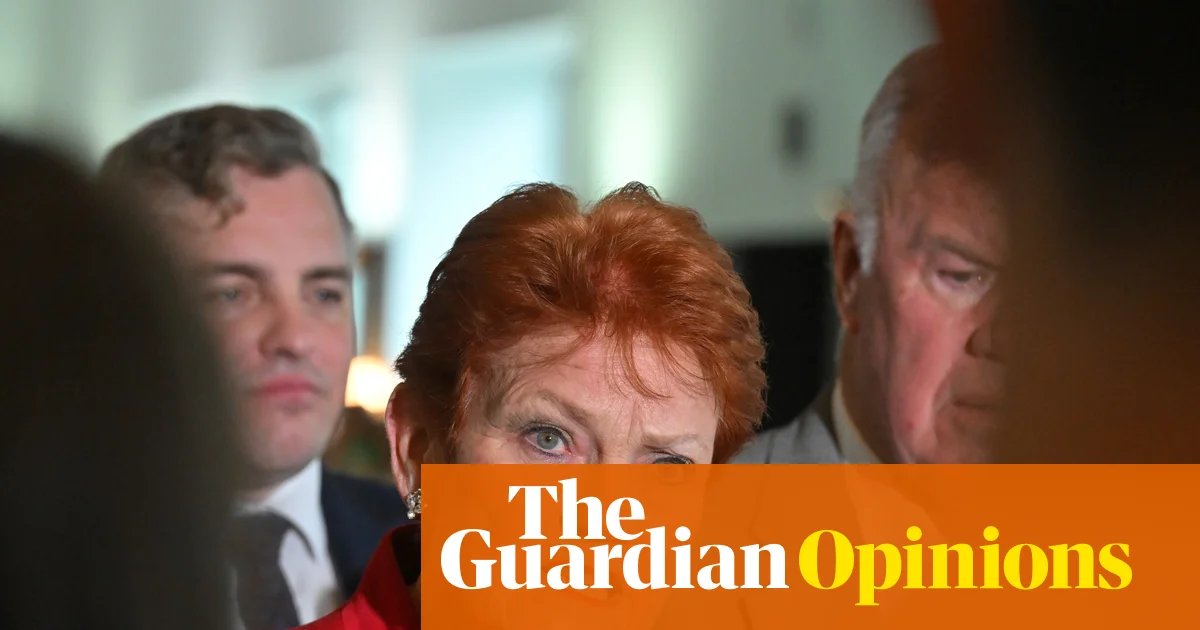
The day before the Farrer byelection on 9 May in which Pauline Hanson’s One Nation party delivered a seismic shock to the Australian political landscape, her party apparatchiks banned the ABC from attending its election-eve press conference.
Thirteen days later, another party apparatchik told a journalist from Guardian Australia to “shut up” during a press conference in Adelaide about the party’s policy on oil and gas. Hanson was later heard describing the journalist as a “nasty bitch”.
And a week before Farrer, at the byelection in the Victorian state seat of Nepean, the One Nation candidate, Darren Hercus, refused to speak to the ABC because, he said, the ABC was biased.
The response of the media industry and the profession of journalism to these anti-democratic outbursts has been supine: a shameful abrogation of their obligation to defend the freedom of the press.
In Farrer, the other journalists stood by and watched as the ABC reporters were ejected. In the ensuing two weeks, not a single word of condemnation has been uttered publicly by any industry or professional leader as one abusive episode followed another.
Yet across the Pacific we see exactly how this plays out in Donald Trump’s US.
A far-right populist leader attains power and then turns on those elements of the media he does not like, branding them the enemy of the people, undermining public trust in their reporting and shutting them out from the access they need to do their job.
Hanson is not there yet but her party’s instincts are clear. The ABC and Guardian Australia have put her and her party under close scrutiny, and this is her party’s response. (Although, in fairness, it should be added that in terms of the Farrer incident Hanson herself said the ABC should not have been ejected.)
However, the ABC has been in Hanson’s gunsights for years. As far back as 2017 she made a deal with Malcolm Turnbull’s government: you give me an inquiry into the ABC and I’ll support the changes you want to make to media ownership laws.
It was simply a stunt to divert resources within the ABC and generate negative headlines for the national broadcaster. It led to no change because there was no basis for change.
The proximate cause of her wrath this time was an ABC story revealing a One Nation candidate in the recent South Australian state election was wanted for questioning in the United Kingdom on allegations of sexual touching.
So less than 24 hours before the polls opened in Farrer, Hanson’s chief of staff, James Ashby, ejected two ABC journalists from the party’s press conference, saying contemptuously, “Bye, bye to the ABC”.
As the Age’s media writer later noted, it was straight out of Trump’s playbook.
Yet we have not heard a word of condemnation from the ABC’s editor-in-chief, Hugh Marks, or the broadcaster’s chair, Kim Williams. Nor has there been editorial commentary or an opinion column in any of our major daily newspapers. What about the Media, Entertainment and Arts Alliance? Silence.
To its credit, the ABC TV program Media Watch did not pull its punches. Its presenter, Linton Besser, described One Nation’s attitude to the press and, in particular, the ABC as ugly. Alarm bells should be ringing, he said, because the slurs about “fake news” and “the enemy of the people” might very well be hurled at others too.
Tellingly, he reported the ABC had declined to comment on the Farrer incident.
Otherwise, the nearest any of Australia’s main media outlets came was an article in the Age and Sydney Morning Herald describing the events in Farrer and setting out the background. Useful as a reference, but it did nothing to defend the principle at stake: that in a democracy the media must be free to cover matters of public interest and their scope to do so must not be subject to the whims and vagaries of political leaders or parties.
Instead, the media has been consumed by One Nation’s historic victory and the prospect that it will make further gains.
Hanson is presented in an heroic light: the Nine papers quote the London Telegraph referring to Hanson as “Australia’s flame-haired answer to Farage”, a reference to the Reform UK leader, Nigel Farage, who also made historic gains in recent local government elections there.
Less heroically, she is also characterised by these newspapers as “mother duck”.
The Australian tells us “the shake-up is just starting”.
And the Age and SMH capture the mood of the electorate: “Voters tell Canberra: ‘Get stuffed’.”
None of this is to say her party’s result in Farrer, its winning of four seats in South Australia and its continuing high ride in the opinion polls is anything other than a story of immense significance. It deserves all the attention it is getting.
But to ignore her party’s anti-democratic behaviour shows wilful blindness to what is happening in the United States and suggests a complacency that it can’t happen here.
Ironically, an American journalist, Sinclair Lewis, has a lesson in this for Australia’s media. In 1935 he wrote a novel called It Can’t Happen Here, predicting with terrifying accuracy what Trump is doing to the American republic.
On the face of it, the exclusion of the ABC from a party press conference may appear to be a small thing. Moreover, there is a healthy belief in newsrooms that the public is not interested in journalists writing about journalists.
But this is not a story about journalists. It is a story about the functioning of the Australian democracy. It is a story requiring the insight to see a large principle in a small thing, a quality we are entitled to expect in the leaders of the fourth estate.
Denis Muller is a senior research fellow at the Centre for Advancing Journalism, The University of Melbourne. This article was originally published on the Conversation