







Pakistan’s defence minister has said the country is willing to go to war with India if it feels its water security is threatened, as the fate of a key treaty governing rivers between the two countries hung in the balance.
India said it suspended the 66-year-old Indus Water Treaty, which sets out how the two countries can use their shared rivers, after a terror attack on civilians in Kashmir in which 26 people were killed. Pakistan has denied any involvement in the attack, while India has said it will not observe the treaty unless Pakistan tackles cross-border terrorism.
Asif Khwaja, the Pakistan defence minister, said his country would consider military action if it received concrete evidence that India was moving at an “alarming speed” to disrupt water flows.
“The moment we feel that our national security, and water is part of our national security, is being threatened, we will go to war against India,” Mr Khwaja told local outlet Ary News.
India and Pakistan have been engaged in a diplomatic standoff for more than a year since a brief four-day conflict in May 2025.
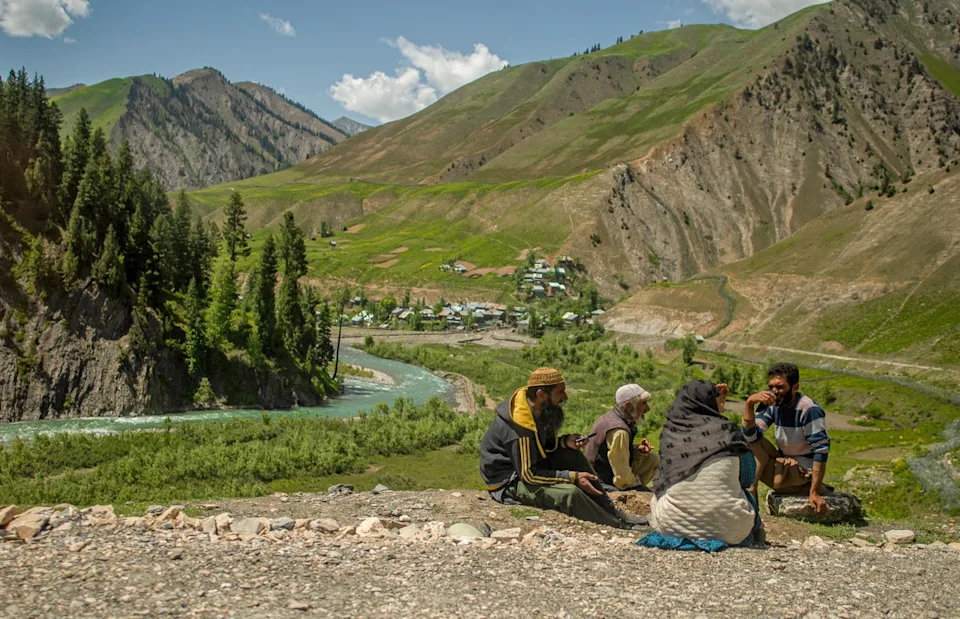
Local people sit on the side of the road with the view of the river in the Gurez valley in Bandipora, India-administered Jammu and Kashmir, near India-Pakistan border on 5 June 2025 (AFP/Getty)
India’s minister for water resources said last week that prime minister Narendra Modi had ordered his government to ensure that “not a single drop of water” flows into Pakistan.
“It still stands,” CR Patil said last week, referring to the Indus Water Treaty. “Rather, the treaty has been kept in abeyance.”
Earlier this month, foreign minister Subrahmanyam Jaishankar said the treaty would stay suspended “until Pakistan completely stops cross-border terrorism”.
The treaty regulates the use of six rivers in the Indus basin. Although the rivers originate in India, several flow into Pakistan through a shared river system. The agreement, negotiated with the assistance of the World Bank, allocates the waters of the basin’s three western rivers – the Indus, Jhelum and Chenab – to Pakistan, while India controls the waters of the eastern rivers – the Ravi, Beas and Sutlej.
Water from the Indus basin is vital to Pakistan, supporting millions of people through irrigation, drinking water supplies and hydropower production. The country’s agriculture sector, which forms a significant part of its economy, is particularly dependent on these flows.
The treaty requires India to permit approximately 43 million acre-feet of water to reach Pakistan each year. This accounts for about 80 per cent of Pakistan’s surface water resources.
Photo shows the lake behind the dam in the Gurez valley in Bandipora, India-administered Jammu and Kashmir, near India-Pakistan border on 5 June 2025 (AFP/Getty)
While the agreement grants India limited rights to use the western rivers for non-consumptive purposes, including hydropower projects, it prevents New Delhi from undertaking measures that would significantly alter river flows or adversely affect Pakistan’s access to water.
Pakistan has also raised the issue at the UN Security Council, saying that India has undertaken at least 17 projects on the rivers with the aim of establishing “hydro-hegemony”. Pakistan’s deputy prime minister and foreign minister Ishaq Dar urged the UN body to take note of India’s “brazen violations” of the Indus Water Treaty.
If the projects are completed, India would be able to halt the flow of waters through the Chenab for a period of 60 to 90 days, Pakistan’s adviser to the prime minister on political affairs Rana Sanaullah informed the Senate last Thursday.
“India wants to weaponise water against Pakistan. Whenever our crops need water, it will stop the flow, and when we no longer need it, the water may be released suddenly, causing floods and devastation,” he said.
India meanwhile, criticised Pakistan at the United Nations Human Rights Council (UNHRC) and called the Indus Waters Treaty outdated and unsuited to present-day realities.
Addressing the 62nd session of the UNHRC, Anupama Singh, first secretary at India’s Permanent Mission to the United Nations, dismissed Pakistan’s allegations against New Delhi and criticised what she described as Islamabad’s continued efforts to internationalise bilateral matters.
She said India’s stance on the Indus Waters Treaty was clear and well established, adding that it was difficult to justify a situation in which a country accused of using terrorism as a tool of state policy continued to seek the benefits of cooperation founded on mutual trust and friendship.
Without going into the specifics of the projects, India earlier in February said that any development project undertaken within the country is based on its own “understanding”.
“Any development project that happens in India is based on our understanding of what our development requirements are and what the need is that we have to meet the aspirations of people. And that is how we look at this particular project as well,” the foreign ministry said.
Earlier last year, Pakistan’s deputy prime minister Ishaq Dar had issued a similar warning after the ceasefire between the two countries, saying the fragile peace could fall apart if the treaty dispute was not resolved. He called New Delhi’s decision to suspend the river sharing agreement an “act of war”.