









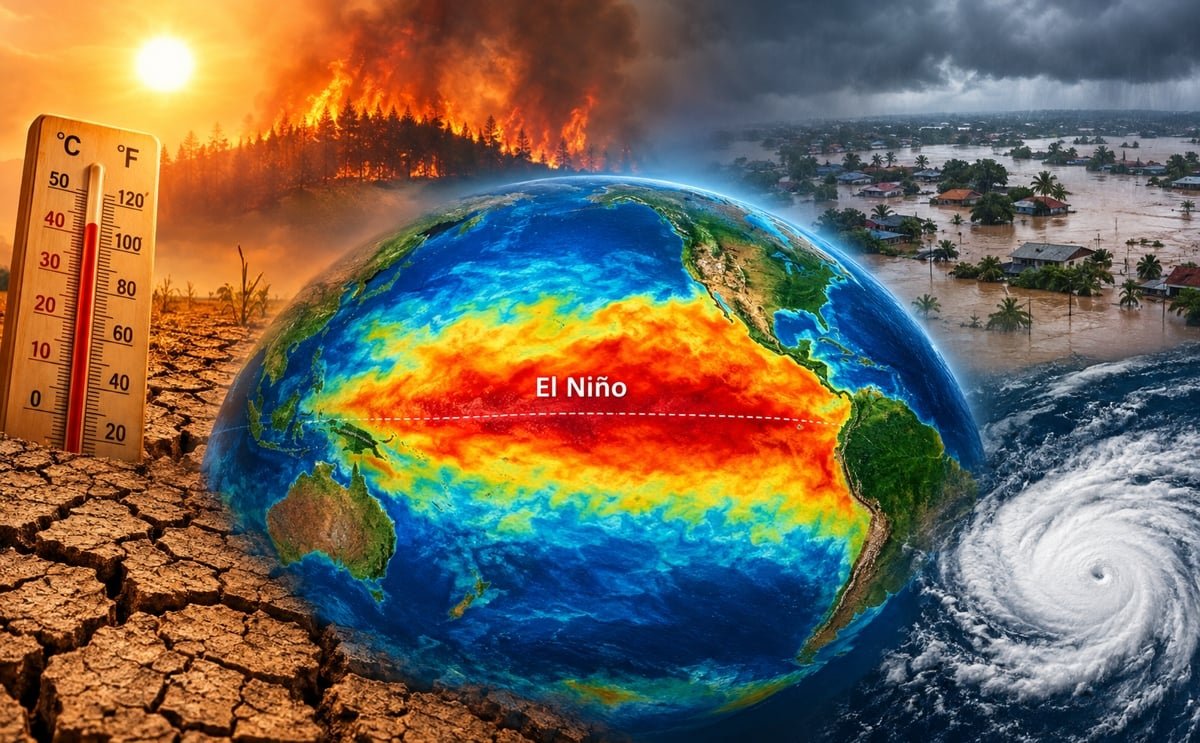
A powerful El Niño developing in the Pacific Ocean has officially shattered previous temperature records, fueling urgent warnings from climate scientists that the world is entering “uncharted waters.” Recent data confirms that sea-surface temperatures in the central Pacific have reached 3.05°C above the 1991–2020 average, surpassing the previous record of 3.02°C set during the catastrophic 2015 event.
What makes this surge particularly alarming is that it is occurring months before the typical peak of the phenomenon. Climate scientist Zeke Hausfather described current forecasts as “mind-blowing,” noting that an average of 14 major climate models suggests temperatures could climb to a staggering 4°C by late this year. Such levels would dwarf those observed during any prior El Niño event on record.
While El Niño is a natural climate cycle, experts emphasize that this event is unfolding against the backdrop of a planet already significantly altered by human-induced greenhouse gas emissions. Professor Friederike Otto of Imperial College London warned that the phenomenon acts as a “huge redistribution of energy” within a system already struggling with elevated baselines. “In many places around the world, we will see never-before-experienced heat extremes,” Otto stated, highlighting the dire consequences for public health, food security, and water supplies.
The impacts are already materializing. Indonesia is currently battling severe wildfires and hazardous air quality, while diminished monsoon rainfall in India has sparked concern for agricultural yields. In Central America, a punishing drought has crippled water levels in the Panama Canal, causing major disruptions to global shipping and trade. The World Food Programme has issued a stark warning, projecting that these conditions could push millions more into acute food insecurity and drive up global food prices.
Conversely, other regions are bracing for excess. Parts of South America are grappling with intense flooding, and southern sections of the United States are expected to face unusually wet conditions in the coming months. Meanwhile, Australia and southern Africa are preparing for a brutal summer season characterized by heightened drought and wildfire risks.
The economic implications are immense. Hausfather noted that previous strong El Niño events, such as those in 1997-98 and 2015-16, resulted in hundreds of billions of dollars in global damage. He added, “This event is leaving those past ones in the dust.”
In response to the escalating threat, the World Meteorological Organization has launched its largest mobilization in half a century to bolster early-warning systems. UN Secretary-General António Guterres encapsulated the gravity of the situation, stating, “El Niño is being supersized before our eyes. The science leaves no room for doubt: the planet is in uncharted waters and the world is in the danger zone of extreme weather.” As the climate continues to shift, the global community faces a challenging winter defined by the volatile convergence of record-breaking ocean temperatures and long-term global warming.
Disclaimer: This content is auto-generated for informational purposes only.
Source: Read Original News