







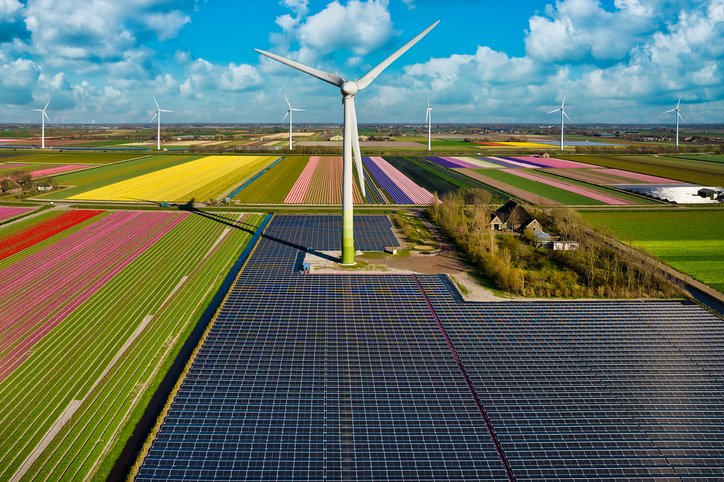
Walk into a newly renovated European home today, and you might find a rooftop solar installation feeding a battery, a heat pump keeping the radiators warm, and an electric vehicle charging in the garage. On paper, these assets represent a miniature clean energy system. In practice, they are often strangers to one another – unable to communicate, unable to coordinate and unable to deliver the grid flexibility that Europe’s energy transition desperately needs.
That disconnect is increasingly at the centre of policy debates in Brussels and beyond. The question of how to get Europe’s growing fleet of distributed energy devices to talk to each other is becoming a central question of the energy transition. “Common standards are important for interoperability but also for consumer trust,” said centre-left Spanish MEP Nicolas Gonzales Cesares at a recent Euractiv event.
“You can imagine that if someone invests in a digital solution for their home and then buys a lightbulb from another company that doesn’t work with it – they’ve wasted their money. And this happens again and again.”
A market exploding in complexity
Europe’s electrification boom is accelerating at a pace that is reshaping the power system from the bottom up. In the first quarter of 2026, battery-electric vehicles accounted for 19.4% of all new car registrations in the EU, up from 15.2% a year earlier. At the same time, Europe’s battery storage market added 27.1 GWh of new capacity in 2025, marking another record year for deployment.
The sheer scale of what is being deployed is staggering. But the explosion in hardware is outpacing the software and standards needed to make it cohere. The challenge is no longer simply deploying more solar PV, battery storage, EV chargers, or heat pumps. Increasingly, the real challenge is making these technologies operate as one coordinated energy system. And closed proprietary standards from each company making the products can make that difficult.
“Open standards have real advantages; they do not disappear overnight,” said Joost Demarest, chief technology officer with KNX, an association of companies established in 1990 using a common electrical standard. Members include Siemens, ABB, Hager and Legrand.
“KNX has existed for 35 years because it’s internationally standardised – it’s both an EN and an ISO standard. With open standards, users have freedom of choice: if one product fails, you can replace it from a different manufacturer. It also drives innovation, because manufacturers can concentrate on their areas of expertise rather than reinventing the underlying communication system. That’s cost efficiency.”
The interoperability gap
Interoperability remains a challenge, with ongoing discussions about standardisation. Manufacturer-independent solutions allow greater flexibility for customers. Other industry-led initiatives seeking to solve this problem include the EEBus Initiative and the Open Charge Point Protocol (OCPP).
The European Commission has been alive to the problem, if not always swift to act. The most significant recent development came from the Joint Research Centre, which expanded its voluntary Code of Conduct for energy-smart appliances. The Code of Conduct for the interoperability of energy smart appliances, a voluntary initiative managed by the European Commission’s Joint Research Centre, now covers additional product categories to support a more flexible electricity system and benefit households through smarter energy use.
The scheme, first launched in 2024, has gradually widened its scope. Home appliances which can “communicate” contribute to improving the timing and the amount of electricity demand on power grids from households. In turn, this flexibility can support the stability of power grids, much needed with the increasing use of renewable energy sources.
A broader regulatory push came in May 2026, when the Commission’s expert groups published landmark recommendations on standardising smart charging and demand response. Now, new artificial intelligence possibilities are coming into play. And the Commission is looking to harness them, as laid out in the recently published roadmap for digitalisation and AI and the digitalisation aspects of the Electrification Action Plan.
“It will become mainstream to be sharing energy and related data in this way,” said Philippe Mosely, a member of cabinet for EU Energy Commissioner Dan Jorgensen. He pointed to a number of EU policies that impact this issue. “Under the Energy Performance of Buildings Directive, we’ve got mandatory building automation control systems for large buildings – applicable to smaller buildings by 2029. We’ve also got the smart readiness indicator, a ratings system coming in for large buildings from next year.”
Security concerns
But there are risks accompanying all of this energy data digitalisation. The same connectivity that makes smart energy management systems so valuable is what makes them an attractive target.
As millions of home devices are drawn into interoperable data networks, the attack surface of Europe’s electricity system expands dramatically. According to the European Union Agency for Cybersecurity (ENISA), more than 200 cyber incidents were reported in the energy sector in 2023 alone, with key targets being data, information, and the deliberate disruption of critical infrastructure.
“Cyber-security should be in the design of the products,” said Gonzales Cesares. “We are moving from an energy system that was concentrated towards a very decentralised system. That means that we have millions of vulnerabilities because there will be lots of devices connected. But we can reduce risk by using tools. We can make the system more resilient.”
A particular worry is the uneven application of cybersecurity rules across the sector. Current regulatory efforts remain focused on traditional energy infrastructure such as large, centralised power plants; utility-scale installations are often managed by experienced operators and covered by the Network and Information Security Directive 2 (NIS2) Directive, while small-scale systems, including rooftop solar, lack stringent cyber rules. It is hoped that the recent policy initiatives will expand the regulatory net.
“Things like cyber-security and interoperability should be taken for granted by default,” said Moseley. “We shouldn’t expect the ordinary consumer to understand these things – it should just happen in the background. We just need to make sure the policies are in place to do that.”
This article follows the Euractiv policy event “Smart Energy, Stronger Europe – How can smart energy management unlock the potential of the built environment” sponsored by KNX.
[BM]