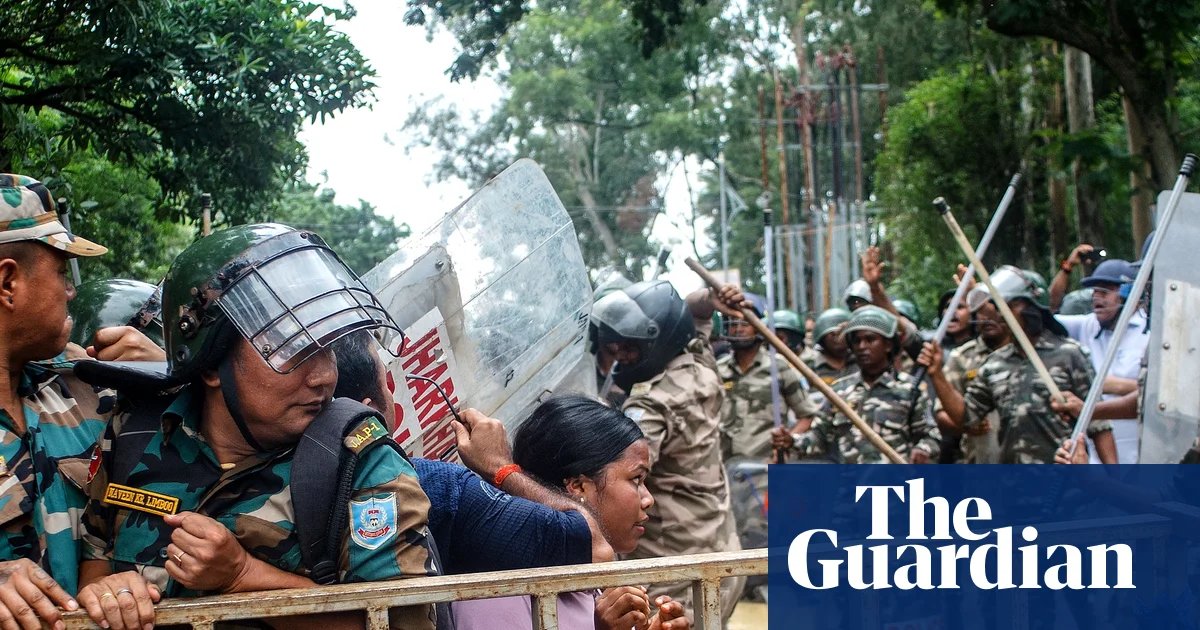
RANCHI, Jharkhand – Thousands of young job-seekers clashed with police in Jharkhand, one of India’s poorest states, on Monday as a weeks-long protest over alleged irregularities in government job recruitment escalated into a march on the state legislature.
Police deployed water cannons and teargas and used batons to repel flag-waving demonstrators who attempted to breach barricades and advance toward the assembly building in Ranchi, the state capital. Despite the police response, some protesters reacted by dancing and cheering amidst the water jets.
Local media reported that both protesters and police officers sustained injuries in the clashes, although no official figures have been released. “The baton charge was barbaric. We were protesting peacefully, but the government used batons against us,” protester Piyush Kumar Soni told the Press Trust of India.
This unrest follows closely on the heels of the “Cockroach Movement,” a youth-led protest that originated as an online joke but evolved into a nationwide outcry over leaks in a national medical entrance examination. That movement exerted significant pressure on the BJP-led national government and ultimately led to the resignation of the education minister.
The demonstrators are demanding an investigation by the CBI, India’s premier investigative agency, asserting that only an independent inquiry can uncover the truth behind the alleged wrongdoing in government recruitment examinations. They accuse authorities of failing to prevent irregularities, including test paper leaks and cheating, arguing that these scandals have denied young people a fair chance at employment.
Jharkhand has historically grappled with high unemployment, making government jobs highly desirable due to the intense competition for civil service and other public sector positions, which offer crucial job security, health benefits, and pensions. Recruitment drives routinely attract hundreds of thousands of applicants, with many young individuals dedicating years to preparing for these examinations. For instance, one recent Jharkhand recruitment exercise saw nearly 640,000 applications for just 2,025 posts, while another involved over 322,000 candidates vying for 510 vacancies.
The state government, led by a regional party allied with the opposition Congress, has attempted to de-escalate the crisis through negotiations. Officials claim that most of the protesters’ demands have been met and that they remain open to further discussions. Rahul Gandhi, a prominent Congress leader, condemned the use of force, stating, “Students have a right to peaceful protest, and only dialogue can yield solutions.”
The controversy has already led to significant repercussions, including the arrest of the former Jharkhand public service commission chair over alleged exam irregularities, and the resignations of three other commission members.
These protests highlight a growing frustration among young Indians regarding corruption within public examinations and recruitment systems, a scarcity of quality jobs, and concerns that opportunities are being lost due to cheating and political influence. Nearly two-thirds of India’s population is under 35. While official data indicates that unemployment fell to 9.9% last year, a 2026 study by Azim Premji University revealed that nearly 40% of graduates aged 15 to 25 were unemployed.