Porsche’s first victory at the Le Mans 24 Hours in 1970 often grabs the limelight when it comes to celebrating the German firm’s early successes in the world’s greatest endurance race. After the near-miss in 1969 and the aerodynamic struggles to get the fearsome 917 to behave, the win for Richard Attwood and Hans Herrmann is rightly seen as a motorsport milestone.
But Porsche’s second success could be regarded as more impressive. Its two factory teams finished first and second in a much faster race that set records that stood for decades.
Helmut Marko, now more famous as the former long-time master of Red Bull’s junior driver programme, and Gijs van Lennep took victory in the only magnesium-chassised 917 ever raced. They were chased home by Attwood and Herbert Muller in the sole surviving JW Automotive Engineering Gulf 917.
Marko admits the 917, which by 1971 had been improved far beyond the early wayward versions, was one of his favourites: “It was a monster. The 12-cylinder sound – I still have it in my ears sometimes. But it was difficult to set up because you got cracks in the frame. It had far too much power for the frame it had, but when the set-up was good the handling was very good.”
As had become standard practice for Porsche across 1970-71 under ambitious and uncompromising engineer Ferdinand Piech, two works-supported teams were entered for the 1971 Le Mans. JWA boss John Wyer was unimpressed at having to race against another Porsche factory team, particularly as it seemed to ‘inherit’ any technical experiments that were rejected, but it was usually the famous blue cars that came out on top.
JWA had won seven of the 10 1970 rounds, six with the 917K – the short-tailed version of Porsche’s first endurance racing giant – and one with the diminutive 908/3.
Gulf 917s had also won four of the eight 1971 championship rounds prior to Le Mans. Hans-Dieter Dechent’s Martini Racing, which had taken over the mantle of second works team from 1970 Le Mans winner Porsche Salzburg, had won the Sebring 12 Hours (with a 917K) and Nurburgring 1000Km (908/3) but had generally played second fiddle to JWA.

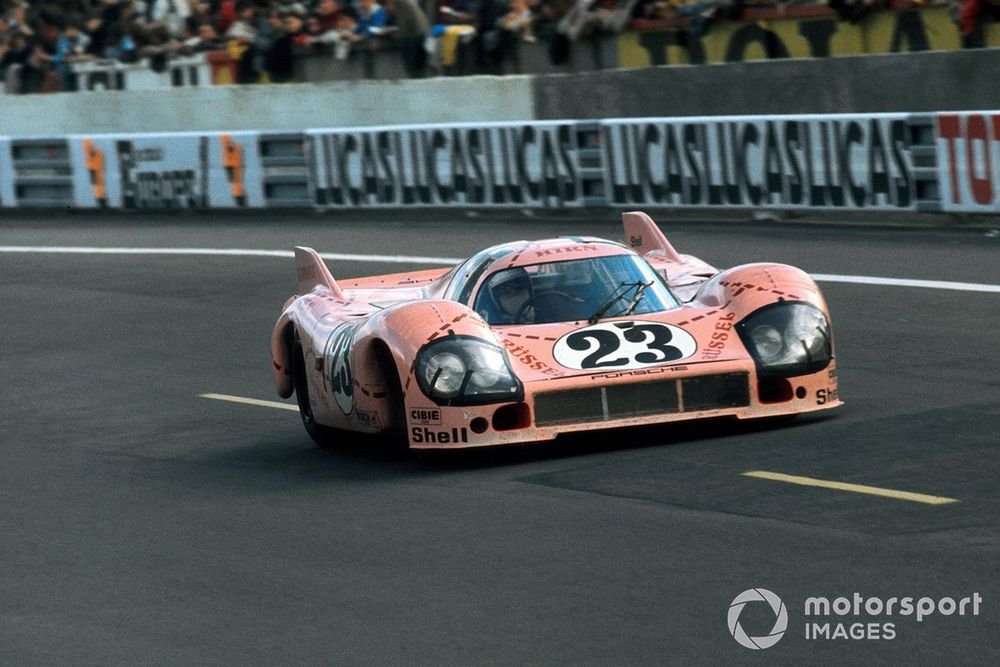
The infamous Pink Pig made an outing in 1971
Photo by: David Phipps
Each had three cars for Le Mans. JWA finally agreed to take two of the latest long-tailed 917Ls, now aerodynamically stable and built for the Mulsanne Straight, plus the ‘finned’ 917K for Attwood/Muller. Martini had a long-tailed car for star driver Vic Elford and Gerard Larrousse, plus the magnesium machine in its one and only race, and the infamous ‘Pink Pig’ 917/20.
The SERA-developed car driven by Reinhold Joest and Willi Kauhsen had been deemed so ugly that it was painted pink with butcher’s cuts. Sponsor Martini failed to see the funny side and refused to allow its logos on the car, but the livery stayed…
The magnesium car was novel (and prettier) but provided little advantage either, despite the theoretical weight saving. “Developing a sufficiently robust chassis in this lightweight material had proved to be very difficult,” wrote Peter Morgan in his book Porsche 917: The winning formula.
The danger of the event, which had 240mph 917s sharing the track with 140mph GTs, had been underlined in practice when a 911 moved over on Siffert approaching White House, forcing the Swiss into a series of high-speed spins
“The reality was that there was little benefit to be had from this kind of weight saving. The aluminium-framed 917 was already down at the minimum weight limit. But like the highest mountain, it was a technical challenge that had to be overcome – and it was.”
Amazingly, Marko says he didn’t even know the car was made of magnesium. “Only after the race did Piech come and say it was a special car with magnesium, which is highly flammable!” recalls the 83-year-old. “But in those days, with the 917, I’d have probably driven it anyway.”
Ranged against Porsche were nine privately entered 512s, though the only one that was really a threat was the Penske-entered 512M of Mark Donohue and David Hobbs.
Nothing had an answer for the straightline speed of the three 917Ls, which topped 240mph down the Mulsanne. They qualified in the top three and one of them, probably the Jackie Oliver/Pedro Rodriguez car, should have won. Marko/van Lennep lined up fifth, 4.8 seconds off pole, with the Penske Ferrari predictably being the interloper in a Porsche 1-2-3-5.

The Penske Ferrari was Porsche’s nearest challenger in qualifying, but soon that threat faded in the race
Photo by: Rainer W. Schlegelmilch / Getty Images
“The long-tail was 1-2s faster than us and we knew we had to do the race as quick as possible but don’t overdo it,” says Marko. “On pure pace, no, but it worked out. The car had really good handling and on top speed it was pretty good, too.”
After the first rolling start in Le Mans history (two minutes early according to Autosport’s report), Marko completed lap one in sixth and the car was always in the mix, if not at the front. After three hours, it was a lap down in fifth but ahead of all but the long-tailed 917s and Penske 512M. Helped by slick pitwork, the blue Ferrari rose as high as second but engine failure put it out before a quarter of the race was run.
At around the same time, Marko/van Lennep lost 10 minutes due to a thrown alternator belt, but otherwise delays were minimal for the number 22 car.
While the race didn’t feature the appalling finishing rate of 1970, reliability was still poor, certainly by 21st century standards. The Martini 917L lost its cooling fan so the engine cooked itself – the other 917s subsequently had their retaining bolts checked. Electrical problems slowed the JWA 917L of Jo Siffert and Derek Bell, and the car then had a rear hub bearing fail – perhaps caused by overheating due to the long bodywork. It finally retired with a cracked crankcase.
Rodriguez/Oliver led for much of the early going, then fell to third after they needed a rear hub bearing replaced. When the other rapid Ferrari of Nino Vaccarella/Jose Juncadella hit clutch problems during the night, Marko/van Lennep moved into the lead. The recovering Rodriguez/Oliver remained a threat – until an oil pipe broke and doused the Mexican in hot oil.
As the solo Matra challenged faded, the only car Marko and van Lennep had to concern themselves with was the similar 917K of Attwood/Muller, which had started 11th and was now recovering after its one significant delay: losing fifth gear in the five-speed ’box.
“We had a gearbox change in the night,” remembers Attwood. “We couldn’t change the gearbox so we had to do the internals. John Wyer knew of the problem [beforehand] and had a cure, but Porsche refused. It was a glue they used – it came undone. It was just unfortunate. Le Mans comes to you or it doesn’t.”

Attwood and Muller suffered a significant delay due to a gearbox change overnight
Photo by: Rainer Schlegelmilch / Getty Images
Aside from mechanical problems, there were also the perils of Le Mans traffic. Shots of the Martini car late in the race show some damage to the front, the legacy of a scare when van Lennep was at the wheel.
“He was a good team-mate,” says Marko of his Dutch colleague. “He had a small crash that damaged the front – the speed difference with some of the cars like the 911s was really big – but he was safe.”
The danger of the event, which had 240mph 917s sharing the track with 140mph GTs, had been underlined in practice when a 911 moved over on Siffert approaching White House, forcing the Swiss into a series of high-speed spins. Siffert didn’t hit anything but said: “I should be dead.” Autosport argued that those cars “simply shouldn’t be in the same race”.
“I went to Piech and said we were running 1-2 and were well ahead of the Ferrari, but he said, ‘The better one will win’. Piech was a very competitive person and liked it like this. So for the last three to four hours we were driving flat-out” Helmut Marko
Nevertheless, with just over 10 hours to go, the leaders enjoyed a five-lap advantage over the Attwood/Muller 917, with no one else in it. Autosport claimed that, although the Gulf car was going a tad faster, “the drivers were told to drive to finish and make it a Porsche 1-2 rather than try to break each other”.
In his book The Certain Sound, Wyer said that “during the last two hours Muller was catching the leading car very quickly indeed, which led Porsche to remonstrate and ask us to go more slowly”, but he did not record what his response was!
It’s not how Marko remembers it: “I went to Piech and said we were running 1-2 and were well ahead of the Ferrari, but he said, ‘The better one will win’. Piech was a very competitive person and liked it like this. So for the last three to four hours we were driving flat-out.”

Marko disputes any team orders in the closing hours of the race
Photo by: Rainer W. Schlegelmilch / Getty Images
Though Attwood believes the drivers were more circumspect because of the machinery, he doesn’t recall any team orders either. “No, we just carried on,” says the 86-year-old. “I don’t think Porsche was bothered. Even in 1969 when me and Vic Elford were miles ahead nobody ever mentioned slowing down. When it was 24 hours you couldn’t sprint. We weren’t flat-out. The 917 was a fragile car. We just drove well and swiftly for 24 hours. Herbie was a bit of a wild child and I gave him a big dressing down beforehand about how we were going to run the race and he drove absolutely impeccably.”
Flat-out or not, they did bring the gap down significantly but fell two laps short, while the victorious Marko and van Lennep completed 3315 miles (397 laps) at an average speed of 138.1mph. That set a distance record that would not be broken until 2010, while Rodriguez’s pole remains the lowest lap time in Le Mans qualifying history.
Only in the years that followed did the records start to mean anything to Marko. “It was more winning the race [at the time] but journalists kept telling me and asking if I thought it’d be broken, so I kept an eye on it,” says the Austrian. “But the track changed after that so we were lucky to hold the record.”

Marko and van Lennep celebrate a record-breaking Le Mans triumph
Photo by: LAT Images via Getty Images
We want to hear from you!
Let us know what you would like to see from us in the future.
– The Autosport.com Team