







The silver screen has always had a magnetic pull toward the courtroom, but few narratives carry the weight of real-world history quite like the life of Ujjwal Nikam. With the release of Prahaar – The Ujjwal Nikam Story, director Avinash Arun has thrust one of India’s most polarizing and pivotal public prosecutors back into the cultural zeitgeist. And if the weekend box office numbers are any indication, audiences are more than ready to dissect the legal labyrinth that defined the nation’s most haunting criminal trials.
The film, which hit theaters on October 16, 2026, saw a notable uptick in momentum during its first Saturday. After an opening day that brought in a steady Rs 2.35 crore, the film surged by 34% on its second day, pulling in Rs 3.15 crore in India net collections. This uptick is a rare and welcome sign in a market often dominated by high-octane action spectacles, suggesting that the “Rajkummar Rao effect”—the actor’s innate ability to draw audiences into character-driven dramas—is in full swing.
The Power of the Positive Trend
In the volatile world of box office reporting, a second-day jump is usually the result of strong word-of-mouth. While the film saw a slight reduction in show counts—moving from 4,133 shows on Friday to 3,908 on Saturday—the increase in occupancy from 13% to 17% highlights that the seats being filled were more densely packed.
By the end of Saturday, the film’s cumulative India net collection stood at a respectable Rs 5.50 crore. When you factor in the international markets, where the film has already garnered Rs 1.50 crore, the worldwide gross is sitting at a healthy Rs 7.98 crore. For a legal drama that eschews the typical trappings of a commercial masala flick in favor of the grim, grit-filled realities of the 1993 Bombay bombings and the 2008 Mumbai attacks, this performance is a clear victory for high-concept storytelling.
Occupancy Patterns: The Late-Night Appeal
Interestingly, the viewing habits for Prahaar reveal a distinct pattern. The film’s Hindi 2D screenings aren’t just attracting casual walk-ins; they are capturing the attention of a demographic that prefers a late-night cinematic experience.
Data shows that while morning shows remained sluggish at roughly 9.77% occupancy, the numbers climbed steadily as the day progressed. By the time the night shows rolled around, occupancy surged to a formidable 31.38%, with evening shows trailing only slightly behind at 30.54%. This suggests that Prahaar is being treated by audiences as a “serious” film—one that demands the viewer’s undivided attention after the workday, rather than a light matinee distraction. It is a testament to the film’s tone that it commands such focus from its audience, keeping them in the theaters well into the late hours.
Rajkummar Rao and the Art of Transformation
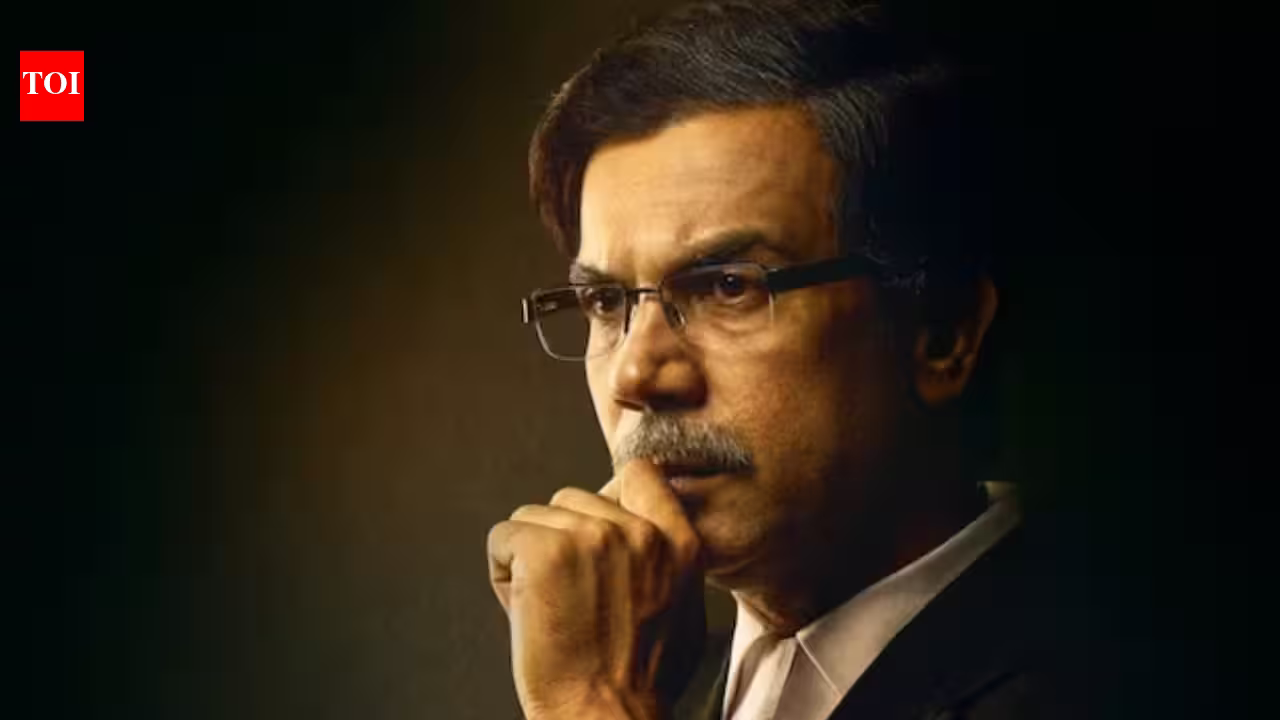
At the heart of the film’s success is Rajkummar Rao’s portrayal of Ujjwal Nikam. Known for his chameleon-like ability to inhabit his roles, Rao steps into the shoes of a man who spent decades at the center of India’s most harrowing legal storms. It is a nuanced performance, one that balances the cold, analytical nature of a prosecutor with the human toll of being the man tasked with delivering justice for thousands of lives.
However, Rao isn’t carrying the weight alone. The production has assembled a dream team of talent that adds immense gravity to the script. Wamiqa Gabbi offers a grounded, emotional anchor as Jyoti Nikam, while Lalit Prabhakar’s chilling performance as Ajmal Kasab serves as the perfect antagonist to Rao’s calculated legal maneuvering. The inclusion of veterans like Ashish Vidyarthi, playing the unflappable Justice M.L. Tahaliyani, and Sikandar Kher as the defense counsel, Abbas Kazmi, turns the courtroom scenes into high-stakes psychological chess matches. The result is an ensemble effort that feels less like a performance and more like a historical reenactment.
Bridging History and Music
One of the more surprising elements of this legal drama is the sonic landscape crafted by composers Vishal Mishra and Emiway Bantai. Usually, courtroom dramas rely on sparse, tense background scores, but by incorporating lyrical contributions from Amitabh Bhattacharya and Emiway, the film manages to bridge the gap between traditional prestige drama and a contemporary auditory experience. It’s a bold choice that reflects the film’s intent: to reach beyond the courtroom and speak to a modern generation of Indian viewers who may only know these historical tragedies through the news cycle or textbooks.
As the film moves into its first Sunday, industry analysts will be watching closely to see if this 34% growth can be sustained. If the momentum continues, Prahaar – The Ujjwal Nikam Story could easily cement itself as one of the most significant critical and commercial hits of the latter half of 2026. For now, however, the numbers tell a story of an audience genuinely engaged, proving once again that when you pair a top-tier cast with a story that truly matters, the public will show up.
Whether you’re a student of Indian legal history or simply a fan of high-caliber acting, Prahaar demands a seat in the theater—if you can manage to snag one of those popular night show slots, that is.
Disclaimer: This content is auto-generated for informational purposes only.
Source: Read Original News