




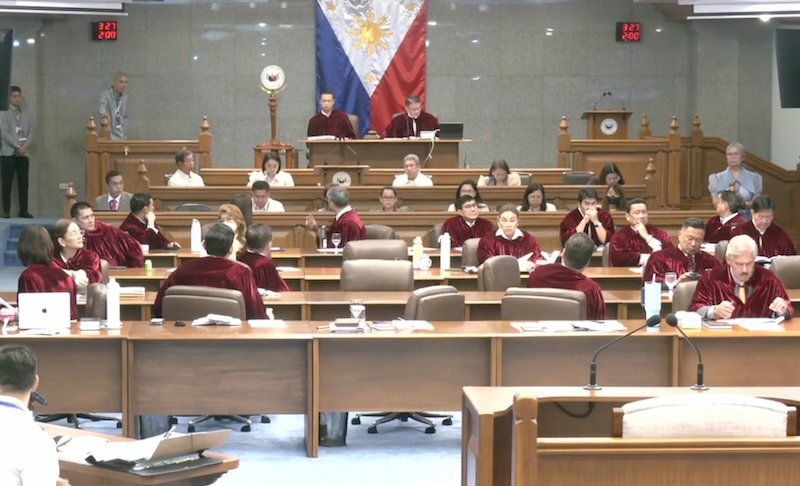
DAVAO CITY (MindaNews / 06 July 2026) – The Prosecution and Defense panels invoked accountability of public officials in their opening statements on Monday, Day 1 of the trial of impeached Vice President Sara Duterte.
But while the Prosecution focused on the accountability of Duterte, the Defense focused on the accountability of the Prosecution panel.
Rep. Gerville Luistro, Lead Prosecution counsel, said they would present “Evidence, hindi chismis, hindi haka-haka, hindi propaganda, at lalong hindi soc-med narrative. Evidence. Official records. Financial documents. Government reports. Video recordings. Statements under oath. Independent findings of institutions created by law.”
She summed this up into “Mga dokumento na hindi bumoboto. Mga records na walang partido. Mia katotohanan na walang kulay pangpolitika,” referring to impartiality and nonpartisanship of documents, records, and truth.

Lead Defense Counsel Sheila Sison emphasized that the burden of proof “never shifts” and those who accuse the Vice President must prove their allegations with “evidence that meets not only the degree of proof required but also meets the evidentiary standards of admissibility, credibility, relevance, materiality, and competence.”
Duterte did not appear at the Senate Impeachment Court. In a statement posted at 12:44 p.m. or an hour and 16 minutes before the 2 p.m. hearing, she said she would be represented by counsel.
“The respondent has the right to be represented by counsel, and the decision to personally testify is a matter of legal strategy and constitutional rights,” she said in a three-paragraph statement.
“The burden remains on the prosecution to prove its case. Choosing to appear through counsel rather than testify personally does not diminish accountability or imply a lack of transparency. The integrity of an impeachment trial depends on adherence to the rule of law-not on whether the respondent personally takes the stand,” she added.
People’s money
Sison said the public should “not lose sight of the core principle that the burden of proof is on the Prosecution, and unless it discharges that burden, the accused need not even offer evidence on her behalf and she will be entitled to an acquittal.” She pointed to the claims of the Prosecution as “speculations and conclusions.”
The Prosecution transmitted four Articles of Impeachment to the Senate for trial: the alleged misuse of 612.5 million pesos of confidential funds by the Office of the Vice President and the Department of Education (DepEd); alleged unexplained wealth, nondisclosure of assets and failure to divest and willful continued business interests; alleged bribery and procurement irregularities of Department of Education officials; and alleged threats of assassination against President Ferdinand Marcos Jr. his wife Liza and former House Speaker Martin Romualdez.
Luistro said some might wonder what the relevance of the impeachment trial is to their lives. But she stressed it is, explaining that“ang usapin ngayon ay patungkol sa isang bagay na pag-aari nilang lahat: ang kanilang pera. Ang kanilang tiwala. Ang kanilang karapatang maningil ng panangutan mula sa mga pinununo na kanilang pinagkakatiwalaan” (what is being discussed today is about something they own: the people’s money. Their trust. Their right to demand accountability from the leaders they entrusted the country to).
If ordinary Filipino is held accountable, why not those in power?
In Filipino, she cited samples of accountability expected of employees and village officials.
She said when an employee errs in using funds of the company, he/she is asked to explain, when a barangay treasurer cannot explain the missing funds, he/she is investigated, and when a principal squanders public funds even if that is only 5,000 pesos, he/she is punished.

“Natural lang na magtanong ang sambayanan kung ang ordinaryong Pilipino ay pinapanagot, bakit hindi ang pinakamakapangyarihan na opisyal ng pamahalaan?” (So it is natural for the people to ask, if an ordinary Filipino is being asked to account for the funds, why not the highest official in government?), Luistro said.
Sison reminded the Prosecution that they want to unseat the Vice President who was elected in May 2022 by “more than 32 million Filipino people,” more than the number of votes President Ferdinand Marcos Jr. got, and “much greater than any of the votes secured by each of the members of the House of Representatives who now are here to prosecute her and seek to undo the people’s choice.”
“Whatever one’s political persuasion is, the reality is that the Prosecution now comes before this Court to remove a Vice President chosen by an overwhelming number of the electorate,” Sison said.
Seeking accountability, she said, “is not a matter of debate” as the people have a right to demand accountability from their leaders.
But the Constitution, she said, does not speak only to the Vice President but also to the public prosecutors and members of the House of Representatives who “are also held to the same constitutional standard.”
Justice includes fairness
The 1987 Constitution lists the officials who can be removed from office through impeachment: the President, Vice President, members of the Supreme Court, members of Constitutional Commissions – Civil Service Commission, Commission on Elections and Commission on Audit – and the Ombudsman.
Sison noted that this is not the first time the Vice President was impeached.
Duterte was impeached in February last year and in May this year. The 2025 impeachment did not reach the trial phase as the Supreme Court stepped in.
Sison cited the July 2025 decision of the Supreme Court which unanimously declared that impeachment proceedings in the House of Representatives were tainted with grave abuse of discretion, rendering the articles of impeachment that the House transmitted last year to the Senate as void ab initio.

Early this year, Sison said, the Supreme Court unanimously denied with finality the House of Representatives’ motion for reconsideration of that decision, with a reminder that while impeachment is a powerful democratic process to call out corruption and grave abuse, impeachment can be abused, and that impeachment “should never be abused to maintain the hegemonic dominance of greed by shaming those who occupy high government positions into preventing them from doing what they were sworn to do.”
Sison added the most enduring reminder of the Supreme Court that should not be forgotten during the trial “is that in the words of the Court, the rule of law that does justice is our lodestar, and that justice includes accountability. Justice includes fairness. Without fairness, there is abuse.”
When the Constitution call, did the Republic answer?
Luistro called on the Senator-judges to judge the case “not by politics, not by popularity, not by fear, not by loyalty” but by the Constitution, by the evidence.
Years from now, she said, future generations will not remember today’s political alliances, headlines, slogans but what they will remember is when accountability was tested, the institutions of the republic stood firm.
“They will remember only one thing: what this court did when the Constitution called… they will ask one thing: when the Constitution called, did the republic answer?”
“Your Honors, this is that moment. This is the moment the Constitution anticipated. This is the moment when accountability must mean exactly what it says. This is the moment when public office must truly remain a public trust. This is the moment when the republic must demonstrate that laws are applied equally to the powerful and the powerless alike,” Luistro said.
“Salus populi est suprema lex. The welfare of the people is the supreme law,” Luistro concluded.
Sison concluded her statement by again invoking the Supreme Court ruling. “The Bill of Rights applies to the entire impeachment process because inasmuch as our court recognizes that impeachment is a political process, it reminds us that it is not a purely political process but a legal and constitutional mechanism,” Sison said, adding that in upholding the rule of law, serving justice and invoking the accountability mechanism, “this Court and we as a people, must guarantee that all efforts to hold our leaders accountable, must be done right.” (Carolyn O. Arguillas / MindaNews)