

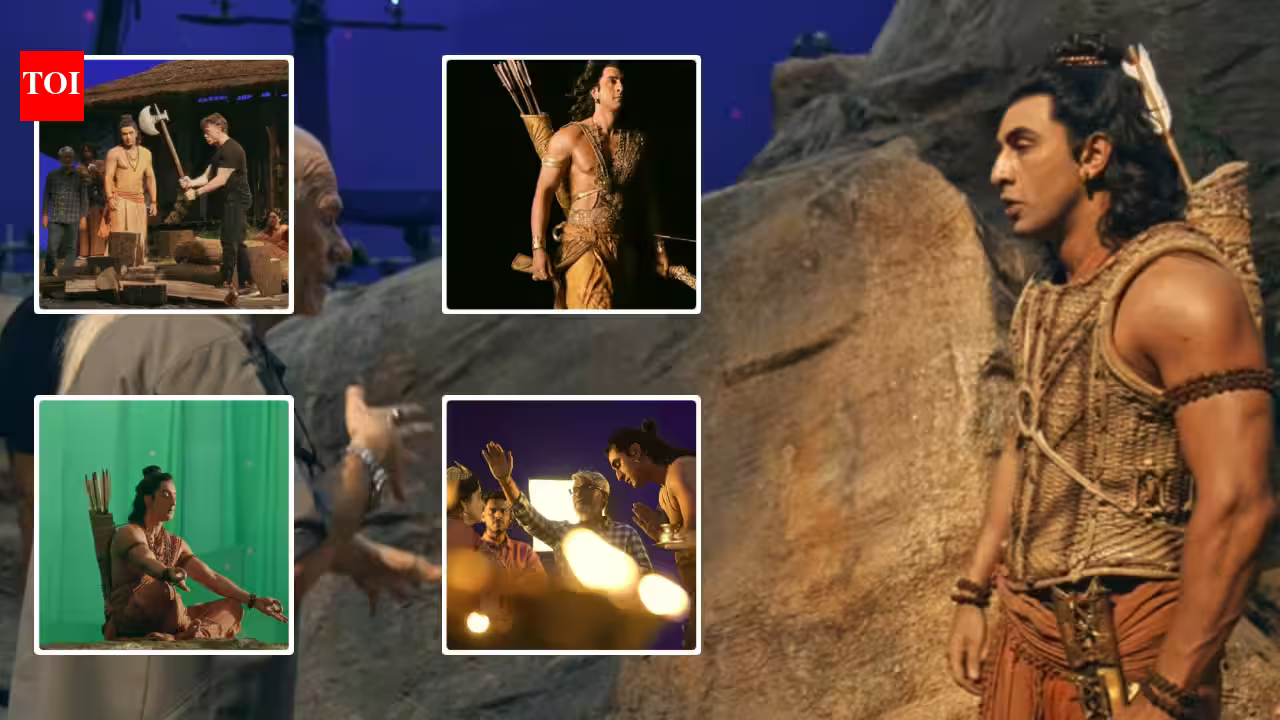


The timing could not have been more poetic. As Ranbir Kapoor celebrated another trip around the sun, the creative team behind the most anticipated project in Indian cinema—Nitesh Tiwari’s Ramayana—gifted audiences a glimpse into the making of a legend. By pulling back the curtain on the grueling physical transformation and spiritual preparation required to play Lord Rama, the makers have done more than just share a behind-the-scenes sizzle reel; they have signaled that this production is not merely a film, but a massive, global undertaking aimed at honoring a cultural bedrock.
For years, the mere mention of a new Ramayana adaptation was enough to stir a cocktail of excitement and skepticism among the Indian public. The epic is not just a story; it is a tapestry woven into the national consciousness. To touch it is to invite intense scrutiny. Yet, as the new BTS footage begins to circulate, the noise seems to be settling into a hum of genuine curiosity, largely anchored by the man at the center of the frame: Ranbir Kapoor.
The Weight of the Crown: Ranbir’s Personal Transformation
In the industry, Ranbir Kapoor is known for a “chameleon” approach to acting, often disappearing into roles that range from the jagged edges of Rockstar to the controlled rage of Animal. However, portraying Lord Rama represents a different tier of responsibility. In the footage released, Kapoor appears stripped of his usual movie-star nonchalance.
He speaks with a gravitas that suggests he understands the heavy mantle he is wearing. “It is a responsibility,” he notes, acknowledging that for millions, the character isn’t a performance but a deity. Watching him rehearse sequences—with focus, silence, and an intense dedication to the physical mechanics of the character—one can see the shift. He isn’t playing a hero; he is attempting to embody a state of being. The preparation captured in the clip suggests that Tiwari and Kapoor are aiming for a grounded, humanistic portrayal of the divine, moving away from the caricatured depictions of the past and toward a character-driven narrative that feels tactile and resonant.
Nitesh Tiwari’s Vision and the Casting Conundrum
Director Nitesh Tiwari has never been one to shy away from difficult subjects, having helmed the poignant Dangal and the socially relevant Chhichhore. But Ramayana is his Everest. During the promotional featurette, Tiwari spoke candidly about the agony and the ecstasy of casting. In a country where every citizen carries a deeply personal version of the epic in their heart, “getting it right” is a moving target.
The inclusion of Arun Govil—the man who became the definitive face of Rama for a generation through the 1980s television series—feels like a symbolic passing of the torch. When veterans like Govil, paired with the immense talent of Sai Pallavi and Ravi Dubey, speak about the qualities that make Kapoor the right fit, it bridges the gap between the nostalgic past and the tech-forward future of Indian cinema. There is a palpable sense of unity in their testimony: this isn’t just about big-budget spectacle; it’s about a team of artists finding a common frequency to tell the greatest story ever told in the subcontinent.
Global Precision: International Action and the “Notary” Touch
One of the most eye-catching elements of the release is the focus on the action choreography. In the past, mythological films in India have relied on heavy visual effects that occasionally struggled to maintain a sense of weight and danger. By bringing in international action director Terry Notary—the man behind the movement coaching for massive blockbusters like The Planet of the Apes—the production is signaling a shift toward physical, visceral storytelling.
This is where producer Namit Malhotra’s influence becomes clear. By merging DNEG’s world-class visual effects pedigree with the raw intensity of Indian stunt professionals, the film is aiming for a synthesis of Eastern emotion and Western kinetic precision. We see brief flashes of training sessions that look less like dance choreography and more like athletic endurance trials. It’s an ambitious gamble: to retain the cultural soul of the Ramayana while giving it the pacing and physical stakes of a global blockbuster.
A Two-Part Epic: Building the Franchise
The business model behind Ramayana is as ambitious as its narrative scope. By splitting the epic into two parts—scheduled for Diwali 2026 and 2027—the makers are allowing the story the room it needs to breathe. There is no attempt to cram the vast moral and physical landscape of the epic into a three-hour window. Instead, they are positioning this as an event series that will demand attendance during the two most significant festival windows of the year.
The distribution strategy is equally formidable. With Sony Pictures handling global markets and Dharma Productions looking after the Hindi belt, the intent is clear: they want this to be the definitive Ramayana for the global stage. Coupled with an IMAX release, the technological aspirations are undeniable. This is intended to be a sensory experience, designed for the largest screens available.
The Road to 2026
As the dust settles on the birthday reveal, what remains is a sense of professional gravity. The casting of Yash as Ravana, Sunny Deol as Hanuman, and the rest of the ensemble suggests a project that isn’t just relying on star power but on dramatic weight.
For now, the audience is left with a teaser of a process—a peek behind the curtain that feels more honest than a standard trailer. By showing the sweat, the struggle, and the international collaboration, the makers of Ramayana are inviting the public to be part of the journey. In a climate where big-budget films are often criticized for lack of soul, this specific production seems determined to prove that with enough time, the right expertise, and a deep respect for the source material, a modern classic is not just possible—it’s inevitable. The countdown to Diwali 2026 has officially begun, and if this behind-the-scenes look is any indication, the wait might just be worth it.
Disclaimer: This content is auto-generated for informational purposes only.
Source: Read Original News