








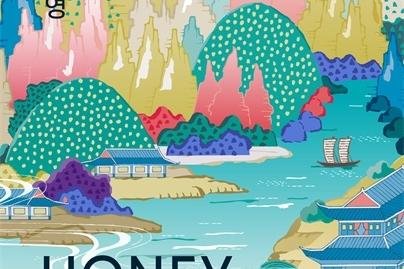
Jiyoung Han’s “Honey in the Wound” is a profoundly moving and expansive Korean epic that chronicles the devastating impact of the Japanese occupation on a mountainside-dwelling family. The narrative begins in 1902, portraying a tranquil existence rooted in hunting and agriculture. This peaceful life, however, is brutally shattered in 1910 with the demise of the 500-year-old Joseon Dynasty and the commencement of the Japanese occupation of Korea. The country is absorbed into the Empire of Japan, and its people are systematically stripped of their native language, traditional names, and fundamental independence.
The initial section of the novel deeply immerses the reader in traditional Korean storytelling, characterized by a rich interplay of nature, symbolism, and elements of magical realism. The family, already distinguished by their innate ability to interpret environmental cues and, in some cases, exhibit shape-shifting abilities, maintains an unusually close connection with tigers. The arrival of the Japanese forces, armed with guns and swords, infuses the atmosphere with palpable tension, signifying the abrupt end of the family’s simple rural existence.
As the narrative progresses, the setting shifts from the serene mountainsides to the bustling urban centers, where Japanese rule tightens its grip, brutally suppressing dissent with violence and executions. Jiyoung Han vividly depicts 1930s Korea, highlighting the Japanese leadership’s contempt for the “dirty little Chosen peasants.” Yet, beneath this oppressive surface, a determined resistance begins to coalesce. This era is marked by shifting identities, where many individuals navigate a complex world speaking multiple languages and concealing their true intentions. The expansion of railway lines and shipping routes facilitates extensive movement across Asia, creating numerous points of geopolitical friction. It is a period rife with puppet states, intricate subterfuge, and clandestine networks of bandits and spies, where keen perceptiveness becomes a vital tool for survival.
The story then focuses on Song Young Ja, a descendant of the original mountain family, whose harrowing experiences form the core of the latter part of the novel. Spanning the diverse landscapes of present-day Korea, North Korea, and China, “Honey in the Wound” offers a devastating third-person account of one Korean woman’s ordeal under Japanese rule. Young Ja’s story poignantly represents the hundreds of thousands of young women, primarily Korean but also from other Asian nations, who were abducted or coerced into sexual slavery by the Imperial Japanese Armed Forces and their collaborators. These “Comfort Women” were subjected to horrific brutality, forced to service numerous soldiers daily for years, under constant threat of death. Many endured unspeakable torture, were killed, or tragically committed suicide.
While the novel contains profoundly disturbing descriptions of violence, these moments are balanced by instances of courageous political defiance. Han introduces compelling characters like Baek Yong Woo, a stylish “tea merchant” also known as Bailong, whose presence evokes the scent of fresh pine needles, and the aristocratic Tayiji of the Sparrows, perpetually accompanied by a flock of birds. Young Ja finds solace and companionship among her friends and fellow victims, as well as encountering empathetic ordinary Japanese individuals. However, the narrative also features terrifying figures, such as the notorious Feng-nushi, who rules her teahouse with sadistic cruelty, wielding a silver pipe and a brass-tipped cane.
The story extends into the 1990s, alternating between Japan and Korea as its settings, underscoring the enduring legacy of merged identities, complex histories, and unresolved trauma. Although Han’s novel begins with a gentle tone, it quickly transforms into a powerful and unflinching exploration of historical atrocities. The elements of magical realism, particularly embodied by the female characters and their unique abilities, imbue the realistic narrative with an unsettling enchantment. The resilience and strength of Korean women, passed down through generations, remain a central theme. This is a magnificent and courageous work that directly confronts the recent and profound trauma of brutal occupation and extensive Japanese war crimes, whose repercussions continue to deeply affect the Republic of Korea today.