







The Rise and Sudden Fall of the Leonida Project
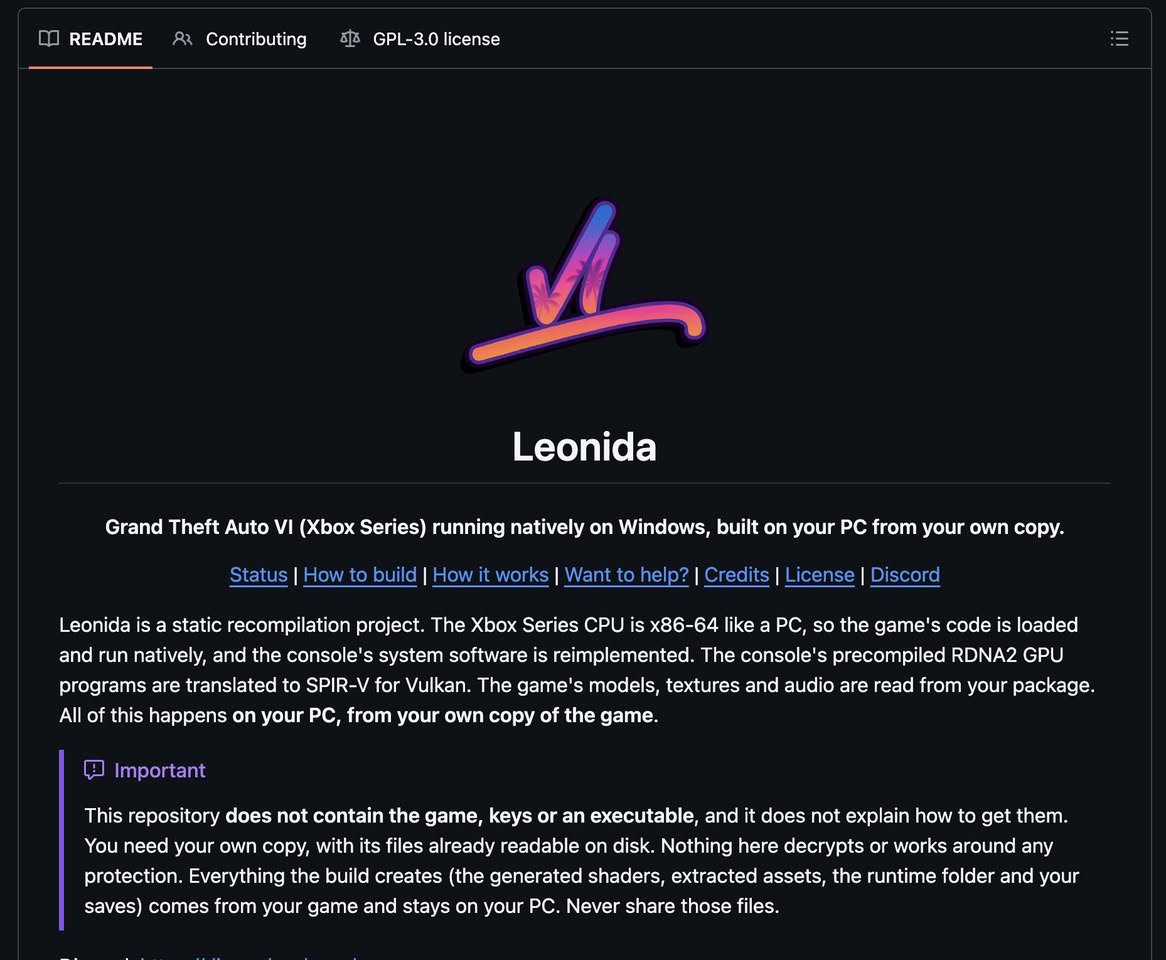
In the rapidly evolving landscape of software reverse engineering and fan-made modifications, the “Leonida” project stood out as a remarkably ambitious technical undertaking. Designed as a static recompilation effort, its primary objective was to translate the console-specific binary of Grand Theft Auto 6 into a native executable capable of running on Windows hardware. Spearheaded by a fifteen-year-old developer operating under the handle “Not Rexed,” the project gained significant momentum shortly after the unauthorized release of an early Xbox build of the game.
The effort reached a fever pitch within a matter of days, culminating in a Discord community that amassed roughly 179,000 members eager to witness the transition of a console-exclusive title to a PC environment. However, the project’s trajectory was cut short with dramatic speed. Citing circumstances beyond his control, the creator announced his departure, leading to the total erasure of the project’s GitHub repositories and its massive communication server. While the developer’s statement was cryptic, subsequent public commentary suggests that direct intervention from Rockstar Games played a decisive role in the cessation of all development activities.
Static Recompilation: Understanding the Technical Process
At its core, Leonida relied on a technique known as static recompilation. This process involves taking a compiled binary file—designed for a specific architecture, such as the custom hardware found in current-generation consoles—and translating its machine code into a format compatible with a different architecture, typically x86-64 for personal computers. Unlike emulation, which simulates the original hardware environment in real-time, static recompilation attempts to create a permanent, native version of the software.
This methodology has seen a resurgence in the gaming community, partially fueled by advancements in artificial intelligence that assist in analyzing vast amounts of machine code. By mapping the original functions and memory pointers to their PC-compatible equivalents, developers can technically achieve performance levels that emulate the efficiency of a native port. Recent successes in the retro gaming scene, such as the native PC implementation of The Legend of Zelda: Ocarina of Time, have demonstrated the viability of this approach. However, applying these techniques to a modern, massive-scale title like GTA 6 presents exponential complexity, making Leonida a noteworthy, albeit brief, experiment in community-led engineering.
The Role of Leaks and Legal Precedents
The impetus for the Leonida project was rooted in a significant security breach. An individual known as “Cyberleek” allegedly leaked a nearly complete Xbox build of the game, including the essential executable file required for the software to initialize. This data dump provided the raw material that enabled developers to begin mapping the game’s internal structures. The subsequent rapid progress, which reportedly included screenshots and video evidence of the game’s opening sequences and setting menus, underscored the high level of technical skill present within the modding community.
However, the legal environment remains hostile to such endeavors. Take-Two Interactive, the parent company of Rockstar Games, has adopted an aggressive posture toward unauthorized ports and modifications. The company recently issued a Digital Millennium Copyright Act (DMCA) takedown notice to the team behind an unofficial port of GTA 5 for the Nintendo Switch. This legal precedent signals a broader strategy to protect intellectual property from being repurposed by independent creators, regardless of the technological curiosity driving the projects. Leonida’s forced shutdown serves as a concrete manifestation of this enforcement strategy.
Security Implications for Enthusiasts
Beyond the legal and developmental challenges, the circulation of unauthorized game files presents significant security risks to the general public. When a high-profile title like GTA 6 is leaked, it often becomes a vehicle for malicious actors to distribute malware. Files purportedly containing “playable” PC builds or “tools” to run the game frequently function as wrappers for trojans, keyloggers, or ransomware.
The abrupt disappearance of the Leonida project serves as a reminder of the instability inherent in unofficial software development. Users who attempt to download files claiming to be early PC versions of unreleased console games put their local machine environments at risk. The lack of code signing, oversight, and legitimate distribution channels makes it impossible to verify the integrity of these downloads. Security experts recommend that players avoid any third-party links related to these leaked assets, as the potential for system compromise far outweighs the curiosity of seeing early, unfinished code in operation.
The Future of Unofficial Porting and Rockstar’s Stance
While Leonida has been shuttered, the underlying demand for native PC versions of major console titles continues to grow. Other initiatives, such as the “VIctory” project, have surfaced in the wake of the takedown, continuing the attempt to reverse-engineer console assets for PC compatibility. These projects remain in a precarious position; they exist in an ecosystem where visibility is necessary for development, yet inherently triggers the attention of intellectual property holders.
The tension between software preservationists, modders, and corporate entities will likely intensify as AI tools make the recompilation process increasingly accessible. Whether Rockstar Games will eventually provide a official, high-quality path for PC users or continue its current policy of strict suppression remains a critical question. For now, the Leonida project stands as a brief, volatile chapter in the history of game development, highlighting the technical ingenuity of its creators while illustrating the formidable legal and security walls that guard the industry’s most valuable assets. The project ultimately serves as a cautionary tale: technical success in a laboratory setting does not guarantee long-term viability in the face of commercial protectionism.
Disclaimer: This content is auto-generated for informational purposes only.
Source: Read Original News